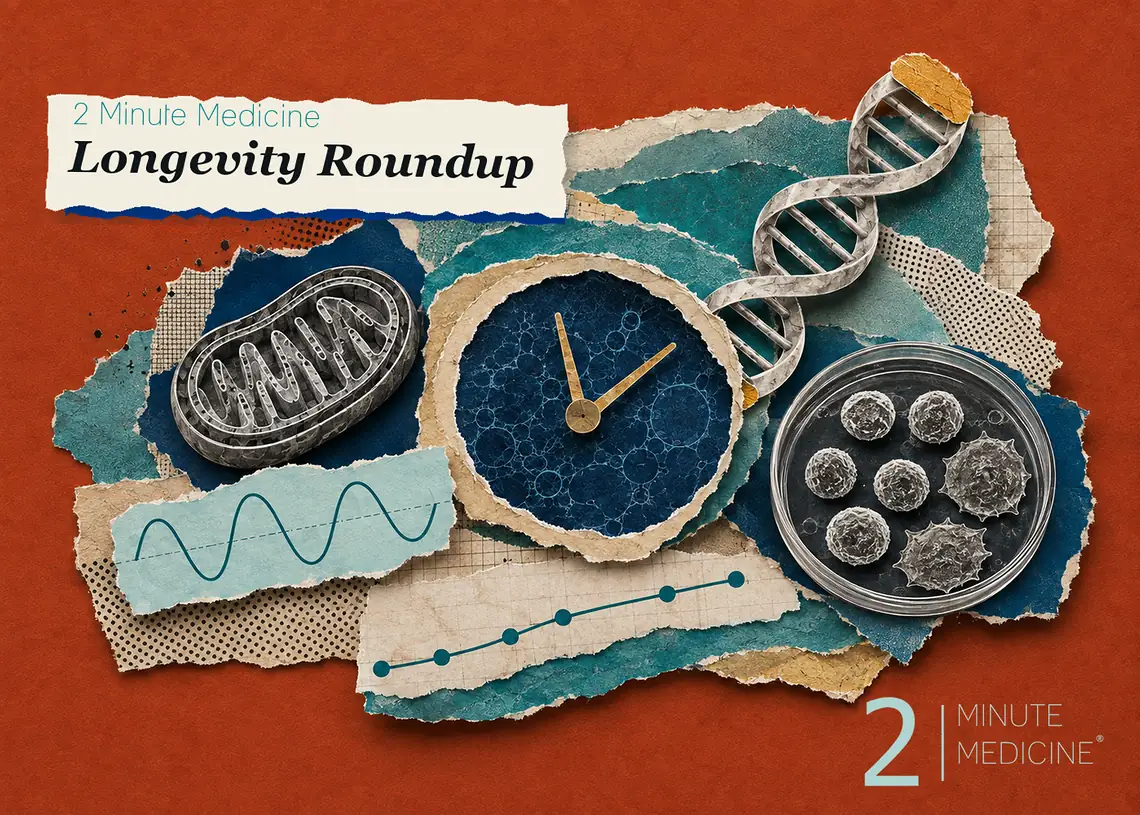
2MM: Longevity Roundup – Sleep patterns track with biological aging, earlier menopause signals cognitive decline, diet predicts aging-related mortality, and lifestyle intervention preserves mobility in frailty
Sleep quality and regularity track with biological aging across multiple systems
Sleep duration alone may be an incomplete way to think about sleep and healthy aging. A human Aging Cell analysis published August 26 used wrist-worn accelerometer data, plasma proteomics, and health records from the UK Biobank to examine six sleep patterns in relation to nine established hallmarks of aging. Longer total sleep, greater deep sleep, and more rapid eye movement sleep were associated with lower risk across most aging hallmarks, while greater wakefulness after sleep onset and more irregular sleep were associated with higher risk. Light sleep showed no significant association, suggesting that time spent asleep does not capture the full relationship between sleep and aging biology. The investigators also identified proteins shared between sleep patterns and aging hallmarks, with many concentrated in immune and inflammatory pathways and several, including interleukin-1 receptor antagonist, fatty acid binding protein 1, growth differentiation factor 15, and leptin, recurring across multiple associations. The study used objectively measured sleep from the UK Biobank, avoiding some of the recall limitations that complicate self-reported sleep research. These findings remain observational and do not establish that modifying a specific sleep stage will slow biological aging, but they strengthen the case that sleep continuity and regularity may matter alongside total duration. The National Institute on Aging continues to recommend approximately 7 to 9 hours of sleep for older adults while emphasizing evaluation of persistent difficulty falling asleep, staying asleep, or excessive daytime sleepiness. For clinicians, the practical longevity conversation may therefore need to move beyond asking how many hours a patient sleeps and include whether that sleep is regular, consolidated, and restorative.
Earlier menopause is associated with faster cognitive decline and greater late-life brain changes
Age at menopause may provide clinically useful information about brain aging decades after the reproductive transition. A JAMA Network Open study published August 25 followed 2,603 older women from the Religious Orders Study and Rush Memory and Aging Project and examined cognition, Alzheimer disease onset, neuropathology, and longitudinal brain imaging. Earlier menopause was associated with faster decline in global cognition and episodic memory as well as earlier clinical Alzheimer disease diagnosis. Among women with serial magnetic resonance imaging, earlier menopause was also associated with faster accumulation of white matter hyperintensity volume, particularly after spontaneous menopause, while associations with total brain volume loss were comparatively modest. The cohorts provide unusually deep longitudinal phenotyping, with the Rush aging studies incorporating annual cognitive evaluations and, for many participants, brain imaging and neuropathologic assessment. Importantly, these observational associations do not demonstrate that menopause itself causes Alzheimer disease or that extending estrogen exposure would prevent cognitive decline. They also should not be interpreted as evidence to prescribe menopausal hormone therapy for dementia prevention, an area in which evidence remains uncertain. Instead, menopause timing may function as a midlife marker that helps identify women who warrant closer attention to modifiable cardiovascular and neurologic risk factors. The findings add reproductive history to a growing list of information that may eventually improve individualized assessment of healthy brain aging.
A machine-learning diet score identifies eating patterns associated with lower aging-related mortality
Researchers are increasingly using large human datasets to ask whether dietary patterns can be optimized specifically around healthy aging rather than individual diseases. An npj Science of Food study analyzed 191,689 UK Biobank participants and used machine learning to develop the Machine-learning YouTHful Diet, or MYTH Diet, based on dietary patterns associated with aging-related mortality. Investigators evaluated 34 dietary components, identified 18 with significant associations, and used machine learning to rank the foods that contributed most strongly to the final dietary score. Over a median 12.2 years of follow-up, 13,652 participants experienced deaths classified by the investigators as aging related, and higher MYTH Diet scores were associated with lower mortality in both the UK Biobank development cohort and an external National Health and Nutrition Examination Survey validation cohort. The model generally favored patterns that included whole grains and nuts while limiting processed meat, red meat, butter, and sweetened beverages, although some components, including alcohol, showed nonlinear associations that should not be interpreted as recommendations to initiate drinking. The investigators also compared the score with established patterns including the Healthy Eating Index and Dietary Approaches to Stop Hypertension, with the new score showing comparable rather than universally superior performance. Because the study is observational, machine learning can identify combinations that predict mortality but cannot establish that following the derived diet will extend lifespan. The analysis also relied substantially on UK Biobank participants, a population that is healthier and less diverse than many general populations, which limits direct translation into universal dietary prescriptions. The clinically useful message is therefore less about adopting another branded longevity diet and more about the consistency with which minimally processed, nutrient-dense dietary patterns continue to track with healthier aging outcomes.
Exercise and nutritional support reduce mobility disability in frail older adults
For older adults with frailty and multiple chronic diseases, longevity is often less about extending lifespan than preserving the ability to walk and live independently. A Nature Aging analysis published August 31 examined 1,199 community-dwelling adults aged 70 years or older with physical frailty, sarcopenia, and at least two chronic conditions from the SPRINTT randomized trial. Participants assigned to a multicomponent program combining physical activity, technological support, and nutritional counseling had a 22% lower overall risk of mobility disability or death than those receiving health education, with a hazard ratio of 0.78. Over 36 months, the intervention group remained free from mobility disability or death for an average of 2.09 months longer, and the absolute difference in event-free probability reached 8.2% at 36 months. The new analysis also identified four multimorbidity patterns and suggested that response may vary according to disease burden, with clearer benefits in participants with psychiatric or less specifically clustered multimorbidity and more uncertain effects in cardiometabolic and respiratory subgroups. Because this was a post hoc analysis, the subgroup findings are hypothesis generating, and the formal interaction between treatment and multimorbidity pattern was not statistically significant. The broader intervention effect nevertheless aligns with physical activity guidelines emphasizing aerobic activity, strength, balance, and functional training in older adults according to individual ability. The study is particularly relevant because its participants were not exceptionally healthy older adults but people already living with frailty, sarcopenia, and a median of six chronic conditions. For clinicians, preserving mobility may be one of the most measurable and immediately meaningful forms of extending healthspan in patients already experiencing age-related vulnerability.
Image: PD
©2026 2 Minute Medicine, Inc. All rights reserved. No works may be reproduced without expressed written consent from 2 Minute Medicine, Inc. Inquire about licensing here. No article should be construed as medical advice and is not intended as such by the authors or by 2 Minute Medicine, Inc.