
• About
  • Masthead
  • License Content
  • Advertise
  • Press Releases
  • Newsroom
  • RSS/Email List
  • 2MM Podcast
  • Write for us
  • Contact Us
2 Minute Medicine
No Result
View All Result

No products in the cart.

Sign in
SUBSCRIBE
  • About
  • Specialties
    • All Specialties, All Recent Reports
    • Cardiology
    • Chronic Disease
    • Dermatology
    • Emergency
    • Endocrinology
    • Gastroenterology
    • Imaging and Intervention
    • Infectious Disease
    • Nephrology
    • Neurology
    • Obstetrics
    • Oncology
    • Ophthalmology
    • Pediatrics
    • Pharma
    • Preclinical
    • Psychiatry
    • Public Health
    • Pulmonology
    • Rheumatology
    • Surgery
    • Rewinds
    • The Scan
  • EvidencePulse™
  • HypeCheck™
  • AI News
  • Classics™
    • 2MM+ Online Access
    • Paperback and Ebook
  • Tools
    • Medical Calculators
    • Clinical Guidelines
    • Physician Pay by Specialty
    • FDA Drug Approvals
    • RVU Search
    • ICD-10 Code Lookup
    • Drug Safety for Breastfeeding/Pregnancy
    • ECG Reference
      • QTc Calculator
      • Sgarbossa Criteria
      • ECG Axis Calculator
      • AV Block Helper
    • NPI Registry Lookup
  • Rankings
    • Medical School Rankings
    • Residency Rankings
  • Partners
    • License Content
    • Advertise with Us
2 Minute Medicine
  • About
  • Specialties
    • All Specialties, All Recent Reports
    • Cardiology
    • Chronic Disease
    • Dermatology
    • Emergency
    • Endocrinology
    • Gastroenterology
    • Imaging and Intervention
    • Infectious Disease
    • Nephrology
    • Neurology
    • Obstetrics
    • Oncology
    • Ophthalmology
    • Pediatrics
    • Pharma
    • Preclinical
    • Psychiatry
    • Public Health
    • Pulmonology
    • Rheumatology
    • Surgery
    • Rewinds
    • The Scan
  • EvidencePulse™
  • HypeCheck™
  • AI News
  • Classics™
    • 2MM+ Online Access
    • Paperback and Ebook
  • Tools
    • Medical Calculators
    • Clinical Guidelines
    • Physician Pay by Specialty
    • FDA Drug Approvals
    • RVU Search
    • ICD-10 Code Lookup
    • Drug Safety for Breastfeeding/Pregnancy
    • ECG Reference
      • QTc Calculator
      • Sgarbossa Criteria
      • ECG Axis Calculator
      • AV Block Helper
    • NPI Registry Lookup
  • Rankings
    • Medical School Rankings
    • Residency Rankings
  • Partners
    • License Content
    • Advertise with Us
Sign in
SUBSCRIBE
2 Minute Medicine
Sign in
Subscribe
2 Minute MedicineFree on Google PlayGet
✦EvidencePulse™by 2 Minute Medicine3 reportsYou askedtop stroke trials 2026Synthesizing medical evidence...Top 2026 stroke trial results:OCEANIC — ischemic stroke: 6.2% vs 8.4%OPTION* — mRS 0–1: 43.6% vs 34.2%ORIENTAL* — mRS 0–2: 58.6% vs 46.6%*Higher sICH in intervention armsParticipants randomizedNOCEANIC12,327OPTION570ORIENTAL564Ask about guidelines or landmark trials...↑Try EvidencePulse™Ask the evidence. Get the signal.Try it now →
Home Health A to Z

Patient Basics: Lyme Disease
by2 Minute Medicine
October 30, 2026
in Health A to Z, Uncategorized
Reading Time: 5 mins read
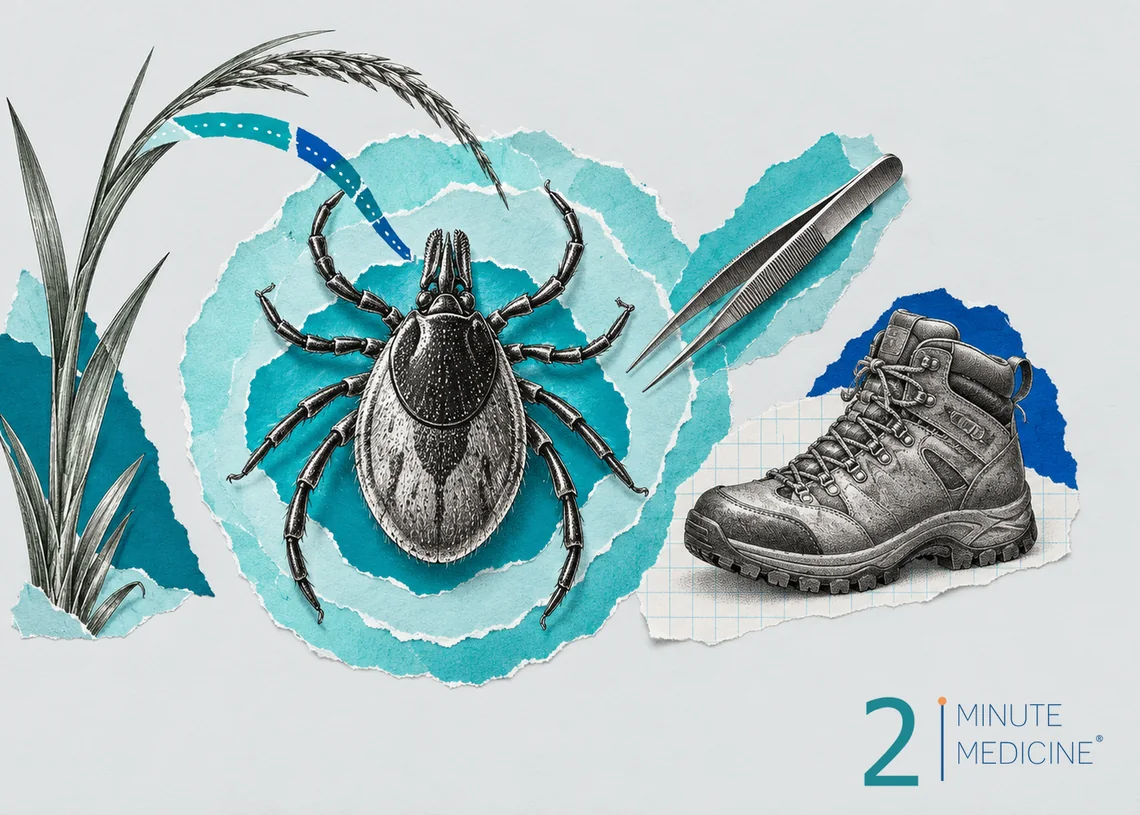
Lyme disease collage: a blacklegged tick, fine-tipped tweezers, a blade of grass, a hiking boot and an expanding ring motif
Share on FacebookShare on TwitterShare on LinkedIn

Lyme disease is a bacterial infection passed to people through the bite of an infected blacklegged tick (deer tick). The germs belong to a group called Borrelia. The first sign is often a red rash that slowly grows around the bite, with fever and aches. Antibiotics cure most people, especially when treatment starts early.

Key points

  • In the US, most cases happen in the Northeast, the mid-Atlantic and the upper Midwest, mostly from late spring through summer.
  • A tick usually has to stay attached for 36 hours or more to pass on Lyme bacteria. Check for ticks every day and remove them quickly.
  • Doctors diagnose the rash by looking at it. Blood tests are most useful several weeks after infection.
  • Doxycycline is the usual treatment.
  • Without treatment, the infection can spread to the joints, heart and nerves.

How Lyme disease spreads

Blacklegged ticks are tiny. Young ticks (nymphs) are about the size of a poppy seed, and they cause most cases because they are so easy to miss. Ticks live in woods, tall grass, brush and leaf piles. They don’t jump or fly. They climb onto you as you brush past plants, then crawl to a warm spot such as the armpit, groin, waist, scalp or behind the knee.

Most US cases come from the Northeast, the mid-Atlantic, and the upper Midwest, including Wisconsin, Minnesota and Michigan. A related tick spreads it on the Pacific coast, mostly in northern California. It doesn’t spread from person to person.

Lyme disease symptoms

Early: 3 to 30 days after the bite

  • Erythema migrans rash. A red patch that grows over days to 2 inches across or larger. It may feel warm but rarely itches or hurts. Some look like a bull’s-eye, but many are evenly red. On brown or Black skin, it can look like a bruise and be harder to spot. Most people with Lyme get this rash, but not everyone does.
  • Fever, chills, headache, tiredness, muscle and joint aches, and swollen glands.

Weeks later, if the infection spreads

  • New rashes in other places
  • Drooping of one or both sides of the face (facial palsy)
  • Bad headache and stiff neck
  • Shooting pain, numbness or tingling in the arms or legs
  • A pounding or skipping heartbeat, dizziness or fainting, from inflammation of the heart
  • Joint pain that moves from joint to joint

Months later

Arthritis with swelling in one or a few large joints, most often a knee. The swelling may come and go.

How to test for Lyme disease

If you have the typical rash and could have been near ticks, your doctor will treat you without a test. In the first few weeks, blood tests often miss the infection, because your body hasn’t yet made enough antibodies.

For later symptoms, doctors use a two-step antibody blood test. If the first test is positive or unclear, a second test is run on the same blood. Both steps are needed for a reliable result. Antibodies can stay in the blood for years after a cure, so a test can’t show whether treatment worked. Testing the tick itself isn’t recommended for deciding on treatment, and some private labs offer tests that haven’t been proven accurate.

RELATED REPORTS

Lyme disease is associated with significant health care costs

Biomarkers distinguish pediatric musculoskeletal infections from similar conditions

Lyme disease treatment

  • Early Lyme disease. Doxycycline pills for about 10 to 14 days. Amoxicillin or cefuroxime are used for people who can’t take doxycycline, such as during pregnancy. Doxycycline makes you sunburn easily, so cover up outdoors.
  • Facial palsy, heart or nerve problems. Antibiotic pills often work. Some people get antibiotics through a vein in the hospital.
  • Lyme arthritis. About 4 weeks of antibiotic pills, with a second course if swelling continues.

A few people have tiredness, aches or trouble thinking for months after treatment. This is called post-treatment Lyme disease syndrome. It usually improves slowly. Long courses of antibiotics haven’t helped it in studies and can cause harm.

What to do after a tick bite

  1. Grab the tick as close to the skin as you can with fine-tipped tweezers.
  2. Pull straight up with steady pressure. Don’t twist or crush it.
  3. Clean the bite and your hands with rubbing alcohol or soap and water.
  4. Seal the tick in a bag or tape, or flush it. Don’t use heat, nail polish or petroleum jelly to remove it.

If a blacklegged tick was attached for 36 hours or more in an area where Lyme is common, a doctor may give one dose of doxycycline within 72 hours of removal to lower your risk. Watch for a rash or fever for the next month.

Other tick-borne diseases

  • Blacklegged ticks can also spread anaplasmosis, babesiosis and, rarely, Powassan virus.
  • Lone star ticks can spread ehrlichiosis and trigger alpha-gal syndrome, an allergy to red meat.
  • American dog ticks are larger and brown with gray-white markings. They can spread Rocky Mountain spotted fever and tularemia.

In Michigan and other Great Lakes states, blacklegged ticks and American dog ticks are the most common, and lone star ticks are moving north.

Preventing tick bites

  • Use an insect repellent registered with the EPA on exposed skin.
  • Treat clothes, shoes and gear with permethrin, which kills ticks. Don’t put it on skin.
  • Wear long sleeves and long pants tucked into socks, and walk in the middle of trails.
  • Shower within 2 hours of coming inside, and check your whole body, your children and your pets.
  • Tumble-dry clothes on high heat for 10 minutes to kill ticks.
  • Keep grass short and clear leaf litter near your home.

Dogs can get a Lyme vaccine. A vaccine for people has been in late-stage testing, so ask your doctor whether one is available.

When to see a doctor

  • A rash that grows larger in the days or weeks after a tick bite or time outdoors
  • Fever, chills or aches after a tick bite
  • Facial drooping, numbness or a swollen joint

Get emergency care for fainting, chest pain, a very slow or skipping heartbeat, or a severe headache with a stiff neck.

Common questions about Lyme disease

Can a tick bite make you sick right away?

Usually not. A small red bump at the bite in the first day or two is a normal reaction, not Lyme disease. The Lyme rash shows up 3 to 30 days later and keeps growing. Fever, chills and aches in the weeks after a bite do need a doctor’s visit.

What is the best tick repellent for humans?

Repellents with DEET, picaridin, IR3535, oil of lemon eucalyptus or 2-undecanone all work when used as the label says. Higher strengths protect for longer. Add permethrin-treated clothing for the best protection. Oil of lemon eucalyptus isn’t for children under 3.

Can you get Lyme disease from a tick with a white dot?

No. A tick with one white dot on its back is usually a female lone star tick. It doesn’t spread Lyme disease, but it can spread ehrlichiosis, cause a rash called STARI, and trigger a red meat allergy. Remove it the same way and watch for fever or rash.

Does Lyme disease go away on its own?

The rash fades even without treatment, but the bacteria can keep spreading to the joints, heart and nerves. That is why doctors treat Lyme disease with antibiotics as soon as it is found. Early treatment cures most people and prevents later problems.

Questions to ask your doctor

  • Does this rash look like Lyme disease?
  • Do I need a blood test, or should I start antibiotics now?
  • How long should I take the antibiotic?
  • What symptoms should make me come back?
  • Could I have another tick-borne infection too?

Learn more

  • Lyme disease (CDC)
  • Ticks (CDC)

This guide is general information and doesn’t replace advice from your own doctor. Last updated October 2026.

Tags: Lyme disease
Previous Post

Patient Basics: Lung Cancer Overview

Next Post

Patient Basics: Leg Fracture

RelatedReports

Longer duration of antibiotic therapy does not reduce persistent symptoms in Lyme disease
Infectious Disease

Lyme disease is associated with significant health care costs

January 19, 2026
Prophylactic platelet transfusions prevent bleeding in hematologic cancers
Emergency

Biomarkers distinguish pediatric musculoskeletal infections from similar conditions

August 4, 2023
Longer duration of antibiotic therapy does not reduce persistent symptoms in Lyme disease
Chronic Disease

Longer duration of antibiotic therapy does not reduce persistent symptoms in Lyme disease

April 1, 2016
Next Post
Collage of engraved shin bones with a thin leg fracture line, a pair of crutches, a walking boot and a blank X-ray card

Patient Basics: Leg Fracture

Liver cancer collage: an engraved liver with an ultrasound probe beside it, a small vaccine vial and a glass of water

Patient Basics: Liver Cancer

Large cell carcinoma collage of an older man beside engraved lungs with a cobalt patch, a blank CT film and a potted fern

Patient Basics: Large Cell Cancer of the Lung

✦ EvidencePulse™ by 2 Minute Medicine 3 reports You asked top stroke trials 2026 Synthesizing medical evidence... Top 2026 stroke trial results: OCEANIC — ischemic stroke: 6.2% vs 8.4% OPTION* — mRS 0–1: 43.6% vs 34.2% ORIENTAL* — mRS 0–2: 58.6% vs 46.6% *Higher sICH in intervention arms Participants randomizedN OCEANIC 12,327 OPTION 570 ORIENTAL 564 Ask about guidelines or landmark trials... Try EvidencePulse™ Get the signal. Try it now → Physician-trained medical AI by 2 Minute Medicine

2MM+ All Access

Full details →
$4.99 /month

3-day free trial · cancel anytime

  • ✓100+ physician-written reports
  • ✓EvidencePulse™ + HypeCheck™
  • ✓Ad-free reading + newsletters
Start 3-day free trial

Then $4.99/month. Manage renewal in your account.

2 Minute Medicine® is an award winning, physician-run, expert medical media company. Our content is curated, written and edited by practicing health professionals who have clinical and scientific expertise in their field of reporting. Our editorial management team is comprised of highly-trained MD physicians. Join numerous brands, companies, and hospitals who trust our licensed content.

Recent Reports

  • Long-term use of mometasone (Asmanex) in adults with sickle cell disease without formal diagnosis of asthma may worsen disease activity
  • Few patients had ED lumbar CT or MRI within 30 days after low-acuity back-pain radiography at urgent care centers
  • A 34-circular RNA blood signature predicted Alzheimer’s disease progression and improved prediction when combined with pTau217
License Content
Terms of Use | Disclaimer
Cookie Policy

Get the app

Read 2 Minute Medicine on iPhone, iPad and Android.

Download on the App StoreGet it on Google Play
QR code for www.2minutemedicine.com/app
On a computer? Scan this with your phone’s camera.
2MM+ All Access Full details →

The medical literature, distilled daily.

Monthly plan selected: $4.99 /month.

$4.99/month

3-day free trial · cancel anytime

Start 3-day free trial

Then $4.99/month. Manage renewal in your account.

Yearly plan selected: $49.90 /year.

$49.90/year

2 months free

Start 3-day free trial

Then $49.90/year.

Membership benefits

  • ✓100+ new physician-written study summaries monthly, 12,000+ searchable
  • ✓AI EvidencePulse™ + HypeCheck™
  • ✓Ad-free reading + newsletters
  • ✓FDA drug approvals + clinical calculators

Already a member? Sign in

  • Get the app
  • About
  • Specialties
    • All Specialties, All Recent Reports
    • Cardiology
    • Chronic Disease
    • Dermatology
    • Emergency
    • Endocrinology
    • Gastroenterology
    • Imaging and Intervention
    • Infectious Disease
    • Nephrology
    • Neurology
    • Obstetrics
    • Oncology
    • Ophthalmology
    • Pediatrics
    • Pharma
    • Preclinical
    • Psychiatry
    • Public Health
    • Pulmonology
    • Rheumatology
    • Surgery
    • Rewinds
    • The Scan
  • EvidencePulse™
  • HypeCheck™
  • AI News
  • Classics™
    • 2MM+ Online Access
    • Paperback and Ebook
  • Tools
    • Medical Calculators
    • Clinical Guidelines
    • Physician Pay by Specialty
    • FDA Drug Approvals
    • RVU Search
    • ICD-10 Code Lookup
    • Drug Safety for Breastfeeding/Pregnancy
    • ECG Reference
      • QTc Calculator
      • Sgarbossa Criteria
      • ECG Axis Calculator
      • AV Block Helper
    • NPI Registry Lookup
  • Rankings
    • Medical School Rankings
    • Residency Rankings
  • Partners
    • License Content
    • Advertise with Us
No Result
View All Result

© 2026 2 Minute Medicine, Inc. - Physician-written medical news.


