• About
  • Masthead
  • License Content
  • Advertise
  • Submit Press Release
  • RSS/Email List
  • 2MM Podcast
  • Write for us
  • Contact Us
2 Minute Medicine
No Result
View All Result

No products in the cart.

SUBSCRIBE
  • About
  • Specialties
    • All Specialties, All Recent Reports
    • Cardiology
    • Chronic Disease
    • Dermatology
    • Emergency
    • Endocrinology
    • Gastroenterology
    • Imaging and Intervention
    • Infectious Disease
    • Nephrology
    • Neurology
    • Obstetrics
    • Oncology
    • Ophthalmology
    • Pediatrics
    • Pharma
    • Preclinical
    • Psychiatry
    • Public Health
    • Pulmonology
    • Rheumatology
    • Surgery
  • Tools+
    • EvidencePulse™
    • HypeCheck™
    • NPI Registry Lookup
    • RVU Search
  • Pharma
  • AI Roundup
  • The Scan+
  • Classics™+
    • 2MM+ Online Access
    • Paperback and Ebook
  • Rewinds
  • Partners
    • License Content
    • Submit Press Release
    • Advertise with Us
  • Account
    • Subscribe
    • My account
    • Cart
    • Sign-in
2 Minute Medicine
  • About
  • Specialties
    • All Specialties, All Recent Reports
    • Cardiology
    • Chronic Disease
    • Dermatology
    • Emergency
    • Endocrinology
    • Gastroenterology
    • Imaging and Intervention
    • Infectious Disease
    • Nephrology
    • Neurology
    • Obstetrics
    • Oncology
    • Ophthalmology
    • Pediatrics
    • Pharma
    • Preclinical
    • Psychiatry
    • Public Health
    • Pulmonology
    • Rheumatology
    • Surgery
  • Tools+
    • EvidencePulse™
    • HypeCheck™
    • NPI Registry Lookup
    • RVU Search
  • Pharma
  • AI Roundup
  • The Scan+
  • Classics™+
    • 2MM+ Online Access
    • Paperback and Ebook
  • Rewinds
  • Partners
    • License Content
    • Submit Press Release
    • Advertise with Us
  • Account
    • Subscribe
    • My account
    • Cart
    • Sign-in
SUBSCRIBE
2 Minute Medicine
Subscribe
EvidencePulse™ by 2 Minute Medicine 2026 evidence scan 3 reports You asked top stroke trials 2026 Synthesizing medical evidence... Top 2026 stroke trial results: OCEANIC — ischemic stroke: 6.2% vs 8.4% OPTION* — mRS 0–1: 43.6% vs 34.2% ORIENTAL* — mRS 0–2: 58.6% vs 46.6% *Higher sICH in intervention arms Participants randomizedN OCEANIC 12,327 OPTION 570 ORIENTAL 564 Ask about guidelines or landmark trials... ↑ Try EvidencePulse™ Ask the evidence.
Get the signal.
Try it now → Physician-trained medical AI by 2 Minute Medicine
Home StudyGraphics

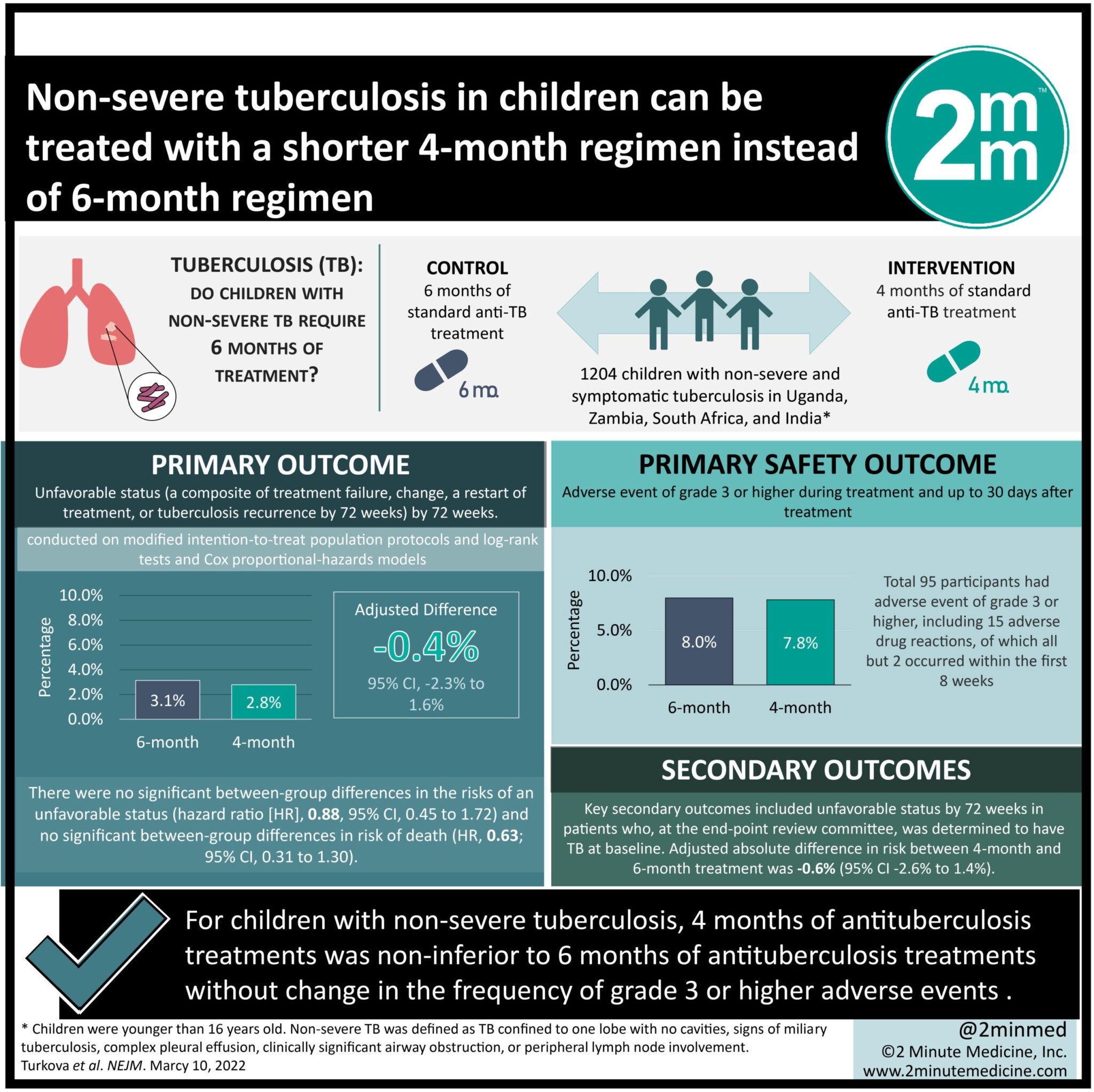
#VisualAbstract: Non-severe tuberculosis in children can be treated with a shorter 4-month regimen instead of 6-month regimen
byMinjee Kim
April 13, 2022
in StudyGraphics
Reading Time: 3 mins read
#VisualAbstract: COVID-19 vaccines provided durable protection from COVID-19, but their effectiveness waned over time in North Carolina
Share on FacebookShare on Twitter

1. For children with non-severe tuberculosis, 4 months of antituberculosis treatments was non-inferior to 6 months of antituberculosis treatments.

2. For children with non-severe tuberculosis, a shorter treatment regimen did not significantly change the frequency of adverse events.

Evidence Rating Level: 1 (Excellent)

Study Rundown: Tuberculosis affects more than 1 million children annually with a mortality rate of about 20%. However, children typically have non-severe, smear-negative tuberculosis compared to adults, but current guidelines recommend 6 months of antituberculosis treatment in children, which is the same length of time as treatment in adults. Therefore, there is a gap in knowledge as to understanding whether 4 months of antituberculosis treatment would be as effective as 6 months of treatment in children with non-severe, smear-negative, drug-susceptible tuberculosis. This study found that 4 months of antituberculosis treatment was non-inferior to 6 months of antituberculosis treatment in children with non-severe tuberculosis. This study was limited by being an open-label trial which can lead to more frequent treatment extensions in the four-month group, as well as the generalizability of the results to settings where chest radiographs are not available for characterizing non-severe tuberculosis.  Nevertheless, these study’s findings are significant, as they demonstrate that 4 months of antituberculosis treatment is effective for treating children with non-severe, drug-susceptible, smear-negative tuberculosis.

Click to read the study in NEJM

RELATED REPORTS

Higher maternal body mass index is associated with increased risk of cardiovascular disease in offspring

Melatonin use is associated with lower proportions of rapid eye movement sleep in children

The association between parental and offspring body mass index may be due to genetic confounding

Relevant Reading: Childhood Tuberculosis — Time for Shorter and Differentiated Treatment

In-Depth [randomized control trial]: This open-label, treatment-shortening, noninferiority trial studied 1204 children with non-severe and symptomatic tuberculosis in Uganda, Zambia, South Africa, and India from July 2016 to July 2018. Patients who were younger than 16 years of age who had symptomatic non-severe and smear-negative tuberculosis were included in the study. Non-severe tuberculosis was characterized as respiratory tuberculosis confined to one lobe with no cavities, no signs of miliary tuberculosis, no complex pleural effusion, and no clinically significant airway obstruction. Patients who did not fit these criteria were excluded from the study. Patients were either assigned to receive 4 months of antituberculosis treatment or the standard 6 months of treatment using WHO-recommended pediatric doses. The primary outcome was unfavorable status, a composite of treatment failure, change, a restart of treatment, or tuberculosis recurrence by 72 weeks. The primary safety outcome was an adverse event of grade 3 or higher during treatment and up to 30 days after treatment. Outcomes in the primary analysis were conducted on modified intention-to-treat population protocols and log-rank tests and Cox proportional-hazards models. Based on the analysis, the noninferiority of 4 months of antituberculosis treatment was consistent across the intention-to-treat, per-protocol, and key secondary analyses. An unfavorable outcome was reported in 3% of the 4-month group and 3% in the 6-month group (95% confidence interval [CI], -2.3 to 1.6). There were no significant between-group differences in the risks of an unfavorable status (hazard ratio [HR], 0.88; 95% CI, 0.45 to 1.72) and no significant between-group differences in risk of death (HR, 0.63; 95% CI, 0.31 to 1.30). Moreover, 8% of participants had an adverse event of grade 3 or higher, all but 2 of which occurred within the first 8 weeks when the treatments were the same in the two groups. Overall, this study demonstrated 4 months of antituberculosis treatment was non-inferior to 6 months of antituberculosis treatment in children with non-severe tuberculosis in Africa and India. This encourages a stratified therapeutic approach to drug-susceptible non-severe tuberculosis in children.

©2022 2 Minute Medicine, Inc. All rights reserved. No works may be reproduced without expressed written consent from 2 Minute Medicine, Inc. Inquire about licensing here. No article should be construed as medical advice and is not intended as such by the authors or by 2 Minute Medicine, Inc.

Tags: antituberculosis treatmentnon-severe tuberculosispediatric tuberculosispediatricstbtuberculosistuberculosis treatment uration
Previous Post

Wellness Check: Spirituality

Next Post

Socioeconomically disadvantaged older persons are at greater risk of impairments after ICU hospitalization

RelatedReports

Behavioral dysregulation in infancy predicts later child mental health
Cardiology

Higher maternal body mass index is associated with increased risk of cardiovascular disease in offspring

September 12, 2026
Parents with poor sleep quality report sleep problems in kids
Pediatrics

Melatonin use is associated with lower proportions of rapid eye movement sleep in children

August 14, 2026
Parents of children with autism report greater difficulty accessing health care
Chronic Disease

The association between parental and offspring body mass index may be due to genetic confounding

June 30, 2026
Prenatal antidepressant exposure may increase risk of poor motor development
Chronic Disease

Maternal use of benzodiazepines and non-benzodiazepine hypnotics is not associated with increased risk of psychiatric

May 6, 2026
Next Post

Socioeconomically disadvantaged older persons are at greater risk of impairments after ICU hospitalization

Decreased expression of nasal ACE2 may be correlated with lower prevalence of COVID-19 in children

SARS-CoV-2 infection during pregnancy associated with severe maternal morbidity, preterm birth, and venous thromboembolism

Implementation of pneumococcal vaccine programs linked to decreased antibiotic prescription

Mortality outcomes from ivermectin trials for COVID-19 associated with strongyloidiasis prevalence: a meta-analysis

EvidencePulse™ by 2 Minute Medicine 2026 evidence scan 3 reports You asked top stroke trials 2026 Synthesizing medical evidence... Top 2026 stroke trial results: OCEANIC — ischemic stroke: 6.2% vs 8.4% OPTION* — mRS 0–1: 43.6% vs 34.2% ORIENTAL* — mRS 0–2: 58.6% vs 46.6% *Higher sICH in intervention arms Participants randomizedN OCEANIC 12,327 OPTION 570 ORIENTAL 564 Ask about guidelines or landmark trials... ↑ Try EvidencePulse™ Get the signal. Try it now → Physician-trained medical AI by 2 Minute Medicine

2MM+ All Access

Full details →
$4.99 /month

3-day free trial · cancel anytime

  • ✓100+ physician-written reports
  • ✓EvidencePulse™ + HypeCheck™
  • ✓Ad-free reading + newsletters
Start 3-day free trial

Then $4.99/month. Manage renewal in your account.

2 Minute Medicine® is an award winning, physician-run, expert medical media company. Our content is curated, written and edited by practicing health professionals who have clinical and scientific expertise in their field of reporting. Our editorial management team is comprised of highly-trained MD physicians. Join numerous brands, companies, and hospitals who trust our licensed content.

Recent Reports

  • Nirsevimab (Beyfortus) may reduce severe respiratory syncytial virus infections among infants
  • An artificial intelligence (AI) tool achieved high diagnostic accuracy for the identification and prediction of sepsis
  • Use of long-acting broadly neutralizing antibodies may delay human immunodeficiency virus (HIV) rebound following discontinuation of antiretroviral therapy
License Content
Terms of Use | Disclaimer
Cookie Policy
Cleantalk Pixel
2MM+ All Access Full details →

The medical literature, distilled daily.

Monthly plan selected: $4.99 /month.

$4.99/month

3-day free trial · cancel anytime

Start 3-day free trial

Then $4.99/month. Manage renewal in your account.

Yearly plan selected: $49.90 /year.

$49.90/year

2 months free

Start 3-day free trial

Then $49.90/year.

Membership benefits

  • ✓100+ physician-written reports
  • ✓AI EvidencePulse™ + HypeCheck™
  • ✓Ad-free reading + newsletters

Already a member? Sign in

  • About
  • Specialties
    • All Specialties, All Recent Reports
    • Cardiology
    • Chronic Disease
    • Dermatology
    • Emergency
    • Endocrinology
    • Gastroenterology
    • Imaging and Intervention
    • Infectious Disease
    • Nephrology
    • Neurology
    • Obstetrics
    • Oncology
    • Ophthalmology
    • Pediatrics
    • Pharma
    • Preclinical
    • Psychiatry
    • Public Health
    • Pulmonology
    • Rheumatology
    • Surgery
  • Tools
    • EvidencePulse™
    • HypeCheck™
    • NPI Registry Lookup
    • RVU Search
  • Pharma
  • AI Roundup
  • The Scan
  • Classics™
    • 2MM+ Online Access
    • Paperback and Ebook
  • Rewinds
  • Partners
    • License Content
    • Submit Press Release
    • Advertise with Us
  • Account
    • Subscribe
    • My account
    • Cart
    • Sign-in
No Result
View All Result

© 2026 2 Minute Medicine, Inc. - Physician-written medical news.