• About
  • Masthead
  • License Content
  • Advertise
  • Submit Press Release
  • RSS/Email List
  • 2MM Podcast
  • Write for us
  • Contact Us
2 Minute Medicine
No Result
View All Result

No products in the cart.

SUBSCRIBE
  • Specialties
    • All Specialties, All Recent Reports
    • Cardiology
    • Chronic Disease
    • Dermatology
    • Emergency
    • Endocrinology
    • Gastroenterology
    • Imaging and Intervention
    • Infectious Disease
    • Nephrology
    • Neurology
    • Obstetrics
    • Oncology
    • Ophthalmology
    • Pediatrics
    • Pharma
    • Preclinical
    • Psychiatry
    • Public Health
    • Pulmonology
    • Rheumatology
    • Surgery
  • Tools
    • EvidencePulse™
    • RVU Search
    • NPI Registry Lookup
  • Pharma
  • AI News
  • The Scan+
  • Classics™+
    • 2MM+ Online Access
    • Paperback and Ebook
  • Rewinds
  • Partners
    • License Content
    • Submit Press Release
    • Advertise with Us
  • Account
    • Subscribe
    • Sign-in
    • My account
2 Minute Medicine
  • Specialties
    • All Specialties, All Recent Reports
    • Cardiology
    • Chronic Disease
    • Dermatology
    • Emergency
    • Endocrinology
    • Gastroenterology
    • Imaging and Intervention
    • Infectious Disease
    • Nephrology
    • Neurology
    • Obstetrics
    • Oncology
    • Ophthalmology
    • Pediatrics
    • Pharma
    • Preclinical
    • Psychiatry
    • Public Health
    • Pulmonology
    • Rheumatology
    • Surgery
  • Tools
    • EvidencePulse™
    • RVU Search
    • NPI Registry Lookup
  • Pharma
  • AI News
  • The Scan+
  • Classics™+
    • 2MM+ Online Access
    • Paperback and Ebook
  • Rewinds
  • Partners
    • License Content
    • Submit Press Release
    • Advertise with Us
  • Account
    • Subscribe
    • Sign-in
    • My account
SUBSCRIBE
2 Minute Medicine
Subscribe
Home StudyGraphics

#VisualAbstract: Catheter ablation reduces rates of persistent atrial fibrillation and atrial tachyarrhythmia
byMinjee Kim
February 3, 2023
in StudyGraphics
Reading Time: 3 mins read
0
Share on FacebookShare on Twitter

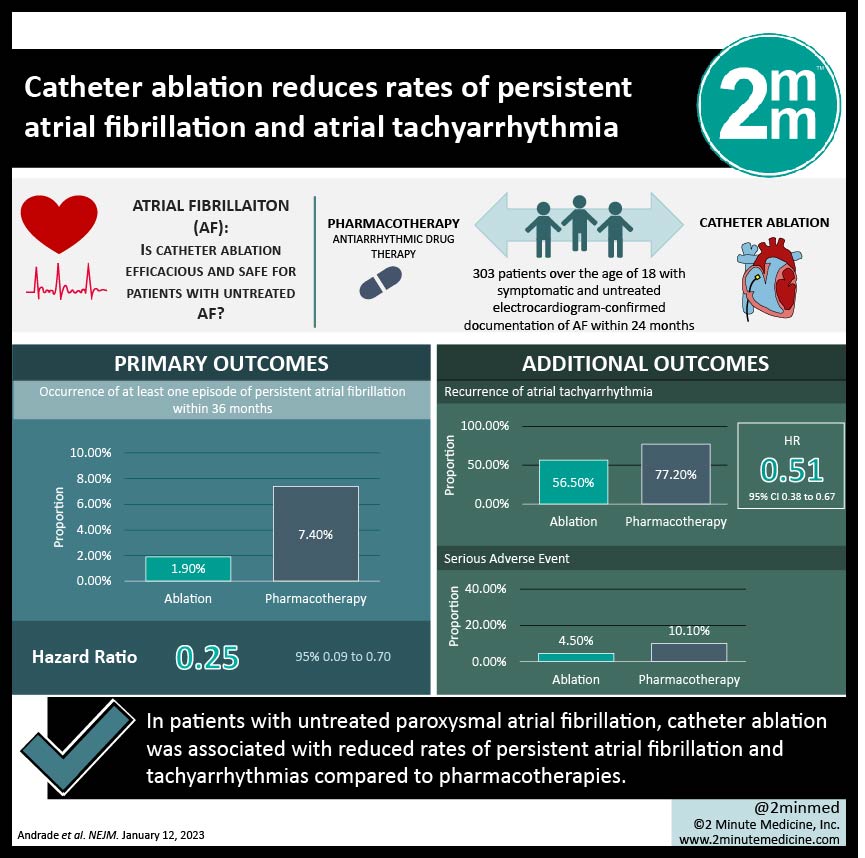
1. In patients with untreated paroxysmal atrial fibrillation, catheter ablation was associated with reduced rates of persistent atrial fibrillation and tachyarrhythmias compared to pharmacotherapies.

2. Catheter ablation was also associated with a lower rate of serious adverse events when compared to antiarrhythmic pharmacotherapy.

Evidence Rating Level: 1 (Excellent)

Study Rundown: Atrial fibrillation is an irregular and fast heart rhythm that can be progressive and chronic. It is associated with a range of complications, such as blood clots and heart failure. Currently, the optimum strategy for treating atrial fibrillation with regard to establishing control of ventricular rhythm is unclear. The main techniques are catheter ablation and pharmacologic control through antiarrhythmic medications. This study was a multi-center randomized trial conducted in Canada investigating the effectiveness and safety profile of single ablation technology against antiarrhythmic pharmacotherapy. Patients with early paroxysmal atrial fibrillation who are symptomatic and have never previously been treated were included. This study found that catheter ablation was more effective than pharmacotherapy at reducing rates of at least one episode of persistent atrial fibrillation and rates of recurrent tachyarrhythmias after the start of the trial. It was also associated with an improved safety profile in terms of a lower proportion of patients experiencing a serious adverse event. Although, this study is limited by significant crossing over of treatment arms (unidirectionally from pharmacotherapy to catheter ablation). Further, results are not generalizable beyond the specific anti-arrhythmic medications and ablation techniques which were utilized.

Click to read the study in NEJM

RELATED REPORTS

Polycythemia is not associated with increased mortality in heart failure

2 Minute Medicine Rewind April 27, 2026

Apixaban (eliquis) outperforms Rivaroxaban (xarelto) in venous thromboembolism bleeding risk

In-Depth [randomized controlled trial]: This study was a multicenter, randomized controlled trial involving 18 study sites in Canada which investigated the efficacy and safety outcomes of cryoballoon ablation compared to anti-arrhythmic pharmacotherapy in patients with paroxysmal atrial fibrillation. Persons older than 18 years old who were symptomatic and not previously treated were included if they had electrocardiogram-confirmed documentation of atrial fibrillation within the previous 24 months. All patients included were implanted with a cardiac monitor to detect cardiac cycle activity. After the application of selection criteria, 303 patients were randomly assigned to receive ablation (n=154) or pharmacotherapy (n=149). The primary outcome of interest was the occurrence of at least one episode of persistent atrial fibrillation within 36 months. Additional outcomes of interest included recurrence of atrial tachyarrhythmia, Atrial Fibrillation Effect on Quality-of-Life survey (AFEQT) score, and adverse events. Results of the primary analysis found that patients receiving pharmacotherapy were more likely to have at least one episode of persistent atrial fibrillation than patients receiving ablation (Hazard Ratio [HR], 0.25; 95% Confidence Interval [CI], 0.09 to 0.70), and more likely to have recurrent atrial tachyarrhythmia (HR, 0.51; 95% CI 0.38 to 0.67). At the final follow-up, 23.5% of patients in the pharmacotherapy group (n=35) and 11.0% of patients in the ablation group (n=17) had experienced a serious adverse effect. This study supports catheter ablation as an initial mechanism of rhythm control for paroxysmal symptomatic atrial fibrillation not previously treated.

©2023 2 Minute Medicine, Inc. All rights reserved. No works may be reproduced without expressed written consent from 2 Minute Medicine, Inc. Inquire about licensing here. No article should be construed as medical advice and is not intended as such by the authors or by 2 Minute Medicine, Inc.

Tags: ablationAFantiarrhythmicsatrial fibrillationcardiac ablationcardiologycryoballoon cardiac ablationparoxysmal atrial fibrillationrhythm controltachyarrhythmia
Previous Post

Efanesoctocog alfa is efficacious in treating severe hemophilia A

Next Post

Guidelines from many countries recommend physical activity during uncomplicated pregnancy

RelatedReports

Remote patient monitoring did not reduce heart failure readmissions: The BEAT-HF trial
Cardiology

Polycythemia is not associated with increased mortality in heart failure

April 28, 2026
Development of a risk index for colorectal cancer screening
Weekly Rewinds

2 Minute Medicine Rewind April 27, 2026

April 27, 2026
Nearly Half of All Pediatric Buprenorphine Exposures Result in Hospitalization
Cardiology

Apixaban (eliquis) outperforms Rivaroxaban (xarelto) in venous thromboembolism bleeding risk

April 9, 2026
2 Minute Medicine: Pharma Roundup: Price Hikes, Breakthrough Approvals, Legal Showdowns, Biotech Expansion, and Europe’s Pricing Debate [May 12nd, 2025]
Endocrinology

2 Minute Medicine: Pharma Roundup – Pfizer’s Talzenna delays prostate cancer progression, apixaban lowers VTE bleeding risk, Lilly’s retatrutide hits Phase III metabolic targets, and FDA warns Novo Nordisk over safety reporting violations [March 2026]

March 30, 2026
Next Post
Risk of autism in offspring linked to maternal pregestational diabetes and severe obesity

Guidelines from many countries recommend physical activity during uncomplicated pregnancy

Comparable cesarean incision infection following Vicryl versus Monocryl skin closure

Subcuticular sutures following elective hepatobiliary surgery may reduce site infections

Physical therapy reduces pain in adults with knee osteoarthritis

High-dose exercise therapy is not superior to low-dose exercise therapy for knee osteoarthritis

2 Minute Medicine® is an award winning, physician-run, expert medical media company. Our content is curated, written and edited by practicing health professionals who have clinical and scientific expertise in their field of reporting. Our editorial management team is comprised of highly-trained MD physicians. Join numerous brands, companies, and hospitals who trust our licensed content.

Recent Reports

  • Polycythemia is not associated with increased mortality in heart failure
  • The American Lung Association issues respiratory warning over viral “mouth taping” fad
  • Early child-rearing conditions may improve psychosocial outcomes in adopted children compared to unadopted biological siblings
License Content
Terms of Use | Disclaimer
Cookie Policy
Privacy Statement (EU)
Disclaimer

The Classics in Medicine Paperback Released!

Over the past 30 years, the transition from print to digital media has contributed to an exponential increase in medical literature. In response, 2 Minute Medicine presents 160+ authoritative, physician-written summaries of the most cited landmark trials in medicine.

amazon-logo_blackGet-it-on-iBooks-badge

Click anywhere to close this announcement

  • Specialties
    • All Specialties, All Recent Reports
    • Cardiology
    • Chronic Disease
    • Dermatology
    • Emergency
    • Endocrinology
    • Gastroenterology
    • Imaging and Intervention
    • Infectious Disease
    • Nephrology
    • Neurology
    • Obstetrics
    • Oncology
    • Ophthalmology
    • Pediatrics
    • Pharma
    • Preclinical
    • Psychiatry
    • Public Health
    • Pulmonology
    • Rheumatology
    • Surgery
  • Tools
    • EvidencePulse™
    • RVU Search
    • NPI Registry Lookup
  • Pharma
  • AI News
  • The Scan
  • Classics™
    • 2MM+ Online Access
    • Paperback and Ebook
  • Rewinds
  • Partners
    • License Content
    • Submit Press Release
    • Advertise with Us
  • Account
    • Subscribe
    • Sign-in
    • My account
No Result
View All Result

© 2026 2 Minute Medicine, Inc. - Physician-written medical news.