• About
  • Masthead
  • License Content
  • Advertise
  • Submit Press Release
  • RSS/Email List
  • 2MM Podcast
  • Write for us
  • Contact Us
2 Minute Medicine
No Result
View All Result

No products in the cart.

SUBSCRIBE
  • About
  • Specialties
    • All Specialties, All Recent Reports
    • Cardiology
    • Chronic Disease
    • Dermatology
    • Emergency
    • Endocrinology
    • Gastroenterology
    • Imaging and Intervention
    • Infectious Disease
    • Nephrology
    • Neurology
    • Obstetrics
    • Oncology
    • Ophthalmology
    • Pediatrics
    • Pharma
    • Preclinical
    • Psychiatry
    • Public Health
    • Pulmonology
    • Rheumatology
    • Surgery
  • Tools+
    • EvidencePulse™
    • HypeCheck™
    • NPI Registry Lookup
    • RVU Search
  • Pharma
  • AI Roundup
  • The Scan+
  • Classics™+
    • 2MM+ Online Access
    • Paperback and Ebook
  • Rewinds
  • Partners
    • License Content
    • Submit Press Release
    • Advertise with Us
  • Account
    • Subscribe
    • My account
    • Cart
    • Sign-in
2 Minute Medicine
  • About
  • Specialties
    • All Specialties, All Recent Reports
    • Cardiology
    • Chronic Disease
    • Dermatology
    • Emergency
    • Endocrinology
    • Gastroenterology
    • Imaging and Intervention
    • Infectious Disease
    • Nephrology
    • Neurology
    • Obstetrics
    • Oncology
    • Ophthalmology
    • Pediatrics
    • Pharma
    • Preclinical
    • Psychiatry
    • Public Health
    • Pulmonology
    • Rheumatology
    • Surgery
  • Tools+
    • EvidencePulse™
    • HypeCheck™
    • NPI Registry Lookup
    • RVU Search
  • Pharma
  • AI Roundup
  • The Scan+
  • Classics™+
    • 2MM+ Online Access
    • Paperback and Ebook
  • Rewinds
  • Partners
    • License Content
    • Submit Press Release
    • Advertise with Us
  • Account
    • Subscribe
    • My account
    • Cart
    • Sign-in
SUBSCRIBE
2 Minute Medicine
Subscribe
EvidencePulse™ by 2 Minute Medicine 2026 evidence scan 3 reports You asked top stroke trials 2026 Synthesizing medical evidence... Top 2026 stroke trial results: OCEANIC — ischemic stroke: 6.2% vs 8.4% OPTION* — mRS 0–1: 43.6% vs 34.2% ORIENTAL* — mRS 0–2: 58.6% vs 46.6% *Higher sICH in intervention arms Participants randomizedN OCEANIC 12,327 OPTION 570 ORIENTAL 564 Ask about guidelines or landmark trials... ↑ Try EvidencePulse™ Ask the evidence.
Get the signal.
Try it now → Physician-trained medical AI by 2 Minute Medicine
Home StudyGraphics

#VisualAbstract: Ultrasound renal denervation lowered daytime ambulatory systolic blood pressure among patients with hypertension
byZain Cheema
April 21, 2023
in StudyGraphics
Reading Time: 3 mins read
#VisualAbstract: Ultrasound renal denervation lowered daytime ambulatory systolic blood pressure among patients with hypertension
Share on FacebookShare on Twitter

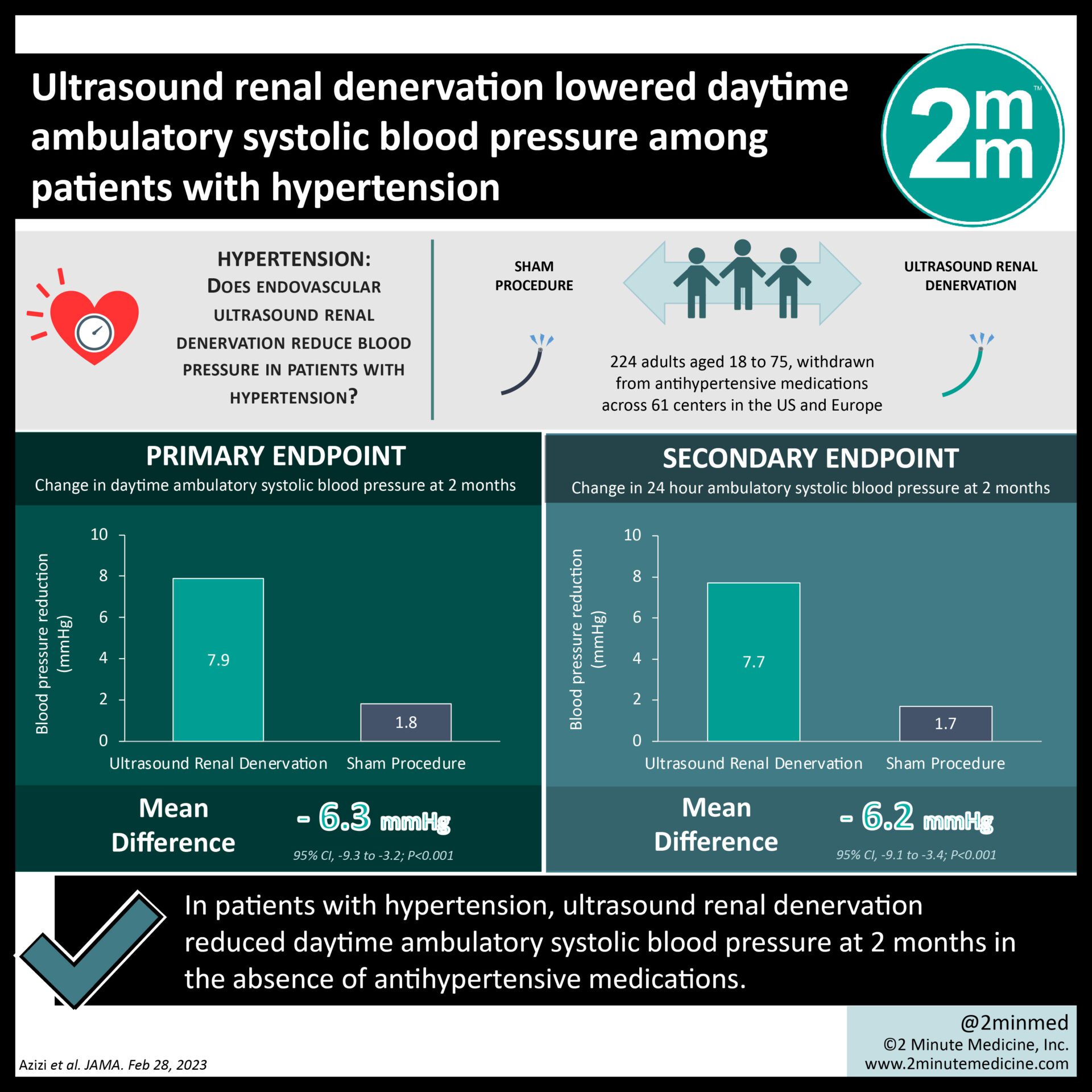
1. In this sham-controlled, randomized clinical trial, among 224 patients with hypertension, ultrasound renal denervation demonstrated clinically relevant reductions in daytime ambulatory systolic blood pressure (SBP) compared to the sham procedure.

2. Among seven secondary blood pressure outcomes, including mean change in 24-hr SBP, home SBP, office SBP, and all diastolic blood pressure parameters at 2 months, six outcomes were significantly improved with ultrasound renal denervation vs the sham procedure.

Evidence Rating Level:1 (Excellent)

Study Rundown: There is an increasing prevalence of poorly controlled hypertension globally, with many patients receiving inadequate treatment. Endovascular, catheter-based renal denervation has been studied as an adjunctive treatment to lower blood pressure (BP); however, there is inconsistency among the results. The RADIANCE II trial investigated the efficacy and safety of ultrasound renal denervation in patients withdrawn from antihypertensive medications. This sham-controlled, randomized clinical trial was conducted between January 2019 and March 2022 at centers in the United States (US) and Europe. Participants were randomized to receive either ultrasound renal denervation (n=150) or a sham procedure (n=74). The primary efficacy outcome was the mean change in daytime ambulatory SBP at 2 months. There was a greater reduction in daytime ambulatory SBP with ultrasound renal denervation (mean, -7.9mmHg) compared to the sham procedure (mean, -1.8mmHg), consistent over the 24-hour circadian cycle. There were no major adverse events in either group. Consistent average reductions in 6 of 7 prespecified secondary BP outcomes at 2 months, including 24-hour SBP, and home and office SBP were achieved after ultrasound renal denervation. A major strength of this study was its rigorous methodology. The generalizability of this study was limited, however, due to the enrollment of patients at low cardiovascular risk with an estimated glomerular filtration rate (eGFR) of 40mL/min/1.73m2 or greater, without significant comorbidities.

Click to read the study in JAMA

Click to read an accompanying editorial in JAMA

RELATED REPORTS

Telehealth yields modest improvements in diabetes outcomes 

Early control of systolic blood pressure following intracerebral hemorrhage may improve functional recovery

New guidelines limit hypertension treatment in adults over 65

Relevant Reading: A controlled trial of renal denervation for resistant hypertension
In-Depth [randomized controlled trial]: This sham-controlled, randomized clinical trial investigated the efficacy and safety of ultrasound renal denervation in patients withdrawn from antihypertensive medications. Patients were recruited between January 2019 and March 2022, with random stratification occurring at 37 centers in the US and 24 centers in Europe. Patients with an eGFR of 40mL/min/1.73m2 or greater with suitable renal artery anatomy were randomized 2:1 to receive ultrasound renal denervation or a sham procedure. Patients were required to abstain from antihypertensive medications until the 2-month follow-up period. Patients were randomized to receive either ultrasound renal denervation (n=150) or a sham procedure (n=74) (mean age, 55 years [SD, 9.3 years]; 28.6% female; and 16.1% self-identified as Black or African American). The primary efficacy outcome was the mean change in daytime ambulatory SBP at 2 months. Secondary outcomes included mean change in 24-hour ambulatory SBP, home SBP, office SBP, and all DBP parameters at 2 months. A greater reduction in daytime ambulatory SBP was seen in the ultrasound renal denervation group (mean, -7.9mmHg [SD, 11.6 mmHg]) vs the sham procedure (mean, -1.8mmHg [SD, 9.5 mmHg]) (baseline adjusted between-group difference, -6.3 mmHg [95% CI, -9.3 to -3.2 mmHg], P < .001). There were no major adverse events reported in either group. Regarding primary safety composite outcomes, no renal artery stenosis greater than 70% was detected.

©2023 2 Minute Medicine, Inc. All rights reserved. No works may be reproduced without expressed written consent from 2 Minute Medicine, Inc. Inquire about licensing here. No article should be construed as medical advice and is not intended as such by the authors or by 2 Minute Medicine, Inc.


Tags: ambulatory blood pressureblood pressure controlhypertensionRADIANCE IIultrasound renal denervation
Previous Post

The Scan by 2 Minute Medicine®: Erythritol and Heart Problems, Maternal Health Trends, the Next Big Thing in Diabetes, and Declining Levels of Sea Ice

Next Post

The emergence of visual artistic creativity in frontotemporal dementia: a case-control study

RelatedReports

Chronic Disease

Telehealth yields modest improvements in diabetes outcomes 

June 22, 2026
No difference in mortality for intensive versus standard reduction in blood pressure in intracerebral hemorrhage: The ATACH-2 trial
Emergency

Early control of systolic blood pressure following intracerebral hemorrhage may improve functional recovery

March 24, 2026
Quick Take: The clinical effectiveness of sertraline in primary care and the role of depression severity and duration (PANDA): a pragmatic, double-blind, placebo-controlled randomized trial
Cardiology

New guidelines limit hypertension treatment in adults over 65

March 16, 2026
UTI associated with increased risk of preeclampsia
Chronic Disease

Elevated blood pressure at discharge from delivery hospitalization predicts earlier admission postpartum

February 23, 2026
Next Post
Myeloperoxidase upregulation in epileptogenesis seen on molecular imaging

The emergence of visual artistic creativity in frontotemporal dementia: a case-control study

Quick Take: Functional Outcome of Intravenous Thrombolysis in Patients With Lacunar Infarcts in the WAKE-UP Trial

Intravenous tenecteplase non-inferior to alteplase for patients with acute ischemic strokes

Development of a risk index for colorectal cancer screening

Radical resection safe for older patients with colorectal cancer

EvidencePulse™ by 2 Minute Medicine 2026 evidence scan 3 reports You asked top stroke trials 2026 Synthesizing medical evidence... Top 2026 stroke trial results: OCEANIC — ischemic stroke: 6.2% vs 8.4% OPTION* — mRS 0–1: 43.6% vs 34.2% ORIENTAL* — mRS 0–2: 58.6% vs 46.6% *Higher sICH in intervention arms Participants randomizedN OCEANIC 12,327 OPTION 570 ORIENTAL 564 Ask about guidelines or landmark trials... ↑ Try EvidencePulse™ Ask the evidence.
Get the signal.
Try it now → Physician-trained medical AI by 2 Minute Medicine

2MM+ All Access

Full details →
$4.99 /month

5-day free trial · cancel anytime

  • ✓100+ physician-written reports
  • ✓EvidencePulse™ + HypeCheck™
  • ✓Ad-free reading + newsletters
Start 5-day free trial

Then $4.99/month. Manage renewal in your account.

2 Minute Medicine® is an award winning, physician-run, expert medical media company. Our content is curated, written and edited by practicing health professionals who have clinical and scientific expertise in their field of reporting. Our editorial management team is comprised of highly-trained MD physicians. Join numerous brands, companies, and hospitals who trust our licensed content.

Recent Reports

  • Video mental health care may have clinical advantages versus phone or in-person visits
  • Higher maternal body mass index is associated with increased risk of cardiovascular disease in offspring
  • Transanastomotic tubes not linked to anastomotic stricture after esophageal atresia repair
License Content
Terms of Use | Disclaimer
Cookie Policy
Cleantalk Pixel
2MM+ All Access Full details →

The medical literature, distilled daily.

Monthly plan selected: $4.99 /month.

$4.99/month

5-day free trial · cancel anytime

Start 5-day free trial

Then $4.99/month. Manage renewal in your account.

Yearly plan selected: $49.90 /year.

$49.90/year

2 months free · only $4.16/month

Start 5-day free trial

Then $49.90/year. Manage renewal in your account.

Membership benefits

  • ✓100+ physician-written reports
  • ✓AI EvidencePulse™ + HypeCheck™
  • ✓Ad-free reading + newsletters

Already a member? Sign in

  • About
  • Specialties
    • All Specialties, All Recent Reports
    • Cardiology
    • Chronic Disease
    • Dermatology
    • Emergency
    • Endocrinology
    • Gastroenterology
    • Imaging and Intervention
    • Infectious Disease
    • Nephrology
    • Neurology
    • Obstetrics
    • Oncology
    • Ophthalmology
    • Pediatrics
    • Pharma
    • Preclinical
    • Psychiatry
    • Public Health
    • Pulmonology
    • Rheumatology
    • Surgery
  • Tools
    • EvidencePulse™
    • HypeCheck™
    • NPI Registry Lookup
    • RVU Search
  • Pharma
  • AI Roundup
  • The Scan
  • Classics™
    • 2MM+ Online Access
    • Paperback and Ebook
  • Rewinds
  • Partners
    • License Content
    • Submit Press Release
    • Advertise with Us
  • Account
    • Subscribe
    • My account
    • Cart
    • Sign-in
No Result
View All Result

© 2026 2 Minute Medicine, Inc. - Physician-written medical news.