• About
  • Masthead
  • License Content
  • Advertise
  • Press Releases
  • Newsroom
  • RSS/Email List
  • 2MM Podcast
  • Write for us
  • Contact Us
2 Minute Medicine
No Result
View All Result

No products in the cart.

Sign in
SUBSCRIBE
  • About
  • Specialties
    • All Specialties, All Recent Reports
    • Cardiology
    • Chronic Disease
    • Dermatology
    • Emergency
    • Endocrinology
    • Gastroenterology
    • Imaging and Intervention
    • Infectious Disease
    • Nephrology
    • Neurology
    • Obstetrics
    • Oncology
    • Ophthalmology
    • Pediatrics
    • Pharma
    • Preclinical
    • Psychiatry
    • Public Health
    • Pulmonology
    • Rheumatology
    • Surgery
    • Rewinds
    • The Scan
  • EvidencePulse™
  • HypeCheck™
  • AI News
  • Classics™
    • 2MM+ Online Access
    • Paperback and Ebook
  • Tools
    • NPI Registry Lookup
    • RVU Search
    • Physician Pay by Specialty
    • ICD-10 Code Lookup
    • FDA Drug Approvals
    • Drug Safety for Breastfeeding/Pregnancy
    • Clinical Guidelines
    • Medical Calculators
    • ECG Reference
      • QTc Calculator
      • Sgarbossa Criteria
      • ECG Axis Calculator
      • AV Block Helper
  • Rankings
    • Medical School Rankings
    • Residency Rankings
  • Partners
    • License Content
    • Advertise with Us
2 Minute Medicine
  • About
  • Specialties
    • All Specialties, All Recent Reports
    • Cardiology
    • Chronic Disease
    • Dermatology
    • Emergency
    • Endocrinology
    • Gastroenterology
    • Imaging and Intervention
    • Infectious Disease
    • Nephrology
    • Neurology
    • Obstetrics
    • Oncology
    • Ophthalmology
    • Pediatrics
    • Pharma
    • Preclinical
    • Psychiatry
    • Public Health
    • Pulmonology
    • Rheumatology
    • Surgery
    • Rewinds
    • The Scan
  • EvidencePulse™
  • HypeCheck™
  • AI News
  • Classics™
    • 2MM+ Online Access
    • Paperback and Ebook
  • Tools
    • NPI Registry Lookup
    • RVU Search
    • Physician Pay by Specialty
    • ICD-10 Code Lookup
    • FDA Drug Approvals
    • Drug Safety for Breastfeeding/Pregnancy
    • Clinical Guidelines
    • Medical Calculators
    • ECG Reference
      • QTc Calculator
      • Sgarbossa Criteria
      • ECG Axis Calculator
      • AV Block Helper
  • Rankings
    • Medical School Rankings
    • Residency Rankings
  • Partners
    • License Content
    • Advertise with Us
Sign in
SUBSCRIBE
2 Minute Medicine
Sign in
Subscribe
2 Minute MedicineFree on Google PlayGet
✦EvidencePulse™by 2 Minute Medicine3 reportsYou askedtop stroke trials 2026Synthesizing medical evidence...Top 2026 stroke trial results:OCEANIC — ischemic stroke: 6.2% vs 8.4%OPTION* — mRS 0–1: 43.6% vs 34.2%ORIENTAL* — mRS 0–2: 58.6% vs 46.6%*Higher sICH in intervention armsParticipants randomizedNOCEANIC12,327OPTION570ORIENTAL564Ask about guidelines or landmark trials...↑Try EvidencePulse™Ask the evidence. Get the signal.Try it now →
Home All Specialties Rheumatology

Utility of long-term routine laboratory toxicity monitoring of immunomodulatory drugs in rheumatoid arthritis

byAdrian WongandThomas Su
August 28, 2025
in Rheumatology
Reading Time: 3 mins read
Blood tests collage: a tray of capped sample tubes lying flat, an open benchtop centrifuge and a pipette
Share on FacebookShare on TwitterShare on LinkedIn

1. In this retrospective cohort study involving patients with rheumatoid arthritis on disease-modifying antirheumatic drugs, long-term routine laboratory toxicity monitoring (lt-RLTM) revealed very abnormal results in less than one percent of all completed tests.

2. Most very abnormal laboratory results were already clinically anticipated and were most often due to renal and urinary disorders unrelated to DMARD use.

Evidence Rating Level: 2 (Good)

Study Rundown: Patients with rheumatoid arthritis (RA) using disease-modifying antirheumatic drugs (DMARDs) are recommended to undergo long term routine laboratory toxicity monitoring (lt-RLTM), involving intensive monitoring in the first 6 months followed by less frequent monitoring for the duration of DMARD use. Current knowledge on the optimal frequency of lt-RLTM is lacking, as reflected in the inconsistency across many existing guidelines. Some studies have also suggested that reduced frequencies not only do not increase patient harm but instead could reduce health care burden and expenses. This study aimed to determine the cumulative probability of and clinical context behind abnormal and very abnormal lt-RLTM test results among patients with RA using DMARDs. Among nearly three hundred thousand lt-RLTM tests, over five percent of results were abnormal and less than one percent were very abnormal. Among patients with new very abnormal results, the median age was high, and a large proportion of patients had high pretest probabilities for abnormal laboratory results. New very abnormal results were most often due to renal and urinary disorders unrelated to DMARD use, including chronic kidney disease, acute kidney injury, and kidney stones. The generalizability of this study is limited by an inability to attribute a lack of serious adverse clinical outcomes to inappropriate testing, as well as challenges conducting subgroup analyses based on each treatment or treatment combination. Nevertheless, this study suggests that current lt-RLTM guidelines may result in unnecessary testing for some laboratory parameters.

Click to read this study in AIM

Relevant Reading: Saving the planet with reduced routine DMARD blood monitoring frequency

RELATED REPORTS

Zemprocitinib sustained clinical responses through Week 76 in rheumatoid arthritis after inadequate response to biologic therapy

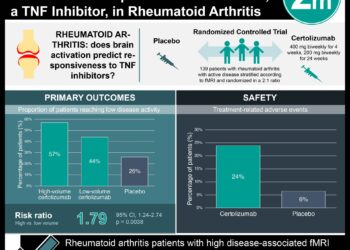
#VisualAbstract: Brain Activation Measured on Functional MRI Predicts Response to Certolizumab, a TNF Inhibitor, in Rheumatoid Arthritis

In-Depth [retrospective cohort]: This retrospective cohort study aimed to evaluate the cumulative probability of abnormal and very abnormal lt-RLTM test results among patients with RA using DMARDs as well as the clinical context behind very abnormal results. A total of 4774 patients were included in this study, with total follow-up of 18,383 patient-years and yielding 8129 patient-DMARD exposure periods. A total of 297,775 lt-RLTM tests were conducted, grouped into 59,555 sets of 5 tests each, with a mean of 12 test sets per patient and 3.2 test sets per patient-year. Abnormal results were most common for estimated glomerular filtration rate (eGFR; 5.3%) and hemoglobin (12%), while very abnormal results were most common for eGFR (1.3%). Among all lt-RLTM tests, 17,343 (5.8%) results were abnormal and 2064 (0.69%) results were very abnormal. Very abnormal results occurred in 492 unique patients, of whom 449 received new results. The cumulative probabilities of abnormal results for the 5 lt-RLTM tests ranged from 4.4% to 47% at 2 years and from 7.5% to 61% at 5 years. The cumulative probabilities of very abnormal results for the 5 tests varied between 0.2% and 6.6% at 2 years and between 0.3% and 11% at 5 years. Among the 449 patients with new very abnormal results, the median age was 73 years (interquartile range [IQR], 65.9 to 79.7), 69.9% (n = 314) were female, and a large proportion had high pretest probability for abnormal results. Test results were deemed unrelated to DMARDs in 116 (24.1%) of participants. New very abnormal causes were mainly due to renal and urinary disorders unrelated to DMARDs, including chronic kidney disease, acute kidney injury, and kidney stones. Overall, this study suggests that lt-RLTM reveals a low proportion of tests as abnormal or very abnormal, and that new very abnormal results may often be unrelated to DMARDs.

Image: PD

©2025 2 Minute Medicine, Inc. All rights reserved. No works may be reproduced without expressed written consent from 2 Minute Medicine, Inc. Inquire about licensing here. No article should be construed as medical advice and is not intended as such by the authors or by 2 Minute Medicine, Inc.

Tags: disease-modifying anti-rheumatic drugs (DMARD)drug toxicitymedication safetyrheumatoid arthritis
Previous Post

Switching to camizestrant after ESR1 mutation detection prolongs progression free survival in advanced breast cancer

Next Post

Similar outcomes between lactated Ringer’s and normal saline for hospitalized patients

RelatedReports

The image shows an illustration of a knee joint, accompanied by a representation of an antibody, suggesting a focus on rheumatoid arthritis or psoriatic arthritis and its treatment.
2MM Trial Briefs

Zemprocitinib sustained clinical responses through Week 76 in rheumatoid arthritis after inadequate response to biologic therapy

October 30, 2026
#VisualAbstract: Brain Activation Measured on Functional MRI Predicts Response to Certolizumab, a TNF Inhibitor, in Rheumatoid Arthritis
StudyGraphics

#VisualAbstract: Brain Activation Measured on Functional MRI Predicts Response to Certolizumab, a TNF Inhibitor, in Rheumatoid Arthritis

July 14, 2025
Obesity treatment collage: a bathroom scale with a blank dial, a coiled tape measure and a bowl of fresh vegetables
Endocrinology

Glucagon-like peptide-1 receptor agonists and co-agonists safe and effective for weight loss

January 7, 2025
#VisualAbstract Use of Certain Biologics or Disease Modifying Antirheumatic Drugs May Be Associated With Cancer Risk
StudyGraphics

#VisualAbstract Use of Certain Biologics or Disease Modifying Antirheumatic Drugs May Be Associated With Cancer Risk

December 5, 2024
Next Post
Surgical site anesthetic infusion may enhance analgesia after mastectomy

Similar outcomes between lactated Ringer’s and normal saline for hospitalized patients

Spinal muscular atrophy collage: a baby girl sitting on a blanket beside a stacking ring toy and a long motor nerve cell

Presymptomatic treatment of spinal muscular atrophy with risdiplam leads to improved functional outcomes

Celiac disease AI diagnosis collage: a biopsy slide, a magnified view of intestinal villi under a tile grid and wheat ears

Machine learning models diagnose celiac disease at similar performance levels to pathologists

✦ EvidencePulse™ by 2 Minute Medicine 3 reports You asked top stroke trials 2026 Synthesizing medical evidence... Top 2026 stroke trial results: OCEANIC — ischemic stroke: 6.2% vs 8.4% OPTION* — mRS 0–1: 43.6% vs 34.2% ORIENTAL* — mRS 0–2: 58.6% vs 46.6% *Higher sICH in intervention arms Participants randomizedN OCEANIC 12,327 OPTION 570 ORIENTAL 564 Ask about guidelines or landmark trials... Try EvidencePulse™ Get the signal. Try it now → Physician-trained medical AI by 2 Minute Medicine

2MM+ All Access

Full details →
$4.99 /month

3-day free trial · cancel anytime

  • ✓100+ physician-written reports
  • ✓EvidencePulse™ + HypeCheck™
  • ✓Ad-free reading + newsletters
Start 3-day free trial

Then $4.99/month. Manage renewal in your account.

NPI Lookup · Free

Look up any US clinician

Search by name or NPI number, live from the CMS NPI Registry.

  • OIG exclusion check
  • Licenses and specialties
  • No account needed
Open NPI Lookup →

2 Minute Medicine® is an award winning, physician-run, expert medical media company. Our content is curated, written and edited by practicing health professionals who have clinical and scientific expertise in their field of reporting. Our editorial management team is comprised of highly-trained MD physicians. Join numerous brands, companies, and hospitals who trust our licensed content.

Recent Reports

  • Non-inpatient care settings may offer alternatives to inpatient beds for select patients
  • Pirtobrutinib improves progression-free survival versus bendamustine plus rituximab in previously untreated CLL/SLL
  • Angiography-derived vessel fractional flow reserve (vFFR) was noninferior to pressure wire–based fractional flow reserve (FFR) for guiding revascularization in intermediate coronary stenoses
License Content
Terms of Use | Disclaimer
Cookie Policy

Get the app

Read 2 Minute Medicine on iPhone, iPad and Android.

Download on the App StoreGet it on Google Play
QR code for www.2minutemedicine.com/app
On a computer? Scan this with your phone’s camera.
2MM+ All Access Full details →

The medical literature, distilled daily.

Monthly plan selected: $4.99 /month.

$4.99/month

3-day free trial · cancel anytime

Start 3-day free trial

Then $4.99/month. Manage renewal in your account.

Yearly plan selected: $49.90 /year.

$49.90/year

2 months free

Start 3-day free trial

Then $49.90/year.

Membership benefits

  • ✓100+ physician-written reports
  • ✓AI EvidencePulse™ + HypeCheck™
  • ✓Ad-free reading + newsletters
  • ✓FDA drug approvals + clinical calculators

Already a member? Sign in

  • Get the app
  • About
  • Specialties
    • All Specialties, All Recent Reports
    • Cardiology
    • Chronic Disease
    • Dermatology
    • Emergency
    • Endocrinology
    • Gastroenterology
    • Imaging and Intervention
    • Infectious Disease
    • Nephrology
    • Neurology
    • Obstetrics
    • Oncology
    • Ophthalmology
    • Pediatrics
    • Pharma
    • Preclinical
    • Psychiatry
    • Public Health
    • Pulmonology
    • Rheumatology
    • Surgery
    • Rewinds
    • The Scan
  • EvidencePulse™
  • HypeCheck™
  • AI News
  • Classics™
    • 2MM+ Online Access
    • Paperback and Ebook
  • Tools
    • NPI Registry Lookup
    • RVU Search
    • Physician Pay by Specialty
    • ICD-10 Code Lookup
    • FDA Drug Approvals
    • Drug Safety for Breastfeeding/Pregnancy
    • Clinical Guidelines
    • Medical Calculators
    • ECG Reference
      • QTc Calculator
      • Sgarbossa Criteria
      • ECG Axis Calculator
      • AV Block Helper
  • Rankings
    • Medical School Rankings
    • Residency Rankings
  • Partners
    • License Content
    • Advertise with Us
No Result
View All Result

© 2026 2 Minute Medicine, Inc. - Physician-written medical news.