• About
  • Masthead
  • License Content
  • Advertise
  • Submit Press Release
  • RSS/Email List
  • 2MM Podcast
  • Write for us
  • Contact Us
2 Minute Medicine
No Result
View All Result

No products in the cart.

SUBSCRIBE
  • About
  • Specialties
    • All Specialties, All Recent Reports
    • Cardiology
    • Chronic Disease
    • Dermatology
    • Emergency
    • Endocrinology
    • Gastroenterology
    • Imaging and Intervention
    • Infectious Disease
    • Nephrology
    • Neurology
    • Obstetrics
    • Oncology
    • Ophthalmology
    • Pediatrics
    • Pharma
    • Preclinical
    • Psychiatry
    • Public Health
    • Pulmonology
    • Rheumatology
    • Surgery
  • Tools+
    • EvidencePulse™
    • HypeCheck™
    • NPI Registry Lookup
    • RVU Search
  • Pharma
  • AI Roundup
  • The Scan+
  • Classics™+
    • 2MM+ Online Access
    • Paperback and Ebook
  • Rewinds
  • Partners
    • License Content
    • Submit Press Release
    • Advertise with Us
  • Account
    • Subscribe
    • My account
    • Cart
    • Sign-in
2 Minute Medicine
  • About
  • Specialties
    • All Specialties, All Recent Reports
    • Cardiology
    • Chronic Disease
    • Dermatology
    • Emergency
    • Endocrinology
    • Gastroenterology
    • Imaging and Intervention
    • Infectious Disease
    • Nephrology
    • Neurology
    • Obstetrics
    • Oncology
    • Ophthalmology
    • Pediatrics
    • Pharma
    • Preclinical
    • Psychiatry
    • Public Health
    • Pulmonology
    • Rheumatology
    • Surgery
  • Tools+
    • EvidencePulse™
    • HypeCheck™
    • NPI Registry Lookup
    • RVU Search
  • Pharma
  • AI Roundup
  • The Scan+
  • Classics™+
    • 2MM+ Online Access
    • Paperback and Ebook
  • Rewinds
  • Partners
    • License Content
    • Submit Press Release
    • Advertise with Us
  • Account
    • Subscribe
    • My account
    • Cart
    • Sign-in
SUBSCRIBE
2 Minute Medicine
Subscribe
EvidencePulse™ by 2 Minute Medicine 2026 evidence scan 3 reports You asked top stroke trials 2026 Synthesizing medical evidence... Top 2026 stroke trial results: OCEANIC — ischemic stroke: 6.2% vs 8.4% OPTION* — mRS 0–1: 43.6% vs 34.2% ORIENTAL* — mRS 0–2: 58.6% vs 46.6% *Higher sICH in intervention arms Participants randomizedN OCEANIC 12,327 OPTION 570 ORIENTAL 564 Ask about guidelines or landmark trials... ↑ Try EvidencePulse™ Ask the evidence.
Get the signal.
Try it now → Physician-trained medical AI by 2 Minute Medicine
Home StudyGraphics

#VisualAbstract: Malaria Chemoprevention Improves Postdischarge Management of Severe Anemia
byConstance Wu
February 4, 2021
in StudyGraphics
Reading Time: 2 mins read
#VisualAbstract: Novel hybrid closed-loop system improves glycemic control in young adults with type 1 diabetes
Share on FacebookShare on Twitter

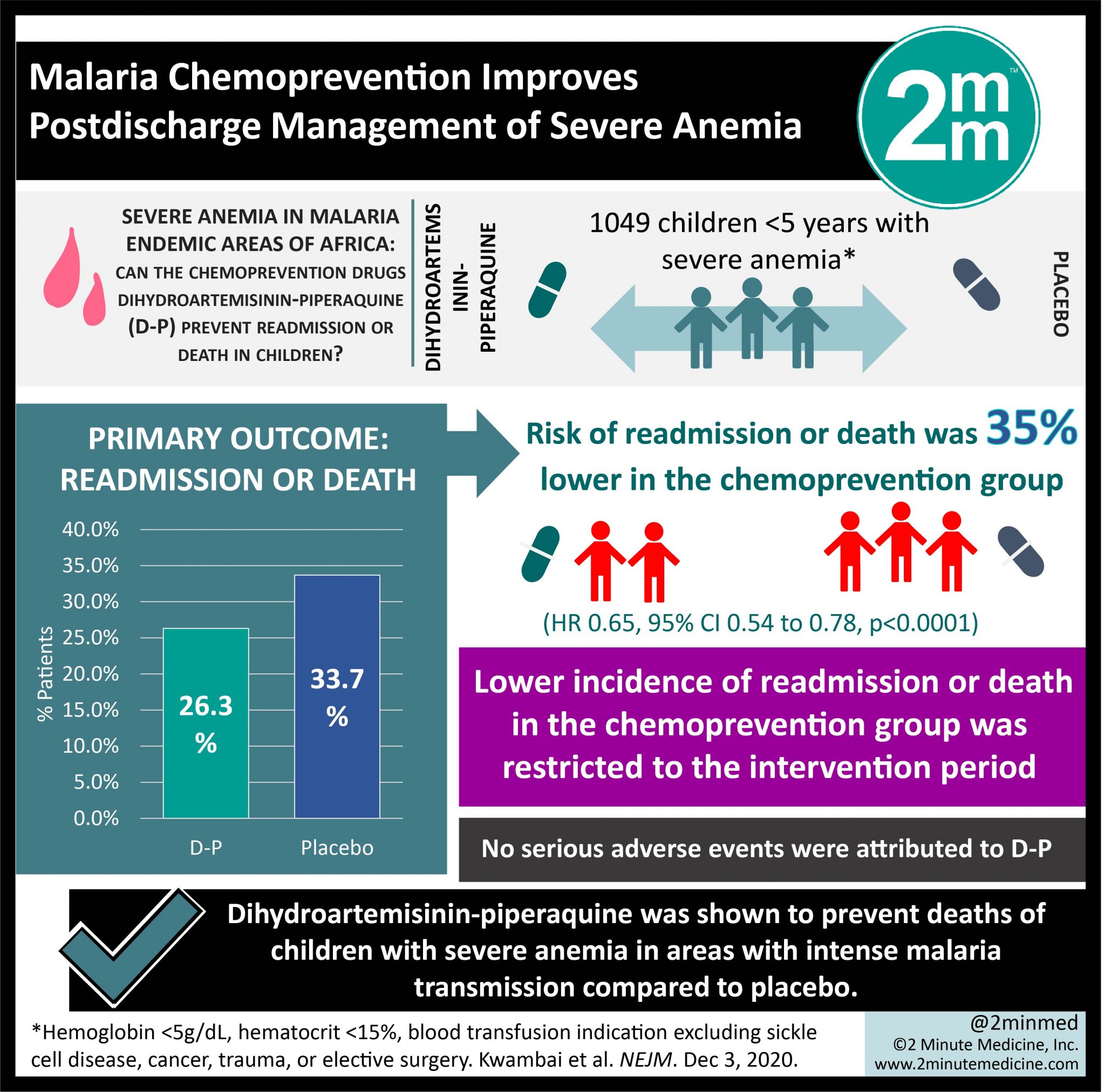
1. Dihydroartemisinin-piperaquine was shown to prevent deaths of children with severe anemia in areas with intense malaria transmission compared to placebo.

2. Monthly chemoprevention with dihydroartemisinin-piperaquine was shown to reduce readmissions for any reason in children with severe anemia compared to placebo.

Evidence Rating Level: 1 (Excellent)

Study Rundown: Severe anemia substantially contributes to childhood mortality and hospital admissions in malaria endemic areas of Africa. Most work of severe anemia in Africa focuses on improving in-hospital care; however, a considerable burden is maintained in the first few months after discharge. Specifically, more deaths occur during the period of discharge compared to the in-hospital care period. As such, this study assessed the efficacy of a three-month post-discharge long-acting antimalarial drug combination of dihydroartemisinin-piperaquine in preventing readmission or death in children with severe anemia. The study determined that dihydroartemisinin-piperaquine use led to a prevention in death and readmission for any reason in children compared to placebo. The randomized controlled trial was limited by the lower-than-expected mortality in the placebo group. Study participation provided the children with a standard of care not readily available; thereby, improving survivorship, but not reflecting the actual mortality burden of the infection. Nonetheless, this study’s results are significant, and its findings highlight a preventative method in increasing children survivorship after malarial infection.

Click to read the study in NEJM

Relevant Reading: Immediate transfusion in African children with uncomplicated severe anemia

RELATED REPORTS

Borderline-low hemoglobin levels linked to increased mortality

Both high and low maternal hemoglobin levels increase neonatal risk

#VisualAbstract: Mass Administration of Ivermectin Reduces Transmission of Malaria in Kwale County, Kenya

In-Depth [randomized controlled trial]: This randomized controlled trial enrolled 1,049 participants at nine hospitals in Kenya and Uganda. Participants included in the study were children younger than the age of five years and admitted with severe anemia. Severe anemia was identified as hemoglobin level of <5 grams (g) per deciliter, hematocrit of <15%, or blood transfusion indication not caused by sickle cell disease, cancer, trauma, or elective surgery. Participants with sickle cell disease or a history of cardiac disorders were excluded from this study. The participants were randomized in a 1:1 ratio to receive post-discharge malaria chemoprevention or placebo treatment, respectively. The primary outcome was hospital readmissions for any reason of death. The participants were followed for six months after discharge. At the end of the follow-up period, 138 of 524 participants (26.3%) had a readmission or died in the chemoprevention group compared to 177 of 525 participants (33.7%) in the placebo group. Overall, the risk of readmission or death was 35% lower in the chemoprevention group compared to the placebo group (hazard ratio, 0.65; 95% confidence interval [CI], 0.54 to 0.78; P<0.0001). The readmission or death incidence was higher among participants with severe malarial anemia (41%) compared to children with nonmalarial anemia (9%); however, the difference was not significant. Finally, there were 284 serious adverse events in the chemoprevention group compared to the 534 events in the placebo group (P<0.001). Furthermore, 12 participants in the chemoprevention group (2.3%) and 30 participants in the placebo group (5.7%) experienced the severe adverse events within four days after medication administration. Taken together, the chemoprevention treatment of dihydroartemisinin-piperaquine significantly reduced deaths and readmissions of children with severe anemia in malaria endemic areas of Africa.

©2021 2 Minute Medicine, Inc. All rights reserved. No works may be reproduced without expressed written consent from 2 Minute Medicine, Inc. Inquire about licensing here. No article should be construed as medical advice and is not intended as such by the authors or by 2 Minute Medicine, Inc.

Tags: anemiachemopreventiondihydroartemisinin-piperaquinemalaria
Previous Post

Metabolic surgery may be more effective than medical therapy for long-term control of type 2 diabetes

Next Post

Hypertension and obesity associated with changes in retinal microvasculature for children

RelatedReports

Cardiology

Borderline-low hemoglobin levels linked to increased mortality

September 14, 2026
Large proportion of late preterm infants and older admitted to the NICU
Hematology

Both high and low maternal hemoglobin levels increase neonatal risk

February 2, 2026
#VisualAbstract: Mass Administration of Ivermectin Reduces Transmission of Malaria in Kwale County, Kenya
StudyGraphics

#VisualAbstract: Mass Administration of Ivermectin Reduces Transmission of Malaria in Kwale County, Kenya

August 13, 2025
Ticagrelor reversal agent provides immediate and sustained effect
Chronic Disease

Mitapivat improves clinical outcomes in patients with non-transfusion dependent thalassemia

July 31, 2025
Next Post
Isolated mild/moderate thrombocytopenia may not require intervention

Hypertension and obesity associated with changes in retinal microvasculature for children

#VisualAbstract ENESTnd: Frontline nilotinib therapy shows improvement in long-term efficacy outcomes for patients in the chronic phase of newly diagnosed chronic myeloid leukemia

#VisualAbstract ENESTnd: Frontline nilotinib therapy shows improvement in long-term efficacy outcomes for patients in the chronic phase of newly diagnosed chronic myeloid leukemia

#VisualAbstract: Fixed-dose, subcutaneous injection of pertuzumab and trastuzumab is noninferior to intravenous administration in HER2⁺ breast cancer

#VisualAbstract: Incidence and prevalence of melanomas and keratinocyte carcinomas have increased from 1990 to 2017

EvidencePulse™ by 2 Minute Medicine 2026 evidence scan 3 reports You asked top stroke trials 2026 Synthesizing medical evidence... Top 2026 stroke trial results: OCEANIC — ischemic stroke: 6.2% vs 8.4% OPTION* — mRS 0–1: 43.6% vs 34.2% ORIENTAL* — mRS 0–2: 58.6% vs 46.6% *Higher sICH in intervention arms Participants randomizedN OCEANIC 12,327 OPTION 570 ORIENTAL 564 Ask about guidelines or landmark trials... ↑ Try EvidencePulse™ Ask the evidence.
Get the signal.
Try it now → Physician-trained medical AI by 2 Minute Medicine

2MM+ All Access

Full details →
$4.99 /month

5-day free trial · cancel anytime

  • ✓100+ physician-written reports
  • ✓EvidencePulse™ + HypeCheck™
  • ✓Ad-free reading + newsletters
Start 5-day free trial

Then $4.99/month. Manage renewal in your account.

2 Minute Medicine® is an award winning, physician-run, expert medical media company. Our content is curated, written and edited by practicing health professionals who have clinical and scientific expertise in their field of reporting. Our editorial management team is comprised of highly-trained MD physicians. Join numerous brands, companies, and hospitals who trust our licensed content.

Recent Reports

  • The rate of urethrocutaneous fistula following caudal and penile blocks for hypospadias repair may be similar
  • Adjuvant chemotherapy not linked to improved outcomes in localized appendiceal adenocarcinoma
  • Deep learning model improved cancer recurrence prediction for pediatric glioma using serial imaging
License Content
Terms of Use | Disclaimer
Cookie Policy
Cleantalk Pixel
2MM+ All Access Full details →

The medical literature, distilled daily.

Monthly plan selected: $4.99 /month.

$4.99/month

5-day free trial · cancel anytime

Start 5-day free trial

Then $4.99/month. Manage renewal in your account.

Yearly plan selected: $49.90 /year.

$49.90/year

2 months free · only $4.16/month

Start 5-day free trial

Then $49.90/year. Manage renewal in your account.

Membership benefits

  • ✓100+ physician-written reports
  • ✓AI EvidencePulse™ + HypeCheck™
  • ✓Ad-free reading + newsletters

Already a member? Sign in

  • About
  • Specialties
    • All Specialties, All Recent Reports
    • Cardiology
    • Chronic Disease
    • Dermatology
    • Emergency
    • Endocrinology
    • Gastroenterology
    • Imaging and Intervention
    • Infectious Disease
    • Nephrology
    • Neurology
    • Obstetrics
    • Oncology
    • Ophthalmology
    • Pediatrics
    • Pharma
    • Preclinical
    • Psychiatry
    • Public Health
    • Pulmonology
    • Rheumatology
    • Surgery
  • Tools
    • EvidencePulse™
    • HypeCheck™
    • NPI Registry Lookup
    • RVU Search
  • Pharma
  • AI Roundup
  • The Scan
  • Classics™
    • 2MM+ Online Access
    • Paperback and Ebook
  • Rewinds
  • Partners
    • License Content
    • Submit Press Release
    • Advertise with Us
  • Account
    • Subscribe
    • My account
    • Cart
    • Sign-in
No Result
View All Result

© 2026 2 Minute Medicine, Inc. - Physician-written medical news.