• About
  • Masthead
  • License Content
  • Advertise
  • Press Releases
  • Newsroom
  • RSS/Email List
  • 2MM Podcast
  • Write for us
  • Contact Us
2 Minute Medicine
No Result
View All Result

No products in the cart.

Sign in
SUBSCRIBE
  • About
  • Specialties
    • All Specialties, All Recent Reports
    • Cardiology
    • Chronic Disease
    • Dermatology
    • Emergency
    • Endocrinology
    • Gastroenterology
    • Imaging and Intervention
    • Infectious Disease
    • Nephrology
    • Neurology
    • Obstetrics
    • Oncology
    • Ophthalmology
    • Pediatrics
    • Pharma
    • Preclinical
    • Psychiatry
    • Public Health
    • Pulmonology
    • Rheumatology
    • Surgery
    • Rewinds
    • The Scan
  • EvidencePulse™
  • HypeCheck™
  • AI News
  • Classics™
    • 2MM+ Online Access
    • Paperback and Ebook
  • Tools
    • NPI Registry Lookup
    • RVU Search
    • Physician Pay by Specialty
    • ICD-10 Code Lookup
    • FDA Drug Approvals
    • Drug Safety for Breastfeeding/Pregnancy
    • Clinical Guidelines
    • Medical Calculators
    • ECG Reference
      • QTc Calculator
      • Sgarbossa Criteria
      • ECG Axis Calculator
      • AV Block Helper
  • Rankings
    • Medical School Rankings
    • Residency Rankings
  • Partners
    • License Content
    • Advertise with Us
2 Minute Medicine
  • About
  • Specialties
    • All Specialties, All Recent Reports
    • Cardiology
    • Chronic Disease
    • Dermatology
    • Emergency
    • Endocrinology
    • Gastroenterology
    • Imaging and Intervention
    • Infectious Disease
    • Nephrology
    • Neurology
    • Obstetrics
    • Oncology
    • Ophthalmology
    • Pediatrics
    • Pharma
    • Preclinical
    • Psychiatry
    • Public Health
    • Pulmonology
    • Rheumatology
    • Surgery
    • Rewinds
    • The Scan
  • EvidencePulse™
  • HypeCheck™
  • AI News
  • Classics™
    • 2MM+ Online Access
    • Paperback and Ebook
  • Tools
    • NPI Registry Lookup
    • RVU Search
    • Physician Pay by Specialty
    • ICD-10 Code Lookup
    • FDA Drug Approvals
    • Drug Safety for Breastfeeding/Pregnancy
    • Clinical Guidelines
    • Medical Calculators
    • ECG Reference
      • QTc Calculator
      • Sgarbossa Criteria
      • ECG Axis Calculator
      • AV Block Helper
  • Rankings
    • Medical School Rankings
    • Residency Rankings
  • Partners
    • License Content
    • Advertise with Us
Sign in
SUBSCRIBE
2 Minute Medicine
Sign in
Subscribe
2 Minute MedicineFree on Google PlayGet
✦EvidencePulse™by 2 Minute Medicine3 reportsYou askedtop stroke trials 2026Synthesizing medical evidence...Top 2026 stroke trial results:OCEANIC — ischemic stroke: 6.2% vs 8.4%OPTION* — mRS 0–1: 43.6% vs 34.2%ORIENTAL* — mRS 0–2: 58.6% vs 46.6%*Higher sICH in intervention armsParticipants randomizedNOCEANIC12,327OPTION570ORIENTAL564Ask about guidelines or landmark trials...↑Try EvidencePulse™Ask the evidence. Get the signal.Try it now →
Home Health A to Z

Patient Basics: Appendicitis
by2 Minute Medicine
October 30, 2026
in Health A to Z
Reading Time: 5 mins read
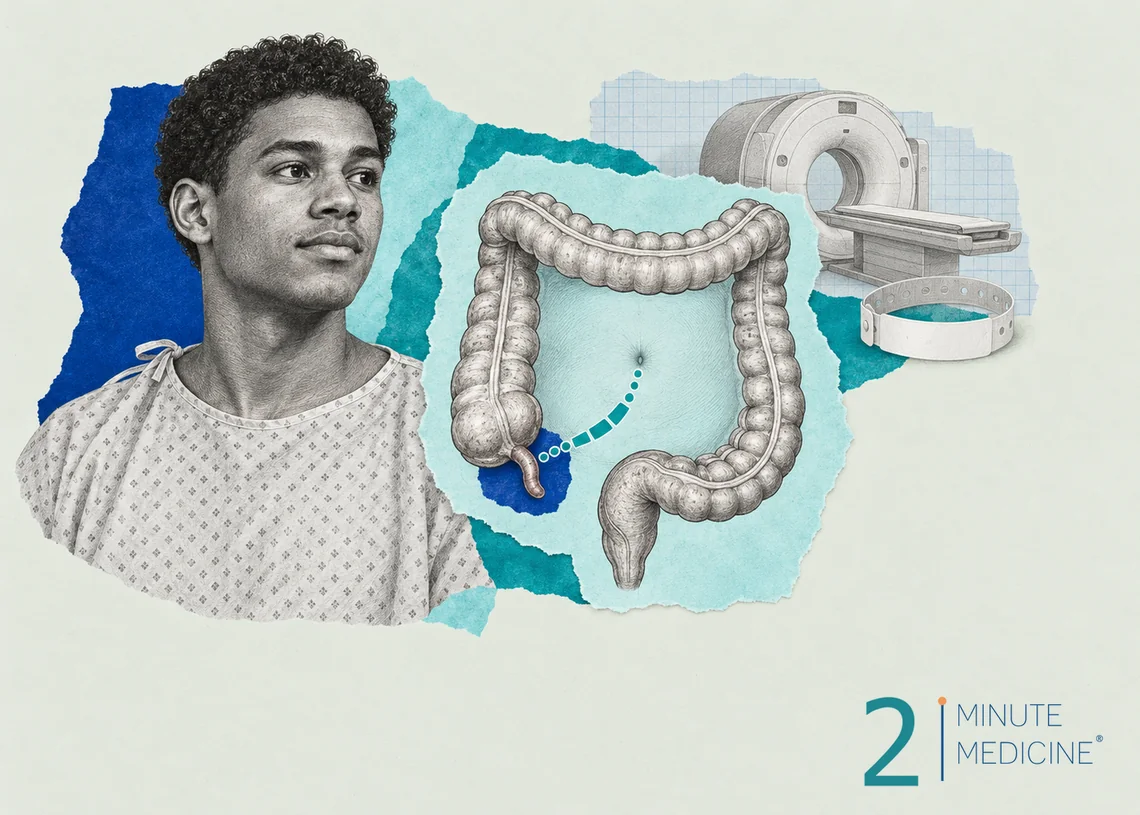
Appendicitis collage of a young man, a large intestine with the appendix marked in blue, a CT scanner and a wristband
Share on FacebookShare on TwitterShare on LinkedIn

Appendicitis is swelling and infection of the appendix, a small finger-shaped pouch attached to the large intestine in the lower right belly. It is the most common reason for emergency belly surgery. If it isn’t treated, the appendix can burst within a day or two, so belly pain that keeps getting worse needs a doctor right away.

Key points

  • Pain often starts around the belly button and moves to the lower right side over several hours.
  • It can happen at any age but is most common in teens and young adults.
  • A CT scan or ultrasound usually confirms it.
  • Most people have the appendix removed through small cuts and go home within a day.
  • Some people with mild cases can be treated with antibiotics alone, but the problem may come back.

What causes appendicitis

The appendix is a dead-end tube. When its opening gets blocked, mucus and bacteria build up inside. The appendix swells, becomes infected and loses blood flow. A small hard lump of stool (an appendicolith) often causes the blockage. Swollen lymph tissue after a virus can also block it. Often no clear cause is found. A sudden attack is called acute appendicitis. It isn’t caused by anything you ate or did, and it isn’t contagious.

Appendicitis symptoms

The appendix usually sits in the lower right part of the belly, about a third of the way from the bony point of the right hip to the belly button. That is where appendix pain usually settles. Common symptoms include:

  • Dull pain near the belly button that moves to the lower right belly and becomes sharp
  • Pain that gets worse when you walk, cough, sneeze or ride over bumps
  • Loss of appetite, often one of the first signs
  • Nausea and vomiting, usually after the pain starts
  • A low fever
  • Constipation, diarrhea or feeling bloated

Not everyone has the classic pattern. The appendix sits in a slightly different place in some people, so pain may be felt in the back, the pelvis or the side.

  • Young children may just seem cranky, stop eating, vomit or have a swollen belly. Their appendix is more likely to burst before the diagnosis is made.
  • During pregnancy, the growing uterus pushes the appendix up, so the pain may be higher on the right side.
  • Older adults may have milder pain and little or no fever, even when the illness is serious.

Signs of a burst appendix

A burst (ruptured or perforated) appendix spills infection into the belly. Pain may ease briefly and then spread across the whole belly. Fever rises, and the belly becomes hard and very tender. This can lead to a widespread belly infection (peritonitis) or a pocket of pus (abscess). It is a serious emergency.

How it’s diagnosed

  • Exam. The doctor presses on your belly to find where it hurts most and checks whether letting go causes sharp pain.
  • Blood tests look for a high white blood cell count and other signs of infection.
  • Urine test helps rule out a kidney stone or bladder infection.
  • Pregnancy test for anyone who could be pregnant, since an ectopic pregnancy can cause similar pain.
  • Imaging. A CT scan is the main test for adults. Children and pregnant women usually have an ultrasound first, and MRI may be used in pregnancy if the ultrasound isn’t clear.

Other problems can feel like appendicitis. They include ovarian cysts, a twisted ovary, a twisted testicle, kidney stones, Crohn’s disease and stomach viruses.

RELATED REPORTS

Antibiotic therapy is inferior to surgery for children with uncomplicated appendicitis

Ultrasound sensitive for appendicitis, improves outcomes [Classics Series]

Treatment

Surgery (appendectomy)

Removing the appendix (appendectomy) is the standard treatment. Most are done by laparoscopy. The surgeon makes a few small cuts and uses a camera and thin tools. You’ll be asleep under general anesthesia, and you’ll get antibiotics through a vein. Open surgery through a larger cut is sometimes needed. You don’t need your appendix, and living without it causes no known problems.

Antibiotics alone

For some adults with mild appendicitis and no appendicolith on the CT scan, antibiotics without surgery is an option. Large studies found that about 3 in 10 people treated this way needed their appendix removed within 3 months, and more did over the next few years. Talk with your surgeon about which choice fits you.

A burst appendix

Treatment may start with several days of IV antibiotics. An abscess is often drained with a thin tube placed through the skin using a CT scan or ultrasound as a guide. The appendix may be removed right away or a few weeks later, once the infection has calmed down.

Recovery

  • After laparoscopic surgery for a simple case, most people go home the same day or the next day. A burst appendix often means a hospital stay of several days.
  • Walk around soon after surgery. It helps prevent blood clots and pneumonia and gets the bowels moving.
  • Expect some soreness, and shoulder pain for a day or two from the gas used to inflate the belly.
  • Avoid heavy lifting and hard exercise for 2 to 4 weeks, or as your surgeon advises. It’s longer after open surgery.
  • Many people return to school or desk work within about a week.

When to see a doctor

Go to an emergency department or urgent care right away if you have:

  • Belly pain that keeps getting worse over several hours, especially on the lower right side
  • Belly pain with fever, vomiting or loss of appetite
  • Pain that makes it hard to walk or stand up straight
  • A belly that is hard or very tender to touch

If you think you might have appendicitis, don’t take laxatives, use an enema or put a heating pad on your belly. They won’t help and could make things worse.

After surgery, call your surgeon for a fever, redness or drainage from a cut, vomiting, or pain that gets worse instead of better.

Common questions about appendicitis

Can appendicitis go away on its own?

Mild appendicitis sometimes settles, but there is no safe way to know whose will, and waiting risks a burst appendix. That is why anyone with symptoms needs a doctor’s exam. If you’re treated with antibiotics instead of surgery, your doctor will plan close follow-up.

How long can you have appendicitis before it bursts?

The risk of a burst grows the longer symptoms go on, especially after the first day or two. Some appendixes burst sooner, most often in young children and older adults. Don’t wait to see whether the pain passes, and get checked within hours if belly pain keeps getting worse.

Can I eat or drink if I think I have appendicitis?

Avoid eating or drinking until a doctor has checked you. You may need surgery, and an empty stomach makes anesthesia safer. If you have diabetes or feel very thirsty, ask the emergency team what you can safely have while you wait.

Is a grumbling appendix real?

Grumbling appendix is a lay term for repeated, milder bouts of pain in the lower right belly. A small number of people do have appendicitis that flares and settles, called chronic or recurrent appendicitis, but other causes are more common. See a doctor if this keeps happening, and get urgent care if the pain grows.

Questions to ask your doctor

  • Is my appendicitis simple or complicated?
  • Would antibiotics alone be a reasonable choice for me?
  • Will my surgery be laparoscopic?
  • When can I go back to work, school or sports?
  • What signs of infection should I watch for at home?

Learn more

  • Appendicitis (National Institute of Diabetes and Digestive and Kidney Diseases)

This guide is general information and doesn’t replace advice from your own doctor. Last updated October 2026.

Tags: appendicitis
Previous Post

Patient Basics: Asymptomatic Bacteriuria

Next Post

Patient Basics: Arm Fracture

RelatedReports

Surgical outcomes collage: an operating lamp above a steel tray of scalpel, forceps and scissors beside a folded drape
Emergency

Antibiotic therapy is inferior to surgery for children with uncomplicated appendicitis

March 4, 2025
ABCD2 Score: Predicting Early Stroke Risk After Transient Ischemic Attack (TIA) [Classics Series]
Emergency Classics

Ultrasound sensitive for appendicitis, improves outcomes [Classics Series]

January 1, 2025
Public Health

Appendicitis hospitalization care costs higher among patients with delayed diagnosis of appendicitis

April 27, 2024
Emergency

24-hour delay may be safe for surgical intervention in patients with uncomplicated appendicitis

November 16, 2023
Next Post
Collage on antisocial personality disorder: two empty armchairs facing each other, a balance scale and a closed notebook

Patient Basics: Antisocial Personality Disorder

Aplastic anemia collage: an older man, a bone showing its marrow, a few blood cells, a thermometer and a soft toothbrush

Patient Basics: Aplastic Anemia

Antibiotic diarrhea collage: an older man in profile, capsules by a blank bottle, a dish of gut bacteria and a cup of broth

Patient Basics: Antibiotic-Associated Diarrhea

✦ EvidencePulse™ by 2 Minute Medicine 3 reports You asked top stroke trials 2026 Synthesizing medical evidence... Top 2026 stroke trial results: OCEANIC — ischemic stroke: 6.2% vs 8.4% OPTION* — mRS 0–1: 43.6% vs 34.2% ORIENTAL* — mRS 0–2: 58.6% vs 46.6% *Higher sICH in intervention arms Participants randomizedN OCEANIC 12,327 OPTION 570 ORIENTAL 564 Ask about guidelines or landmark trials... Try EvidencePulse™ Get the signal. Try it now → Physician-trained medical AI by 2 Minute Medicine

2MM+ All Access

Full details →
$4.99 /month

3-day free trial · cancel anytime

  • ✓100+ physician-written reports
  • ✓EvidencePulse™ + HypeCheck™
  • ✓Ad-free reading + newsletters
Start 3-day free trial

Then $4.99/month. Manage renewal in your account.

2 Minute Medicine® is an award winning, physician-run, expert medical media company. Our content is curated, written and edited by practicing health professionals who have clinical and scientific expertise in their field of reporting. Our editorial management team is comprised of highly-trained MD physicians. Join numerous brands, companies, and hospitals who trust our licensed content.

Recent Reports

  • 101-PGC-005 improved hospitalized patients with COVID-19 faster than systemic dexamethasone in topline phase 2/3 results
  • 2MM: Pharma Roundup – First DNA therapy approved which could reduce airway surgeries, novel siRNA targets dual lipid pathways, GLP-1s outperform metformin in prediabetes, and Zolgensma tumor risks under FDA review
  • Tafolecimab monotherapy reduced low-density lipoprotein cholesterol by more than 60% at week 12 in phase 3 CREDIT-5 results
License Content
Terms of Use | Disclaimer
Cookie Policy

Get the app

Read 2 Minute Medicine on iPhone, iPad and Android.

Download on the App StoreGet it on Google Play
QR code for www.2minutemedicine.com/app
On a computer? Scan this with your phone’s camera.
2MM+ All Access Full details →

The medical literature, distilled daily.

Monthly plan selected: $4.99 /month.

$4.99/month

3-day free trial · cancel anytime

Start 3-day free trial

Then $4.99/month. Manage renewal in your account.

Yearly plan selected: $49.90 /year.

$49.90/year

2 months free

Start 3-day free trial

Then $49.90/year.

Membership benefits

  • ✓100+ new physician-written study summaries monthly, 12,000+ searchable
  • ✓AI EvidencePulse™ + HypeCheck™
  • ✓Ad-free reading + newsletters
  • ✓FDA drug approvals + clinical calculators

Already a member? Sign in

  • Get the app
  • About
  • Specialties
    • All Specialties, All Recent Reports
    • Cardiology
    • Chronic Disease
    • Dermatology
    • Emergency
    • Endocrinology
    • Gastroenterology
    • Imaging and Intervention
    • Infectious Disease
    • Nephrology
    • Neurology
    • Obstetrics
    • Oncology
    • Ophthalmology
    • Pediatrics
    • Pharma
    • Preclinical
    • Psychiatry
    • Public Health
    • Pulmonology
    • Rheumatology
    • Surgery
    • Rewinds
    • The Scan
  • EvidencePulse™
  • HypeCheck™
  • AI News
  • Classics™
    • 2MM+ Online Access
    • Paperback and Ebook
  • Tools
    • NPI Registry Lookup
    • RVU Search
    • Physician Pay by Specialty
    • ICD-10 Code Lookup
    • FDA Drug Approvals
    • Drug Safety for Breastfeeding/Pregnancy
    • Clinical Guidelines
    • Medical Calculators
    • ECG Reference
      • QTc Calculator
      • Sgarbossa Criteria
      • ECG Axis Calculator
      • AV Block Helper
  • Rankings
    • Medical School Rankings
    • Residency Rankings
  • Partners
    • License Content
    • Advertise with Us
No Result
View All Result

© 2026 2 Minute Medicine, Inc. - Physician-written medical news.