

Patient Basics: Pseudogout (CPPD)
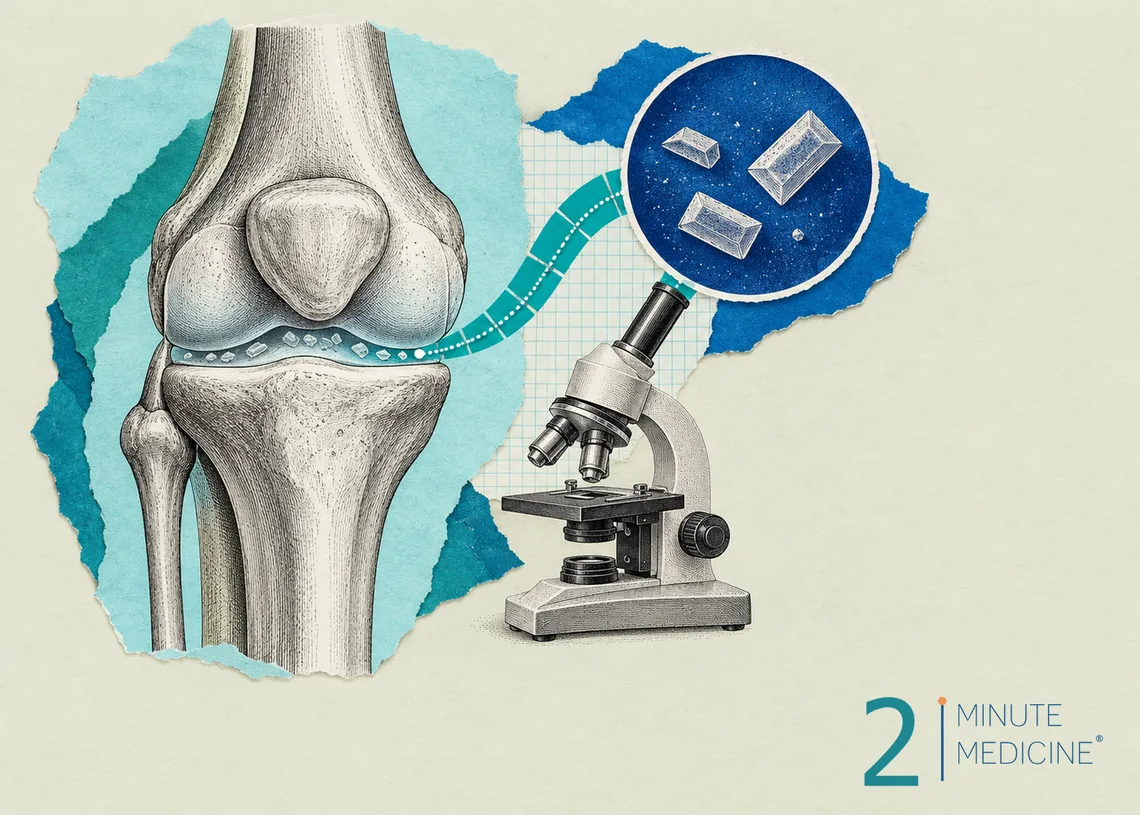
Pseudogout is a sudden attack of pain, heat and swelling in a joint, most often the knee or wrist. It happens when tiny crystals of calcium pyrophosphate, which build up in joint cartilage over years, shed into the joint and set off inflammation. Doctors now call the whole condition calcium pyrophosphate deposition disease, or CPPD for short. An attack looks a lot like gout or a joint infection, so a doctor should check any hot, swollen joint.
Key points
- CPPD is mostly a condition of older adults. It becomes more common with each decade after 60.
- The best test is drawing fluid from the joint with a needle and looking for crystals under a microscope.
- Attacks are treated by draining the joint, steroid shots, anti-inflammatory pills or colchicine.
- No medicine removes the crystals, but daily colchicine can lower the number of attacks.
- A hot, swollen joint with fever needs care the same day to rule out infection.
What causes it
Calcium pyrophosphate is a natural chemical in cartilage, the smooth cushion that covers the ends of bones. In some people it forms crystals that collect in the cartilage. Many have no symptoms at all, and the deposits show up by chance on an X-ray. Doctors call this finding chondrocalcinosis.
An attack starts when crystals shake loose from the cartilage and the immune system reacts to them. Things that can bring on an attack include:
- Surgery, especially on another part of the body
- A serious illness, such as pneumonia or a heart attack
- A minor injury to the joint
- Fluid shifts or sudden changes in blood calcium
Things that raise the risk of CPPD:
- Older age, which is by far the biggest factor
- Osteoarthritis or an old joint injury
- Too much iron in the body (hemochromatosis)
- An overactive parathyroid gland, which raises blood calcium
- Low magnesium in the blood
- A family history, in rare families where it starts at a younger age
If CPPD shows up before about age 60, doctors often test for the conditions on this list.
Symptoms
CPPD can show up in several ways.
- Sudden attacks (pseudogout). One joint becomes painful, swollen, warm and red over a few hours to a day. The knee is the most common, then the wrist, shoulder, ankle and elbow. Some people also get a fever. Without treatment an attack can last days to a few weeks.
- Long-term joint damage. Some people have ongoing stiffness and aching that looks like osteoarthritis, sometimes with flares on top.
- Neck pain. Rarely, crystals collect around the top of the spine and cause sudden, severe neck pain and stiffness with fever. This can be mistaken for meningitis.
- No symptoms. Many people only learn they have crystals from an X-ray done for another reason.
How pseudogout differs from gout
Gout comes from crystals of uric acid, not calcium pyrophosphate. Gout often starts in the big toe and tends to strike people in middle age. Pseudogout favors the knee and wrist and is more common in older people. Medicines that lower uric acid, such as allopurinol, help gout but do nothing for CPPD.
How it’s diagnosed
- Joint fluid test. After numbing the skin, the doctor draws fluid from the joint with a needle. A lab looks at it under a special microscope to find the crystals. The fluid is also checked for bacteria, since an infected joint needs very different treatment. Removing the fluid often eases the pain right away.
- X-rays or ultrasound can show thin lines of calcium in the cartilage of the knee, wrist or hip.
- Blood tests look for inflammation and check calcium, magnesium, phosphate, iron levels and thyroid and parathyroid function.
Treatment
During an attack
- Rest and ice. Keep weight off the joint for a day or two and use a cold pack wrapped in a cloth for 15 to 20 minutes at a time.
- Draining the joint and injecting a steroid into it. This works well when only one or two joints are affected.
- Nonsteroidal anti-inflammatory drugs (NSAIDs), such as naproxen or ibuprofen, if your kidneys, stomach and heart allow it
- Colchicine, best started early in an attack
- Steroid pills for a short time, often used when several joints are swollen or other medicines aren’t safe
For attacks that don’t respond, a specialist may use a medicine that blocks the inflammation signal interleukin-1, such as anakinra.
Preventing more attacks
If attacks keep coming back, a low daily dose of colchicine can help. Treating a linked problem, such as removing extra iron or correcting low magnesium, may also help. For long-term joint pain, the approach is much like osteoarthritis: exercise, weight control, physical therapy and sometimes joint replacement.
Living with CPPD
- Keep moving. Gentle exercise and strong thigh muscles protect the knees between attacks.
- Learn the early feeling of a flare and start treatment quickly, as your doctor advised.
- Before any planned surgery, tell your care team you have CPPD so they can watch for an attack afterward.
- Ask before taking NSAIDs or colchicine with other medicines, since both can interact with common drugs.
When to see a doctor
- A joint that suddenly becomes painful, swollen or warm
- Attacks that keep coming back
- Joint pain or stiffness that limits walking or daily tasks
Get care the same day for a hot, swollen joint with fever or chills, or sudden severe neck pain and stiffness with fever. A joint infection can destroy cartilage within days.
Common questions about pseudogout
What foods trigger pseudogout?
No foods are known to cause pseudogout or set off attacks. That’s different from gout, where meat, seafood, alcohol and sugary drinks can play a part. A balanced diet and a healthy weight still help, because extra weight puts more strain on the knees.
Can pseudogout be cured?
There’s no cure that clears the crystals out of the cartilage. Attacks can be treated quickly, though, and many people go long stretches without one. A low daily dose of colchicine, and treating linked problems such as too much iron, can make attacks less frequent.
Is pseudogout hereditary?
Usually not. Most cases come with aging and wear on the joints. In a small number of families, a gene change causes CPPD that starts at a younger age, so tell your doctor if close relatives had joint attacks like yours early in life.
Is CPPD an autoimmune disease?
No. CPPD is caused by crystals. The immune system reacts to them and causes the swelling, but it doesn’t attack the body’s own tissues the way it does in rheumatoid arthritis or lupus. Blood tests for autoimmune diseases are usually normal in people with CPPD.
Questions to ask your doctor
- How do you know this is pseudogout and not gout or an infection?
- Should I be tested for iron, calcium or magnesium problems?
- Which treatment is safest for me with my other health conditions?
- Should I take a daily medicine to prevent attacks?
- What exercises will help protect this joint?
Learn more
- Calcium pyrophosphate arthritis (MedlinePlus, U.S. National Library of Medicine)
This guide is general information and doesn’t replace advice from your own doctor. Last updated October 2026.






 Get the app