
• About
  • Masthead
  • License Content
  • Advertise
  • Press Releases
  • Newsroom
  • RSS/Email List
  • 2MM Podcast
  • Write for us
  • Contact Us
2 Minute Medicine
No Result
View All Result

No products in the cart.

Sign in
SUBSCRIBE
  • About
  • Specialties
    • All Specialties, All Recent Reports
    • Cardiology
    • Chronic Disease
    • Dermatology
    • Emergency
    • Endocrinology
    • Gastroenterology
    • Imaging and Intervention
    • Infectious Disease
    • Nephrology
    • Neurology
    • Obstetrics
    • Oncology
    • Ophthalmology
    • Pediatrics
    • Pharma
    • Preclinical
    • Psychiatry
    • Public Health
    • Pulmonology
    • Rheumatology
    • Surgery
    • Rewinds
    • The Scan
  • EvidencePulse™
  • HypeCheck™
  • AI News
  • Classics™
    • 2MM+ Online Access
    • Paperback and Ebook
  • Tools
    • Medical Calculators
    • Clinical Guidelines
    • Physician Pay by Specialty
    • FDA Drug Approvals
    • RVU Search
    • ICD-10 Code Lookup
    • Drug Safety for Breastfeeding/Pregnancy
    • ECG Reference
      • QTc Calculator
      • Sgarbossa Criteria
      • ECG Axis Calculator
      • AV Block Helper
    • NPI Registry Lookup
  • Rankings
    • Medical School Rankings
    • Residency Rankings
  • Partners
    • License Content
    • Advertise with Us
2 Minute Medicine
  • About
  • Specialties
    • All Specialties, All Recent Reports
    • Cardiology
    • Chronic Disease
    • Dermatology
    • Emergency
    • Endocrinology
    • Gastroenterology
    • Imaging and Intervention
    • Infectious Disease
    • Nephrology
    • Neurology
    • Obstetrics
    • Oncology
    • Ophthalmology
    • Pediatrics
    • Pharma
    • Preclinical
    • Psychiatry
    • Public Health
    • Pulmonology
    • Rheumatology
    • Surgery
    • Rewinds
    • The Scan
  • EvidencePulse™
  • HypeCheck™
  • AI News
  • Classics™
    • 2MM+ Online Access
    • Paperback and Ebook
  • Tools
    • Medical Calculators
    • Clinical Guidelines
    • Physician Pay by Specialty
    • FDA Drug Approvals
    • RVU Search
    • ICD-10 Code Lookup
    • Drug Safety for Breastfeeding/Pregnancy
    • ECG Reference
      • QTc Calculator
      • Sgarbossa Criteria
      • ECG Axis Calculator
      • AV Block Helper
    • NPI Registry Lookup
  • Rankings
    • Medical School Rankings
    • Residency Rankings
  • Partners
    • License Content
    • Advertise with Us
Sign in
SUBSCRIBE
2 Minute Medicine
Sign in
Subscribe
2 Minute MedicineFree on Google PlayGet
✦EvidencePulse™by 2 Minute Medicine3 reportsYou askedtop stroke trials 2026Synthesizing medical evidence...Top 2026 stroke trial results:OCEANIC — ischemic stroke: 6.2% vs 8.4%OPTION* — mRS 0–1: 43.6% vs 34.2%ORIENTAL* — mRS 0–2: 58.6% vs 46.6%*Higher sICH in intervention armsParticipants randomizedNOCEANIC12,327OPTION570ORIENTAL564Ask about guidelines or landmark trials...↑Try EvidencePulse™Ask the evidence. Get the signal.Try it now →
Home Health A to Z

Patient Basics: Sigmoidoscopy
by2 Minute Medicine
October 30, 2026
in Health A to Z
Reading Time: 5 mins read
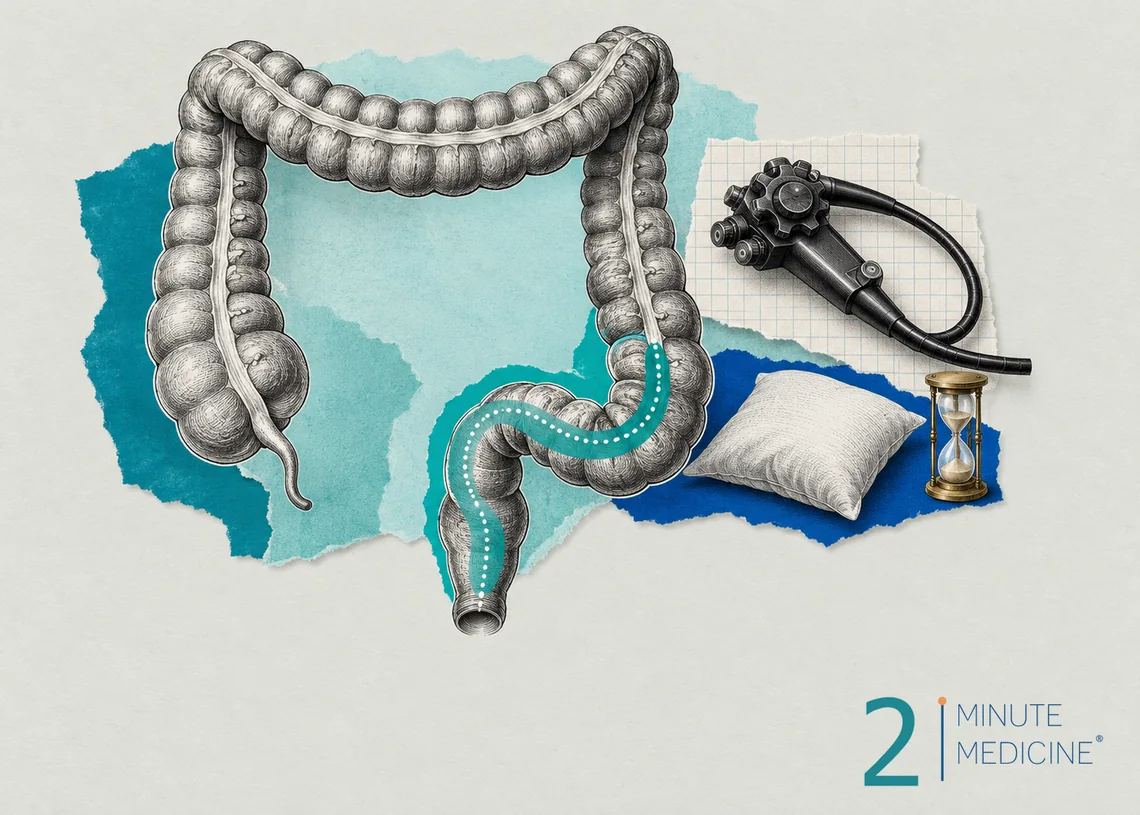
Sigmoidoscopy collage: a large intestine with its S-shaped lower curve marked, a flexible scope, a pillow, an hourglass
Share on FacebookShare on TwitterShare on LinkedIn

A sigmoidoscopy is a test in which a doctor uses a thin, flexible tube with a camera to look inside your rectum and the lower part of your colon (large intestine). It is used to screen for colorectal cancer and to find the cause of bleeding, diarrhea or other bowel changes. It takes about 10 to 20 minutes, needs a simpler bowel prep than a colonoscopy, and usually doesn’t need sedation.

Key points

  • A flexible sigmoidoscopy looks at about the last third of the colon, where many polyps and cancers form.
  • Preparation is usually one or two enemas shortly before the test.
  • You may feel pressure, cramping or bloating, but the test isn’t usually painful.
  • Small growths (polyps) can be removed and tissue samples taken during the test.
  • If polyps are found, you’ll likely need a full colonoscopy to check the rest of the colon.

Sigmoidoscopy vs. colonoscopy

The colon is about 5 feet long. Its last section, just above the rectum, is S-shaped and called the sigmoid colon. A sigmoidoscope reaches the rectum and sigmoid colon, about the last 2 feet.

  • Sigmoidoscopy checks only the lower colon. The prep is quick, sedation is rarely needed, and you can usually drive yourself home.
  • Colonoscopy checks the whole colon. It needs a full day of liquid diet and laxatives beforehand, and most people have sedation.

Because a sigmoidoscopy can’t see the upper part of the colon, it can miss polyps or cancers there. Colonoscopy is more common in the US, but a sigmoidoscopy is still a valid screening choice.

Why a sigmoidoscopy is done

  • Colorectal cancer screening for adults at average risk, starting at age 45. It is repeated every 5 years, or every 10 years when combined with a yearly stool test (FIT).
  • Bright red blood from the rectum
  • Diarrhea that won’t go away
  • Pain in the lower belly or rectum
  • A change in bowel habits
  • Checking inflammation of the rectum and lower colon, such as ulcerative colitis
  • Following up an abnormal stool test or X-ray

Getting ready for a sigmoidoscopy

  • Bowel prep. Most people use one or two enemas from a drugstore, 1 to 2 hours before the test, to empty the lower bowel. Some clinics also ask you to drink only clear liquids or take a laxative the day before. Follow your own instructions, since a poorly cleaned bowel can hide problems.
  • Medicines. Tell your doctor if you take blood thinners, aspirin, diabetes medicines or iron pills. You may need to adjust them before the test. Don’t stop a blood thinner without asking.
  • Health history. Mention any heart or lung problems, past bowel surgery, or pregnancy.
  • Getting home. If you’ll have sedation, arrange for someone to drive you.

During the test

You’ll change into a gown and lie on your left side with your knees drawn toward your chest. The doctor first checks the rectum with a gloved finger. Then they gently pass the lubricated scope through the anus and into the rectum and colon.

Air or carbon dioxide is pumped in to open the bowel so the doctor can see the lining clearly. This can cause pressure, cramping, bloating or the feeling that you need to have a bowel movement. Taking slow, deep breaths helps. The doctor may take tiny tissue samples (biopsies) or remove polyps with a small wire loop. You won’t feel these.

The test usually takes 10 to 20 minutes.

RELATED REPORTS

Sigmoidoscopy reduces colon cancer risk for men, but not women

Afterward

  • You may feel bloated and pass a lot of gas for a few hours. Walking helps move the gas along.
  • You can eat normally and return to your usual activities the same day, unless you had sedation.
  • A small amount of blood in your first bowel movement is common if a biopsy was taken or a polyp was removed.
  • Ask when to restart any medicines you paused.

Possible risks

Sigmoidoscopy is a low-risk test. Rare problems include:

  • Bleeding, mostly after a polyp is removed. It can start up to a week or two later.
  • A tear in the bowel wall (perforation). This is very rare and may need surgery.
  • A reaction to sedation, if used

Your results

The doctor can often tell you what they saw right after the test. Biopsy and polyp results come back in several days to two weeks.

  • Normal: the lining looks healthy. For screening, you’ll be due again in 5 years, or 10 years if you also do a yearly FIT.
  • Polyps: most are harmless, but some types can turn into cancer over years. If polyps are found, you’ll usually be advised to have a colonoscopy to look at the whole colon.
  • Other findings: swollen veins in the rectum (hemorrhoids), small pouches in the colon wall (diverticulosis), inflammation, or a tumor that needs more tests

When to call your doctor

  • More than a few tablespoons of blood from the rectum, or bleeding that keeps going
  • Severe or worsening belly pain
  • A belly that becomes hard or swollen
  • Fever or chills
  • Vomiting, dizziness or feeling faint

For heavy bleeding, severe pain or fainting, call 911 or go to an emergency department.

Common questions about sigmoidoscopy

Is a sigmoidoscopy painful?

Most people find it uncomfortable rather than painful. The air used to open the bowel causes cramping, pressure and an urge to pass gas, which fades soon after the test. Tell the doctor if you feel pain. They can slow down, let some air out or change your position.

Are you put to sleep for a sigmoidoscopy?

Usually not. Most sigmoidoscopies are done while you’re awake, because the test is short and reaches only the lower bowel. Some people choose light sedation if they are anxious. In that case, you’ll need someone to drive you home and should rest for the day.

Can a sigmoidoscopy find colon cancer?

Yes, in the rectum and lower colon, where many colorectal cancers start. Studies show screening with sigmoidoscopy lowers deaths from colorectal cancer. It can’t see the upper colon, though, so polyps or cancer there can be missed. That’s why some people pair it with a yearly stool test.

Questions to ask your doctor

  • Is a sigmoidoscopy or a colonoscopy better for me?
  • How should I prepare, and which medicines should I pause?
  • Will I have sedation?
  • When will I get my biopsy or polyp results?
  • When should I have my next screening test?

Learn more

  • Flexible sigmoidoscopy (National Institute of Diabetes and Digestive and Kidney Diseases)
  • Sigmoidoscopy (MedlinePlus, U.S. National Library of Medicine)

This guide is general information and doesn’t replace advice from your own doctor. Last updated October 2026.

Tags: Sigmoidoscopy
Previous Post

Patient Basics: Radionuclide Scanning

Next Post

Patient Basics: Radiation Therapy

RelatedReports

Chronic Disease

Sigmoidoscopy reduces colon cancer risk for men, but not women

April 24, 2018
Next Post
Radiation therapy collage: an older woman in a calm portrait beside the curved arm of a treatment machine and a mesh mask

Patient Basics: Radiation Therapy

Pneumonectomy collage: one engraved lung beside the dotted outline of the removed lung, a breathing trainer and a pillow

Patient Basics: Pneumonectomy

Collage on the PSA blood test: an engraved bladder and prostate, a capped blood tube, a balance scale and a blank calendar

Patient Basics: Prostate-Specific Antigen Blood Test (PSA Test)

✦ EvidencePulse™ by 2 Minute Medicine 3 reports You asked top stroke trials 2026 Synthesizing medical evidence... Top 2026 stroke trial results: OCEANIC — ischemic stroke: 6.2% vs 8.4% OPTION* — mRS 0–1: 43.6% vs 34.2% ORIENTAL* — mRS 0–2: 58.6% vs 46.6% *Higher sICH in intervention arms Participants randomizedN OCEANIC 12,327 OPTION 570 ORIENTAL 564 Ask about guidelines or landmark trials... Try EvidencePulse™ Get the signal. Try it now → Physician-trained medical AI by 2 Minute Medicine

2MM+ All Access

Full details →
$4.99 /month

3-day free trial · cancel anytime

  • ✓100+ physician-written reports
  • ✓EvidencePulse™ + HypeCheck™
  • ✓Ad-free reading + newsletters
Start 3-day free trial

Then $4.99/month. Manage renewal in your account.

2 Minute Medicine® is an award winning, physician-run, expert medical media company. Our content is curated, written and edited by practicing health professionals who have clinical and scientific expertise in their field of reporting. Our editorial management team is comprised of highly-trained MD physicians. Join numerous brands, companies, and hospitals who trust our licensed content.

Recent Reports

  • Medicaid-reimbursed weight-loss GLP-1 prescriptions fell after coverage withdrawal in 4 states
  • Social isolation and loneliness is associated with worse physical and mental health among middle-aged and older adults
  • Gait analysis predicts health, sleep, and medication use across 18 body systems
License Content
Terms of Use | Disclaimer
Cookie Policy

Get the app

Read 2 Minute Medicine on iPhone, iPad and Android.

Download on the App StoreGet it on Google Play
QR code for www.2minutemedicine.com/app
On a computer? Scan this with your phone’s camera.
2MM+ All Access Full details →

The medical literature, distilled daily.

Monthly plan selected: $4.99 /month.

$4.99/month

3-day free trial · cancel anytime

Start 3-day free trial

Then $4.99/month. Manage renewal in your account.

Yearly plan selected: $49.90 /year.

$49.90/year

2 months free

Start 3-day free trial

Then $49.90/year.

Membership benefits

  • ✓100+ new physician-written study summaries monthly, 12,000+ searchable
  • ✓AI EvidencePulse™ + HypeCheck™
  • ✓Ad-free reading + newsletters
  • ✓FDA drug approvals + clinical calculators

Already a member? Sign in

  • Get the app
  • About
  • Specialties
    • All Specialties, All Recent Reports
    • Cardiology
    • Chronic Disease
    • Dermatology
    • Emergency
    • Endocrinology
    • Gastroenterology
    • Imaging and Intervention
    • Infectious Disease
    • Nephrology
    • Neurology
    • Obstetrics
    • Oncology
    • Ophthalmology
    • Pediatrics
    • Pharma
    • Preclinical
    • Psychiatry
    • Public Health
    • Pulmonology
    • Rheumatology
    • Surgery
    • Rewinds
    • The Scan
  • EvidencePulse™
  • HypeCheck™
  • AI News
  • Classics™
    • 2MM+ Online Access
    • Paperback and Ebook
  • Tools
    • Medical Calculators
    • Clinical Guidelines
    • Physician Pay by Specialty
    • FDA Drug Approvals
    • RVU Search
    • ICD-10 Code Lookup
    • Drug Safety for Breastfeeding/Pregnancy
    • ECG Reference
      • QTc Calculator
      • Sgarbossa Criteria
      • ECG Axis Calculator
      • AV Block Helper
    • NPI Registry Lookup
  • Rankings
    • Medical School Rankings
    • Residency Rankings
  • Partners
    • License Content
    • Advertise with Us
No Result
View All Result

© 2026 2 Minute Medicine, Inc. - Physician-written medical news.


