• About
  • Masthead
  • License Content
  • Advertise
  • Submit Press Release
  • RSS/Email List
  • 2MM Podcast
  • Write for us
  • Contact Us
2 Minute Medicine
No Result
View All Result

No products in the cart.

SUBSCRIBE
  • Specialties
    • All Specialties, All Recent Reports
    • Cardiology
    • Chronic Disease
    • Dermatology
    • Emergency
    • Endocrinology
    • Gastroenterology
    • Imaging and Intervention
    • Infectious Disease
    • Nephrology
    • Neurology
    • Obstetrics
    • Oncology
    • Ophthalmology
    • Pediatrics
    • Pharma
    • Preclinical
    • Psychiatry
    • Public Health
    • Pulmonology
    • Rheumatology
    • Surgery
  • Tools
    • EvidencePulse™
    • RVU Search
    • NPI Registry Lookup
  • Pharma
  • AI News
  • The Scan+
  • Classics™+
    • 2MM+ Online Access
    • Paperback and Ebook
  • Rewinds
  • Partners
    • License Content
    • Submit Press Release
    • Advertise with Us
  • Account
    • Subscribe
    • Sign-in
    • My account
2 Minute Medicine
  • Specialties
    • All Specialties, All Recent Reports
    • Cardiology
    • Chronic Disease
    • Dermatology
    • Emergency
    • Endocrinology
    • Gastroenterology
    • Imaging and Intervention
    • Infectious Disease
    • Nephrology
    • Neurology
    • Obstetrics
    • Oncology
    • Ophthalmology
    • Pediatrics
    • Pharma
    • Preclinical
    • Psychiatry
    • Public Health
    • Pulmonology
    • Rheumatology
    • Surgery
  • Tools
    • EvidencePulse™
    • RVU Search
    • NPI Registry Lookup
  • Pharma
  • AI News
  • The Scan+
  • Classics™+
    • 2MM+ Online Access
    • Paperback and Ebook
  • Rewinds
  • Partners
    • License Content
    • Submit Press Release
    • Advertise with Us
  • Account
    • Subscribe
    • Sign-in
    • My account
SUBSCRIBE
2 Minute Medicine
Subscribe
Home StudyGraphics

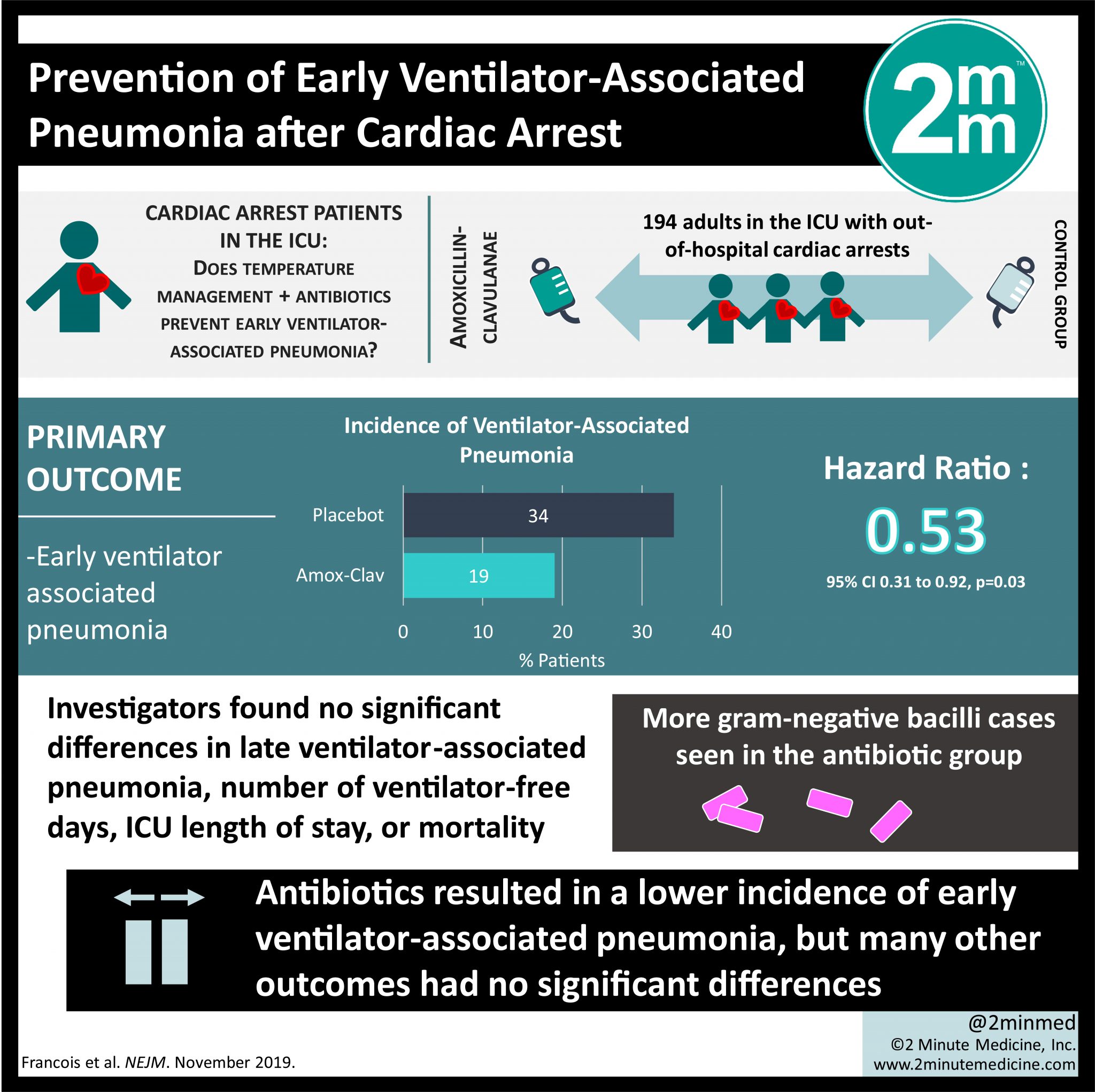
#VisualAbstract: Prevention of Early Ventilator-Associated Pneumonia after Cardiac Arrest
byConstance Wu
December 17, 2019
in StudyGraphics
Reading Time: 2 mins read
0
Share on FacebookShare on Twitter

1. A 2-day course of amoxicillin-clavulanate and targeted temperature management of 32-34 degrees Celsius after cardiac arrest with shockable rhythm resulted in a lower incidence of early ventilator-associated pneumonia than the control group.

2. The intervention did not cause a significant decrease in the rate of late ventilator-associated pneumonia, number of ventilator-free days, ICU length of stay, and mortality at day 28 as compared to the control group.

Evidence Rating Level: 1 (Excellent)

Study Rundown: Survival rates upon discharge among patients with out-of-hospital cardiac arrests is poor, remaining below 20%. In addition, targeted temperature management is recommended in such patients but is associated with increased risk of infection. This randomized controlled trial was designed to test the use of antibiotics plus temperature control to decrease the amount of ventilator-associated pneumonia in patients with out-of-hospital cardiac arrest with a shockable rhythm. A 2-day course of amoxicillin-clavulanate and targeted temperature management of 32-34°C after cardiac arrest with shockable rhythm resulted in a lower incidence of early ventilator-associated pneumonia. A higher frequency of enterobacteria was seen in patients that received amoxicillin-clavulanate. No significant difference was seen between the two groups in the rate of late ventilator-associated pneumonia, number of ventilator-free days, ICU length of stay, and mortality at day 28. Given the small sample size and specific inclusion criteria, further research is required to determine whether antibiotics and targeted temperature control decrease the amount of early ventilator-associated pneumonia in cardiac arrest patients, and if the findings can be applied to other populations.

Click to read the study in NEJM

©2019 2 Minute Medicine, Inc. All rights reserved. No works may be reproduced without expressed written consent from 2 Minute Medicine, Inc. Inquire about licensing here. No article should be construed as medical advice and is not intended as such by the authors or by 2 Minute Medicine, Inc.

RELATED REPORTS

Resuscitative endovascular balloon occlusion of the aorta may not improve outcomes in adults with non-traumatic out-of-hospital cardiac arrest

2 Minute Medicine Rewind May 11, 2026

Shorter antibiotic courses non-inferior for inpatient community-acquired pneumonia

Tags: amoxicillin–clavulanatecardiac arrestpneumoniaventilator associated pneumonia
Previous Post

Safety and immunogenicity of the oral, inactivated, enterotoxigenic Escherichia coli vaccine ETVAX in Bangladeshi children and infants

Next Post

Long-term impact of an educational antimicrobial stewardship programme in primary care on infections caused by extended-spectrum β-lactamase-producing Escherichia coli in the community

RelatedReports

Antiarrhythmic drugs have no survival benefit in shock-refractory out-of-hospital cardiac arrest
Cardiology

Resuscitative endovascular balloon occlusion of the aorta may not improve outcomes in adults with non-traumatic out-of-hospital cardiac arrest

May 14, 2026
Live attenuated vaccine less effective in recent influenza season
Weekly Rewinds

2 Minute Medicine Rewind May 11, 2026

May 11, 2026
Prescription of antibiotics for acute respiratory infections increasing
Infectious Disease

Shorter antibiotic courses non-inferior for inpatient community-acquired pneumonia

April 13, 2026
Bystander CPR positively associated with cardiac arrest survival
Cardiology

Television CPR scripts undercut bystander response in real emergencies

February 3, 2026
Next Post
Publication of pneumonia antibiotic guidelines changed prescribing trends

Long-term impact of an educational antimicrobial stewardship programme in primary care on infections caused by extended-spectrum β-lactamase-producing Escherichia coli in the community

Pre-operative magnetic resonance imaging may not improve contralateral breast cancer detection

Low risk of nephrogenic systemic fibrosis with group II gadolinium contrast agents in chronic kidney disease

#VisualAbstract: Bedside Optic Nerve Ultrasonography for Diagnosing Increased Intracranial Pressure

#VisualAbstract: Bedside Optic Nerve Ultrasonography for Diagnosing Increased Intracranial Pressure

2 Minute Medicine® is an award winning, physician-run, expert medical media company. Our content is curated, written and edited by practicing health professionals who have clinical and scientific expertise in their field of reporting. Our editorial management team is comprised of highly-trained MD physicians. Join numerous brands, companies, and hospitals who trust our licensed content.

Recent Reports

  • Selective serotonin reuptake inhibitors may reduce risk of total joint arthroplasty in osteoarthritis
  • Physical frailty is associated with increased risk of epilepsy
  • Exercise continues to outperform pharmacologic longevity strategies
License Content
Terms of Use | Disclaimer
Cookie Policy
Privacy Statement (EU)
Disclaimer
  • Specialties
    • All Specialties, All Recent Reports
    • Cardiology
    • Chronic Disease
    • Dermatology
    • Emergency
    • Endocrinology
    • Gastroenterology
    • Imaging and Intervention
    • Infectious Disease
    • Nephrology
    • Neurology
    • Obstetrics
    • Oncology
    • Ophthalmology
    • Pediatrics
    • Pharma
    • Preclinical
    • Psychiatry
    • Public Health
    • Pulmonology
    • Rheumatology
    • Surgery
  • Tools
    • EvidencePulse™
    • RVU Search
    • NPI Registry Lookup
  • Pharma
  • AI News
  • The Scan
  • Classics™
    • 2MM+ Online Access
    • Paperback and Ebook
  • Rewinds
  • Partners
    • License Content
    • Submit Press Release
    • Advertise with Us
  • Account
    • Subscribe
    • Sign-in
    • My account
No Result
View All Result

© 2026 2 Minute Medicine, Inc. - Physician-written medical news.