• About
  • Masthead
  • License Content
  • Advertise
  • Submit Press Release
  • RSS/Email List
  • 2MM Podcast
  • Write for us
  • Contact Us
2 Minute Medicine
No Result
View All Result

No products in the cart.

SUBSCRIBE
  • About
  • Specialties
    • All Specialties, All Recent Reports
    • Cardiology
    • Chronic Disease
    • Dermatology
    • Emergency
    • Endocrinology
    • Gastroenterology
    • Imaging and Intervention
    • Infectious Disease
    • Nephrology
    • Neurology
    • Obstetrics
    • Oncology
    • Ophthalmology
    • Pediatrics
    • Pharma
    • Preclinical
    • Psychiatry
    • Public Health
    • Pulmonology
    • Rheumatology
    • Surgery
  • Tools+
    • EvidencePulse™
    • HypeCheck™
    • NPI Registry Lookup
    • RVU Search
  • Pharma
  • AI Roundup
  • The Scan+
  • Classics™+
    • 2MM+ Online Access
    • Paperback and Ebook
  • Rewinds
  • Partners
    • License Content
    • Submit Press Release
    • Advertise with Us
  • Account
    • Subscribe
    • My account
    • Cart
    • Sign-in
2 Minute Medicine
  • About
  • Specialties
    • All Specialties, All Recent Reports
    • Cardiology
    • Chronic Disease
    • Dermatology
    • Emergency
    • Endocrinology
    • Gastroenterology
    • Imaging and Intervention
    • Infectious Disease
    • Nephrology
    • Neurology
    • Obstetrics
    • Oncology
    • Ophthalmology
    • Pediatrics
    • Pharma
    • Preclinical
    • Psychiatry
    • Public Health
    • Pulmonology
    • Rheumatology
    • Surgery
  • Tools+
    • EvidencePulse™
    • HypeCheck™
    • NPI Registry Lookup
    • RVU Search
  • Pharma
  • AI Roundup
  • The Scan+
  • Classics™+
    • 2MM+ Online Access
    • Paperback and Ebook
  • Rewinds
  • Partners
    • License Content
    • Submit Press Release
    • Advertise with Us
  • Account
    • Subscribe
    • My account
    • Cart
    • Sign-in
SUBSCRIBE
2 Minute Medicine
Subscribe
EvidencePulse™ by 2 Minute Medicine 2026 evidence scan 3 reports You asked top stroke trials 2026 Synthesizing medical evidence... Top 2026 stroke trial results: OCEANIC — ischemic stroke: 6.2% vs 8.4% OPTION* — mRS 0–1: 43.6% vs 34.2% ORIENTAL* — mRS 0–2: 58.6% vs 46.6% *Higher sICH in intervention arms Participants randomizedN OCEANIC 12,327 OPTION 570 ORIENTAL 564 Ask about guidelines or landmark trials... ↑ Try EvidencePulse™ Ask the evidence.
Get the signal.
Try it now → Physician-trained medical AI by 2 Minute Medicine
Home StudyGraphics

#VisualAbstract: Treatment of gestational diabetes before 20 weeks’ gestation improves neonatal outcomes
byMinjee Kim
June 28, 2023
in StudyGraphics
Reading Time: 3 mins read
#VisualAbstract: Treatment of gestational diabetes before 20 weeks’ gestation improves neonatal outcomes
Share on FacebookShare on Twitter

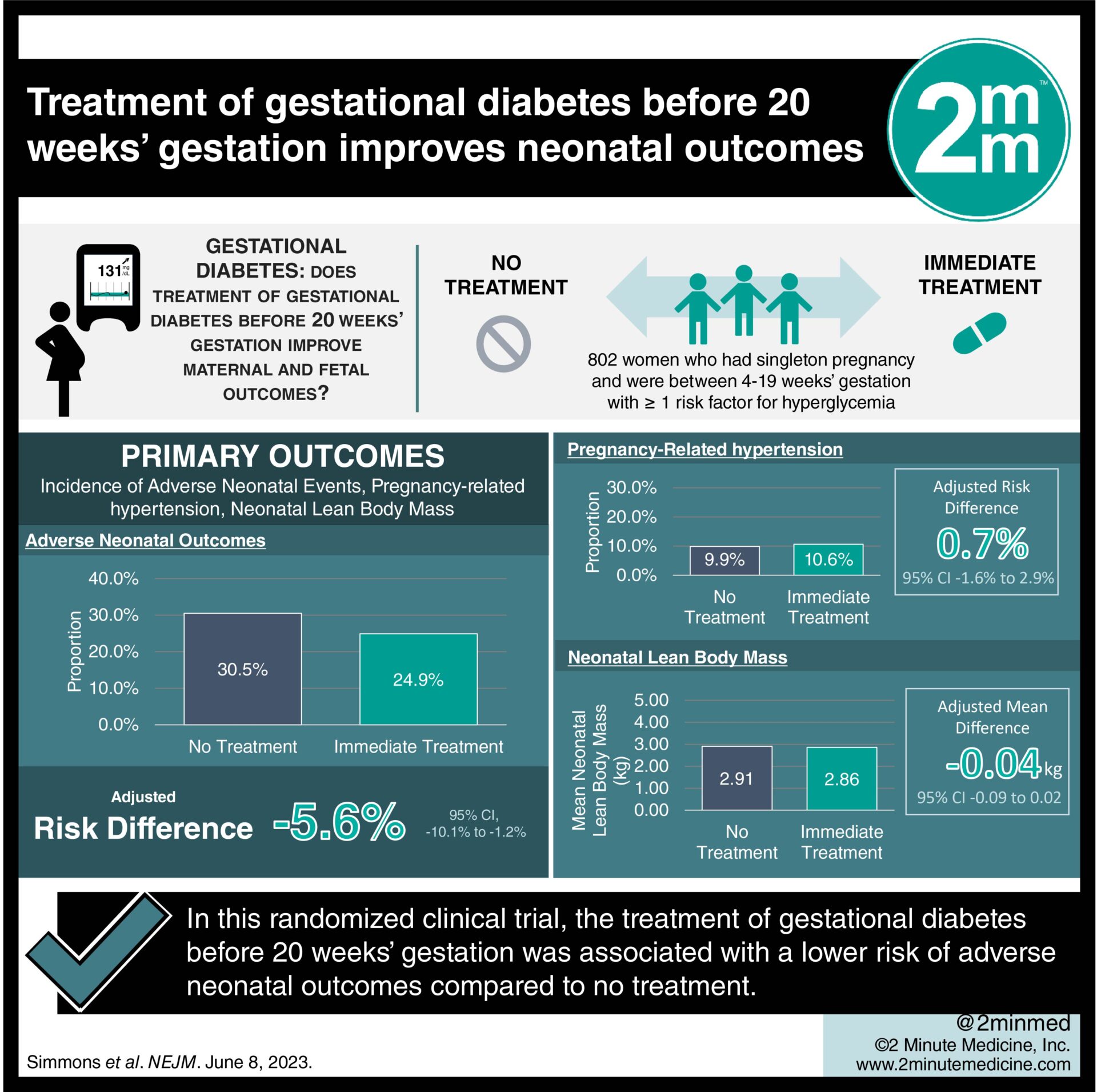
1. In this randomized controlled trial, the treatment of gestational diabetes before 20 weeks’ gestation was associated with a lower risk of adverse neonatal outcomes compared to no treatment. 

2. There was no significant difference between treatment and no treatment with respect to maternal hypertension or neonatal lean body mass.

Evidence Rating Level: 1 (Excellent)

Study Rundown: Gestational diabetes occurs when the human body is unable to make sufficient amounts of insulin, resulting in high blood glucose levels. The primary concern with gestational diabetes is an increased risk of both maternal and fetal adverse events. Specifically, an increased risk of large-for-gestational-age infants, shoulder dystocia, and birth trauma. The current recommendations for screening and treatment of gestational diabetes focus on the period of 24 to 28 weeks’ gestation. There is interest in testing earlier in pregnancy for pregnant individuals who may be at higher risk for gestational diabetes. Notably, robust data demonstrating its benefits are currently lacking. This multicenter, randomized controlled trial evaluated the maternal and fetal outcomes of screening and initiating treatment for gestational diabetes before 20 weeks’ gestation. The primary results of the analysis found that there was a marginal improvement in the incidence of adverse neonatal outcomes, such as respiratory distress. Though, there was no significant difference in maternal high blood pressure or neonatal lean body mass. The major limitation was the duration of follow-up and the definition of early gestational diabetes. Further, there was non-standardization of treatment approaches across the various centers, and the results of the study cannot be generalized to patients without risk factors for hyperglycemia. In summary, this was a positive study that provided evidence of the benefit of early screening and treatment of gestational diabetes.

Click here to read the study in NEJM

RELATED REPORTS

Deep-learning model achieved high diagnostic performance for diabetic macular edema detection using optical coherence tomography (OCT) scans

Cataract surgery is associated with increased incidence of diabetic retinopathy among patients with diabetes

Foundayo (Orforglipron) Approval Marks the Beginning of the Oral GLP-1 Era for Obesity Treatment

In-Depth [randomized controlled trial]: This was a randomized controlled trial evaluating the effect of starting treatment for gestational diabetes prior to 20 weeks’ gestation on maternal and fetal outcomes. The primary outcome of interest was the incidence of adverse neonatal events, pregnancy-related hypertension, and neonatal lean body mass. Adult women who had a singleton pregnancy and were between four and 19 weeks’ gestation with at least one risk factor for hyperglycemia were included. Women who met the criteria for gestational diabetes as determined by the World Health Organization criteria were included. Women who had preexisting diabetes, high fasting glucose level, a high two-hour glucose level, or contraindications to participation as determined by local investigators were excluded. In total, 802 participants were randomized in a 1:1 ratio to immediate treatment for gestational diabetes (n=406) or a no-treatment control group (n=396). The primary analysis of the results found that the incidence of adverse neonatal outcomes was significantly lower in the immediate-treatment group compared to the control group (adjusted risk difference, -5.6 percentage points; 95% Confidence Interval [CI], -10.1 to -1.2). There was no significant difference in outcomes as it pertained to pregnancy-related hypertension or neonatal lean body mass. Though,, there was a significant difference in the incidence of severe peroneal injury which was higher in the control group (adjusted mean difference, -2.8 percentage points; 95% CI, -4.1 to -1.5). Overall, this study found that treatment of gestational diabetes early in the gestational age lead to a marginal improvement in incidence of adverse neonatal outcomes compared to no treatment, with the major cause of this effect due to neonatal respiratory distress.


©2023 2 Minute Medicine, Inc. All rights reserved. No works may be reproduced without expressed written consent from 2 Minute Medicine, Inc. Inquire about licensing here. No article should be construed as medical advice and is not intended as such by the authors or by 2 Minute Medicine, Inc.


Tags: diabetesgestationalDMneonatal outcomespregnancypregnancy outcomes
Previous Post

Physical activity may improve the reproductive function in women with polycystic ovarian syndrome

Next Post

Transcatheter repair of mitral regurgitation secondary to cardiomyopathy is safe and effective

RelatedReports

Endocrinology

Deep-learning model achieved high diagnostic performance for diabetic macular edema detection using optical coherence tomography (OCT) scans

September 10, 2026
Adalimumab aids in control of noninfectious uveitis
Chronic Disease

Cataract surgery is associated with increased incidence of diabetic retinopathy among patients with diabetes

September 8, 2026
Cost-related medication nonadherence associated with increased ED utilization
Pharma

Foundayo (Orforglipron) Approval Marks the Beginning of the Oral GLP-1 Era for Obesity Treatment

September 4, 2026
Weekly Rewinds

2 Minute Medicine Rewind June 29, 2026

June 29, 2026
Next Post
Quick Take: Left ventricular mechanical dispersion predicts arrhythmic risk in mitral valve prolapse

Transcatheter repair of mitral regurgitation secondary to cardiomyopathy is safe and effective

#VisualAbstract: Comparison between hydroxychloroquine and systemic corticosteroids in IgA nephropathy

#VisualAbstract: Comparison between hydroxychloroquine and systemic corticosteroids in IgA nephropathy

Compliance-linked incentives increase infant immunizations rates in rural India

Meningococcal NmCV-5 Vaccine is effective in 2-to-29-year-olds in Mali and Gambia

EvidencePulse™ by 2 Minute Medicine 2026 evidence scan 3 reports You asked top stroke trials 2026 Synthesizing medical evidence... Top 2026 stroke trial results: OCEANIC — ischemic stroke: 6.2% vs 8.4% OPTION* — mRS 0–1: 43.6% vs 34.2% ORIENTAL* — mRS 0–2: 58.6% vs 46.6% *Higher sICH in intervention arms Participants randomizedN OCEANIC 12,327 OPTION 570 ORIENTAL 564 Ask about guidelines or landmark trials... ↑ Try EvidencePulse™ Ask the evidence.
Get the signal.
Try it now → Physician-trained medical AI by 2 Minute Medicine

2MM+ All Access

Full details →
$4.99 /month

5-day free trial · cancel anytime

  • ✓100+ physician-written reports
  • ✓EvidencePulse™ + HypeCheck™
  • ✓Ad-free reading + newsletters
Start 5-day free trial

Then $4.99/month. Manage renewal in your account.

2 Minute Medicine® is an award winning, physician-run, expert medical media company. Our content is curated, written and edited by practicing health professionals who have clinical and scientific expertise in their field of reporting. Our editorial management team is comprised of highly-trained MD physicians. Join numerous brands, companies, and hospitals who trust our licensed content.

Recent Reports

  • Deficits in executive function are not universal among patients with alcohol use disorder
  • Choice of bicarbonate-buffered solution versus compound sodium lactate as the intraoperative crystalloid solution during abdominal surgery remains unclear
  • Artificial intelligence (AI)-based coronary calcium quantification successfully identified patients who could benefit from lipid-lowering therapy
License Content
Terms of Use | Disclaimer
Cookie Policy
Cleantalk Pixel
2MM+ All Access Full details →

The medical literature, distilled daily.

Monthly plan selected: $4.99 /month.

$4.99/month

5-day free trial · cancel anytime

Start 5-day free trial

Then $4.99/month. Manage renewal in your account.

Yearly plan selected: $49.90 /year.

$49.90/year

2 months free · only $4.16/month

Start 5-day free trial

Then $49.90/year. Manage renewal in your account.

Membership benefits

  • ✓100+ physician-written reports
  • ✓AI EvidencePulse™ + HypeCheck™
  • ✓Ad-free reading + newsletters

Already a member? Sign in

  • About
  • Specialties
    • All Specialties, All Recent Reports
    • Cardiology
    • Chronic Disease
    • Dermatology
    • Emergency
    • Endocrinology
    • Gastroenterology
    • Imaging and Intervention
    • Infectious Disease
    • Nephrology
    • Neurology
    • Obstetrics
    • Oncology
    • Ophthalmology
    • Pediatrics
    • Pharma
    • Preclinical
    • Psychiatry
    • Public Health
    • Pulmonology
    • Rheumatology
    • Surgery
  • Tools
    • EvidencePulse™
    • HypeCheck™
    • NPI Registry Lookup
    • RVU Search
  • Pharma
  • AI Roundup
  • The Scan
  • Classics™
    • 2MM+ Online Access
    • Paperback and Ebook
  • Rewinds
  • Partners
    • License Content
    • Submit Press Release
    • Advertise with Us
  • Account
    • Subscribe
    • My account
    • Cart
    • Sign-in
No Result
View All Result

© 2026 2 Minute Medicine, Inc. - Physician-written medical news.