• About
  • Masthead
  • License Content
  • Advertise
  • Submit Press Release
  • RSS/Email List
  • 2MM Podcast
  • Write for us
  • Contact Us
2 Minute Medicine
No Result
View All Result

No products in the cart.

SUBSCRIBE
  • About
  • Specialties
    • All Specialties, All Recent Reports
    • Cardiology
    • Chronic Disease
    • Dermatology
    • Emergency
    • Endocrinology
    • Gastroenterology
    • Imaging and Intervention
    • Infectious Disease
    • Nephrology
    • Neurology
    • Obstetrics
    • Oncology
    • Ophthalmology
    • Pediatrics
    • Pharma
    • Preclinical
    • Psychiatry
    • Public Health
    • Pulmonology
    • Rheumatology
    • Surgery
  • Tools+
    • EvidencePulse™
    • HypeCheck™
    • NPI Registry Lookup
    • RVU Search
  • Pharma
  • AI Roundup
  • The Scan+
  • Classics™+
    • 2MM+ Online Access
    • Paperback and Ebook
  • Rewinds
  • Partners
    • License Content
    • Submit Press Release
    • Advertise with Us
  • Account
    • Subscribe
    • My account
    • Cart
    • Sign-in
2 Minute Medicine
  • About
  • Specialties
    • All Specialties, All Recent Reports
    • Cardiology
    • Chronic Disease
    • Dermatology
    • Emergency
    • Endocrinology
    • Gastroenterology
    • Imaging and Intervention
    • Infectious Disease
    • Nephrology
    • Neurology
    • Obstetrics
    • Oncology
    • Ophthalmology
    • Pediatrics
    • Pharma
    • Preclinical
    • Psychiatry
    • Public Health
    • Pulmonology
    • Rheumatology
    • Surgery
  • Tools+
    • EvidencePulse™
    • HypeCheck™
    • NPI Registry Lookup
    • RVU Search
  • Pharma
  • AI Roundup
  • The Scan+
  • Classics™+
    • 2MM+ Online Access
    • Paperback and Ebook
  • Rewinds
  • Partners
    • License Content
    • Submit Press Release
    • Advertise with Us
  • Account
    • Subscribe
    • My account
    • Cart
    • Sign-in
SUBSCRIBE
2 Minute Medicine
Subscribe
EvidencePulse™ by 2 Minute Medicine 2026 evidence scan 3 reports You asked top stroke trials 2026 Synthesizing medical evidence... Top 2026 stroke trial results: OCEANIC — ischemic stroke: 6.2% vs 8.4% OPTION* — mRS 0–1: 43.6% vs 34.2% ORIENTAL* — mRS 0–2: 58.6% vs 46.6% *Higher sICH in intervention arms Participants randomizedN OCEANIC 12,327 OPTION 570 ORIENTAL 564 Ask about guidelines or landmark trials... ↑ Try EvidencePulse™ Ask the evidence.
Get the signal.
Try it now → Physician-trained medical AI by 2 Minute Medicine
Home All Specialties Chronic Disease

Adulthood Atopic Dermatitis Associated With Venous Thromboembolism
byAliyah KingandYuchen Dai
June 9, 2023
in Chronic Disease, Dermatology, Hematology
Reading Time: 3 mins read
Topical pimecrolimus use for atopic dermatitis not linked to malignancy
Share on FacebookShare on Twitter

1. Adulthood atopic dermatitis (AD) was significantly associated with an increased risk of venous thromboembolism (VTE); however, the absolute risk was small.

2. Vascular examination and consultation involving various specialties (e.g., emergency department, cardiologists, pulmonologists, etc.) are indicated for patients with AD experiencing common VTE symptoms (e.g., unexplained dyspnea, chest tightness, and limb swelling). 

Evidence Rating Level: 2 (Good)         

Study Rundown: Atopic dermatitis (AD) is a chronic immune-mediated inflammatory skin condition. AD is associated with sleep disturbances, increased risk of cardiovascular disease, and an overall decreased quality of life. Venous thromboembolism (VTE) is a vascular disease comprised of deep vein thrombosis (DVT) and pulmonary embolism (PE). Both AD and VTE result in patients having high levels of inflammatory and prothrombotic markers. Despite this similarity, seldom studies have investigated the association between AD and VTE in adulthood. Therefore, this retrospective study aimed to evaluate the risk of VTE among patients with AD. The absolute risk difference of VTE between adults with and without AD was small; however, AD in adulthood was found to have a significantly increased risk of incident DVT, PE, and VTE. A strength of this study is the large nationwide database. A limitation of this study includes the lack of comorbidity, lifestyle factor, and laboratory result analyses. Other potential limitations include ICD misclassification, the use of non-valid measures to assess AD severity, and the exclusion of persistent AD. 

Click to read the study in JAMA Dermatology

Relevant Reading: Association of risk of incident venous thromboembolism with atopic dermatitis and treatment with Janus kinase inhibitors: A systematic review and meta-analysis

RELATED REPORTS

Atopic dermatitis activity is not associated with cardiovascular risk

Apixaban reduces bleeding risk versus rivaroxaban in acute venous thromboembolism

Artificial intelligence-guided ultrasound lacks sufficient accuracy for deep vein thrombosis detection

In-Depth [retrospective cohort]: All data for this nationwide retrospective cohort study was derived from Taiwan’s National Health Insurance Research Database (NHIRD), which encompasses approximately 23.6 million patient health records. Patients were included in the exposed (AD) cohort if they were 20 years or older, within the NHIRD between January 1, 2003, and December 31, 2017, and diagnosed with AD by a dermatologist or rheumatologist. A diagnosis of AD was defined by 3 or more outpatient appointments concerning AD within 1 year or a discharge diagnosis using ICD-9-CM code 691.8 and ICD-10-CM code L20. Patients were included in the unexposed (non-AD) cohort if they were in NHIRD, 20 years or older, and did not have an AD diagnosis between 2000 and 2018. Each patient with AD was randomly matched with a control patient from NHIRD based on matching age, sex, and index date. Exclusion criteria included any AD diagnoses before 2003 and patients with any record of VTE before the index date. Hazard ratios (HR) for incident VTE associated with AD, the main outcome of this study, were evaluated using Cox proportional hazard models. In total, 284,858 patients were included in this study, with 142,429 in the AD group (mean [SD] age, 44.9 [18.3] years; 78,213 women) and 142,429 in the non-AD group (mean [SD] age, 44.1 [18.1] years; 79,636 women). More patients in the AD group developed VTE compared to the non-AD group (0.7% and 0.6%, respectively). Furthermore, adults with AD had significantly increased incident VTE risk (HR, 1.28; 95% Cl, 1.17-1.40) compared to adults without AD. AD patients were also found to have higher risks of DVT (HR, 1.26; 95% Cl, 1.14-1.40) and PE (HR, 1.30; 95% Cl, 1.08-1.57), which both comprise VTE. Although the absolute risk difference of VTE between adults with and without AD was small, this study found an association between AD in adulthood and an increased risk of VTE.

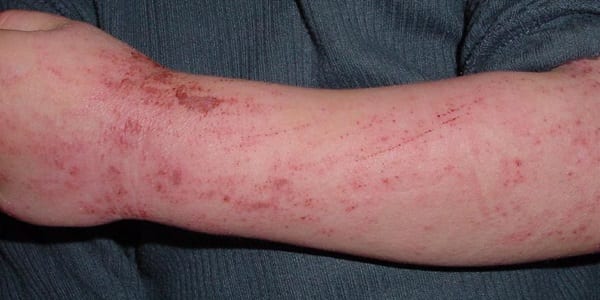
Image: PD

©2023 2 Minute Medicine, Inc. All rights reserved. No works may be reproduced without expressed written consent from 2 Minute Medicine, Inc. Inquire about licensing here. No article should be construed as medical advice and is not intended as such by the authors or by 2 Minute Medicine, Inc.
Tags: atopic dermatitisdeep vein thrombosis (DVT)pulmonary embolismvenous thromboembolism (VTE)
Previous Post

#VisualAbstract: Peresolimab reduces disease severity in adults with rheumatoid arthritis

Next Post

Bariatric metabolic surgery more effective than medical therapy and lifestyle modifications for non-alcoholic steatohepatitis

RelatedReports

Eczema more prevalent among older adults than previously thought
Cardiology

Atopic dermatitis activity is not associated with cardiovascular risk

April 2, 2026
siRNA against antithrombin alleviates symptoms of hemophilia [PreClinical]
Pharma

Apixaban reduces bleeding risk versus rivaroxaban in acute venous thromboembolism

March 23, 2026
Patient Basics: Ultrasound
2 Minute Medicine

Artificial intelligence-guided ultrasound lacks sufficient accuracy for deep vein thrombosis detection

August 22, 2025
#VisualAbstract: Dapagliflozin Reduced Death and Worsening Heart Failure in Transcatheter Aor-tic-Valve Implantation
StudyGraphics

#VisualAbstract: Reduced-Dose Apixaban was Noninferior to Full-Dose for Cancer-Associated Venous Thromboembolism

April 22, 2025
Next Post
Laparoscopic colon cancer management may be beneficial in elderly

Bariatric metabolic surgery more effective than medical therapy and lifestyle modifications for non-alcoholic steatohepatitis

Parental nonmedical prescription opioid use linked to adolescent use

Topical tranexamic acid may be an effective adjunctive analgesic post hip arthroplasty

Quick Take: Intravenous patient-controlled analgesia versus thoracic epidural analgesia after open liver surgery

2 Minute Medicine Rewind June 12, 2023

EvidencePulse™ by 2 Minute Medicine 2026 evidence scan 3 reports You asked top stroke trials 2026 Synthesizing medical evidence... Top 2026 stroke trial results: OCEANIC — ischemic stroke: 6.2% vs 8.4% OPTION* — mRS 0–1: 43.6% vs 34.2% ORIENTAL* — mRS 0–2: 58.6% vs 46.6% *Higher sICH in intervention arms Participants randomizedN OCEANIC 12,327 OPTION 570 ORIENTAL 564 Ask about guidelines or landmark trials... ↑ Try EvidencePulse™ Ask the evidence.
Get the signal.
Try it now → Physician-trained medical AI by 2 Minute Medicine

2MM+ All Access

Full details →
$4.99 /month

5-day free trial · cancel anytime

  • ✓100+ physician-written reports
  • ✓EvidencePulse™ + HypeCheck™
  • ✓Ad-free reading + newsletters
Start 5-day free trial

Then $4.99/month. Manage renewal in your account.

2 Minute Medicine® is an award winning, physician-run, expert medical media company. Our content is curated, written and edited by practicing health professionals who have clinical and scientific expertise in their field of reporting. Our editorial management team is comprised of highly-trained MD physicians. Join numerous brands, companies, and hospitals who trust our licensed content.

Recent Reports

  • Deficits in executive function are not universal among patients with alcohol use disorder
  • Choice of bicarbonate-buffered solution versus compound sodium lactate as the intraoperative crystalloid solution during abdominal surgery remains unclear
  • Artificial intelligence (AI)-based coronary calcium quantification successfully identified patients who could benefit from lipid-lowering therapy
License Content
Terms of Use | Disclaimer
Cookie Policy
Cleantalk Pixel
2MM+ All Access Full details →

The medical literature, distilled daily.

Monthly plan selected: $4.99 /month.

$4.99/month

5-day free trial · cancel anytime

Start 5-day free trial

Then $4.99/month. Manage renewal in your account.

Yearly plan selected: $49.90 /year.

$49.90/year

2 months free · only $4.16/month

Start 5-day free trial

Then $49.90/year. Manage renewal in your account.

Membership benefits

  • ✓100+ physician-written reports
  • ✓AI EvidencePulse™ + HypeCheck™
  • ✓Ad-free reading + newsletters

Already a member? Sign in

  • About
  • Specialties
    • All Specialties, All Recent Reports
    • Cardiology
    • Chronic Disease
    • Dermatology
    • Emergency
    • Endocrinology
    • Gastroenterology
    • Imaging and Intervention
    • Infectious Disease
    • Nephrology
    • Neurology
    • Obstetrics
    • Oncology
    • Ophthalmology
    • Pediatrics
    • Pharma
    • Preclinical
    • Psychiatry
    • Public Health
    • Pulmonology
    • Rheumatology
    • Surgery
  • Tools
    • EvidencePulse™
    • HypeCheck™
    • NPI Registry Lookup
    • RVU Search
  • Pharma
  • AI Roundup
  • The Scan
  • Classics™
    • 2MM+ Online Access
    • Paperback and Ebook
  • Rewinds
  • Partners
    • License Content
    • Submit Press Release
    • Advertise with Us
  • Account
    • Subscribe
    • My account
    • Cart
    • Sign-in
No Result
View All Result

© 2026 2 Minute Medicine, Inc. - Physician-written medical news.