

Patient Basics: Kidney Cancer
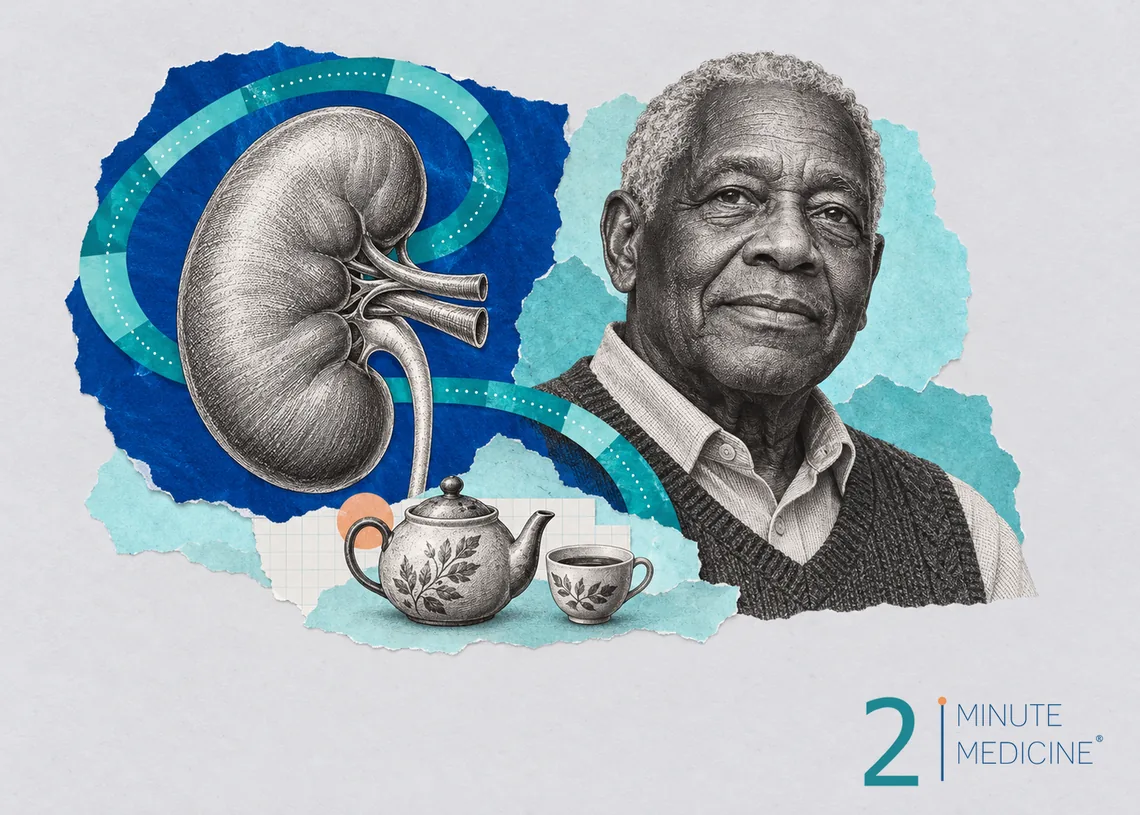
Kidney cancer is a cancer that starts in one of the kidneys, the two bean-shaped organs that filter your blood and make urine. Most kidney cancers cause no symptoms at first and are found by chance on a scan done for another reason. When it is found before it spreads, surgery or other local treatment cures most people.
Key points
- Renal cell carcinoma is the most common type in adults. Wilms tumor is a different kind that affects young children.
- Smoking, obesity, high blood pressure and long-term dialysis raise the risk.
- Blood in the urine, pain in the side or a lump in the belly can be signs, but many people have none.
- A CT scan is the main test. Many small kidney masses turn out not to be cancer.
- Small tumors can often be removed while keeping the rest of the kidney. Newer immune and targeted drugs help people whose cancer has spread.
Types of kidney cancer
- Renal cell carcinoma (RCC). About 9 in 10 kidney cancers. It starts in the tiny tubes that filter the blood. Clear cell is the most common subtype. Papillary and chromophobe are others.
- Urothelial carcinoma. This starts in the lining of the part of the kidney that collects urine (the renal pelvis). It behaves more like bladder cancer.
- Wilms tumor. A kidney cancer of young children, most often found around ages 3 to 4 as a swelling in the belly. With surgery and chemotherapy, about 9 in 10 children are cured.
What raises the risk of kidney cancer
- Smoking
- Obesity
- High blood pressure
- Long-term dialysis for kidney failure, which can cause cysts in the kidneys that sometimes turn into cancer
- A parent, brother or sister with kidney cancer
- Rare inherited conditions, such as von Hippel-Lindau disease
- Contact at work with certain chemicals, such as the solvent trichloroethylene
Kidney cancer is about twice as common in men as in women, and most people are over 55 when it’s found.
Symptoms
- Blood in the urine, which may look pink, red or cola-colored, or show up only on a urine test
- A dull pain in the side or lower back that doesn’t go away
- A lump or swelling in the side or belly
- Tiredness, weight loss, poor appetite or fevers with no clear cause
- A low red blood count (anemia)
- In men, a sudden cluster of swollen veins in the scrotum, usually on the left
These symptoms have many other causes, such as kidney stones or infection. Still, blood in the urine always needs a check.
Tests for kidney cancer
There is no routine screening test for people at average risk. People with an inherited condition or on long-term dialysis may get regular scans. If your doctor suspects a problem, tests may include:
- Urine and blood tests to look for blood in the urine, check kidney function and blood counts, and measure calcium.
- CT scan with contrast dye. This is the main test. A CT urogram, which also shows the tubes that drain the kidneys, has replaced an older X-ray test called an IVP (intravenous pyelogram).
- MRI if you can’t have CT dye or more detail is needed.
- Ultrasound, which helps tell a fluid-filled cyst from a solid mass.
- Biopsy. A thin needle takes a sample of the mass. It isn’t always needed, because scans are often clear enough, but it helps when the choice is between treatment and watching.
- Chest CT, and sometimes a bone scan, to see whether cancer has spread.
What a kidney mass can mean
A spot on the kidney (a renal lesion or mass) is a common finding. Most are simple cysts, which are harmless. Others are harmless solid growths, such as an angiomyolipoma or an oncocytoma. A solid mass or a cyst with thick walls is more likely to be cancer and needs follow-up with a specialist. About 1 in 5 small solid kidney masses turn out not to be cancer.
How kidney cancer is treated
Treatment depends on the size of the tumor, whether it has spread, your kidney function and your overall health.
Cancer that hasn’t spread
- Active surveillance. Small, slow-growing tumors, especially in older adults or people with other serious health problems, may be watched with scans every few months.
- Partial nephrectomy. The surgeon removes the tumor and keeps the rest of the kidney. This is preferred for most small tumors.
- Radical nephrectomy. The whole kidney is removed, often for larger tumors. Most people do well with one healthy kidney.
- Ablation. A needle placed through the skin freezes or heats a small tumor to destroy it.
Most kidney surgery is now done through small cuts with a camera, often robot-assisted. After surgery for some higher-risk cancers, a year of the immune drug pembrolizumab lowers the chance of the cancer coming back.
Cancer that has spread
- Immunotherapy. Drugs such as pembrolizumab, nivolumab and ipilimumab help the immune system attack the cancer. They are often combined with a targeted drug.
- Targeted drugs. Pills such as cabozantinib, axitinib, lenvatinib and belzutifan block signals the cancer needs to grow.
- Radiation. High-energy rays aimed at the cancer, often in a few precise, high doses. It is used for spots in the bones, spine or brain, and it eases pain.
- Surgery to remove the kidney or single areas of spread, for some people.
When kidney cancer spreads to the spine, doctors may combine radiation, surgery to protect the spinal cord, bone-strengthening drugs and immune or targeted drugs. Standard chemotherapy works poorly for most kidney cancers.
Outlook
When kidney cancer is found before it has spread, about 9 in 10 people are alive 5 years later, and many are cured. The outlook is less good once it has spread, but today’s drugs control the cancer for years in some people.
When to see a doctor
- You see blood in your urine, even once
- You have side or back pain that doesn’t go away
- You notice a lump in your side or belly
- You lose weight without trying or have ongoing fevers
Common questions about kidney cancer
Is kidney cancer rare?
No. It is one of the more common cancers in US adults, with about 80,000 new cases each year. It is more common in men and in people over 55. Because so many scans are done today, more kidney cancers are found early and small.
Can you live a normal life after a partial nephrectomy?
Yes. Most people return to their usual activities within about 4 to 6 weeks. For small cancers, a partial nephrectomy often cures the cancer, and life expectancy is usually close to that of people the same age without cancer. You’ll have follow-up scans and kidney blood tests for several years.
Will I need dialysis after kidney cancer surgery?
Most people don’t. One healthy kidney can do the work of two. Dialysis may be needed if both kidneys are affected, if you already have serious kidney disease, or if your only kidney is removed. Dialysis cleans the blood but does not treat cancer.
Are the tests for kidney cancer the same as for bladder cancer?
They overlap. Both can cause blood in the urine, so a check often includes a CT urogram and a camera look inside the bladder (cystoscopy). A CT scan is the key test for kidney cancer. Cystoscopy and a urine test for cancer cells are the key tests for bladder cancer.
Questions to ask your doctor
- What type and stage of kidney cancer do I have?
- Could my tumor be watched instead of treated right away?
- Can you remove just the tumor and save my kidney?
- How will treatment affect my kidney function?
- Should I have genetic testing for an inherited condition?
Learn more
- Kidney (renal cell) cancer (National Cancer Institute)
- Kidney cancer (MedlinePlus, U.S. National Library of Medicine)
This guide is general information and doesn’t replace advice from your own doctor. Last updated October 2026.
RelatedReports








 Get the app