• About
  • Masthead
  • License Content
  • Advertise
  • Press Releases
  • Newsroom
  • RSS/Email List
  • 2MM Podcast
  • Write for us
  • Contact Us
2 Minute Medicine
No Result
View All Result

No products in the cart.

Sign in
SUBSCRIBE
  • About
  • Specialties
    • All Specialties, All Recent Reports
    • Cardiology
    • Chronic Disease
    • Dermatology
    • Emergency
    • Endocrinology
    • Gastroenterology
    • Imaging and Intervention
    • Infectious Disease
    • Nephrology
    • Neurology
    • Obstetrics
    • Oncology
    • Ophthalmology
    • Pediatrics
    • Pharma
    • Preclinical
    • Psychiatry
    • Public Health
    • Pulmonology
    • Rheumatology
    • Surgery
    • Rewinds
    • The Scan
  • EvidencePulse™
  • HypeCheck™
  • AI News
  • Classics™
    • 2MM+ Online Access
    • Paperback and Ebook
  • Tools
    • NPI Registry Lookup
    • RVU Search
    • Physician Pay by Specialty
    • ICD-10 Code Lookup
    • FDA Drug Approvals
    • Drug Safety for Breastfeeding/Pregnancy
    • Clinical Guidelines
    • Medical Calculators
    • ECG Reference
      • QTc Calculator
      • Sgarbossa Criteria
      • ECG Axis Calculator
      • AV Block Helper
  • Rankings
    • Medical School Rankings
    • Residency Rankings
  • Partners
    • License Content
    • Advertise with Us
2 Minute Medicine
  • About
  • Specialties
    • All Specialties, All Recent Reports
    • Cardiology
    • Chronic Disease
    • Dermatology
    • Emergency
    • Endocrinology
    • Gastroenterology
    • Imaging and Intervention
    • Infectious Disease
    • Nephrology
    • Neurology
    • Obstetrics
    • Oncology
    • Ophthalmology
    • Pediatrics
    • Pharma
    • Preclinical
    • Psychiatry
    • Public Health
    • Pulmonology
    • Rheumatology
    • Surgery
    • Rewinds
    • The Scan
  • EvidencePulse™
  • HypeCheck™
  • AI News
  • Classics™
    • 2MM+ Online Access
    • Paperback and Ebook
  • Tools
    • NPI Registry Lookup
    • RVU Search
    • Physician Pay by Specialty
    • ICD-10 Code Lookup
    • FDA Drug Approvals
    • Drug Safety for Breastfeeding/Pregnancy
    • Clinical Guidelines
    • Medical Calculators
    • ECG Reference
      • QTc Calculator
      • Sgarbossa Criteria
      • ECG Axis Calculator
      • AV Block Helper
  • Rankings
    • Medical School Rankings
    • Residency Rankings
  • Partners
    • License Content
    • Advertise with Us
Sign in
SUBSCRIBE
2 Minute Medicine
Sign in
Subscribe
2 Minute MedicineFree on Google PlayGet
✦EvidencePulse™by 2 Minute Medicine3 reportsYou askedtop stroke trials 2026Synthesizing medical evidence...Top 2026 stroke trial results:OCEANIC — ischemic stroke: 6.2% vs 8.4%OPTION* — mRS 0–1: 43.6% vs 34.2%ORIENTAL* — mRS 0–2: 58.6% vs 46.6%*Higher sICH in intervention armsParticipants randomizedNOCEANIC12,327OPTION570ORIENTAL564Ask about guidelines or landmark trials...↑Try EvidencePulse™Ask the evidence. Get the signal.Try it now →
Home Health A to Z

Patient Basics: Nephrectomy (Kidney Removal Surgery)
by2 Minute Medicine
October 30, 2026
in Health A to Z
Reading Time: 5 mins read
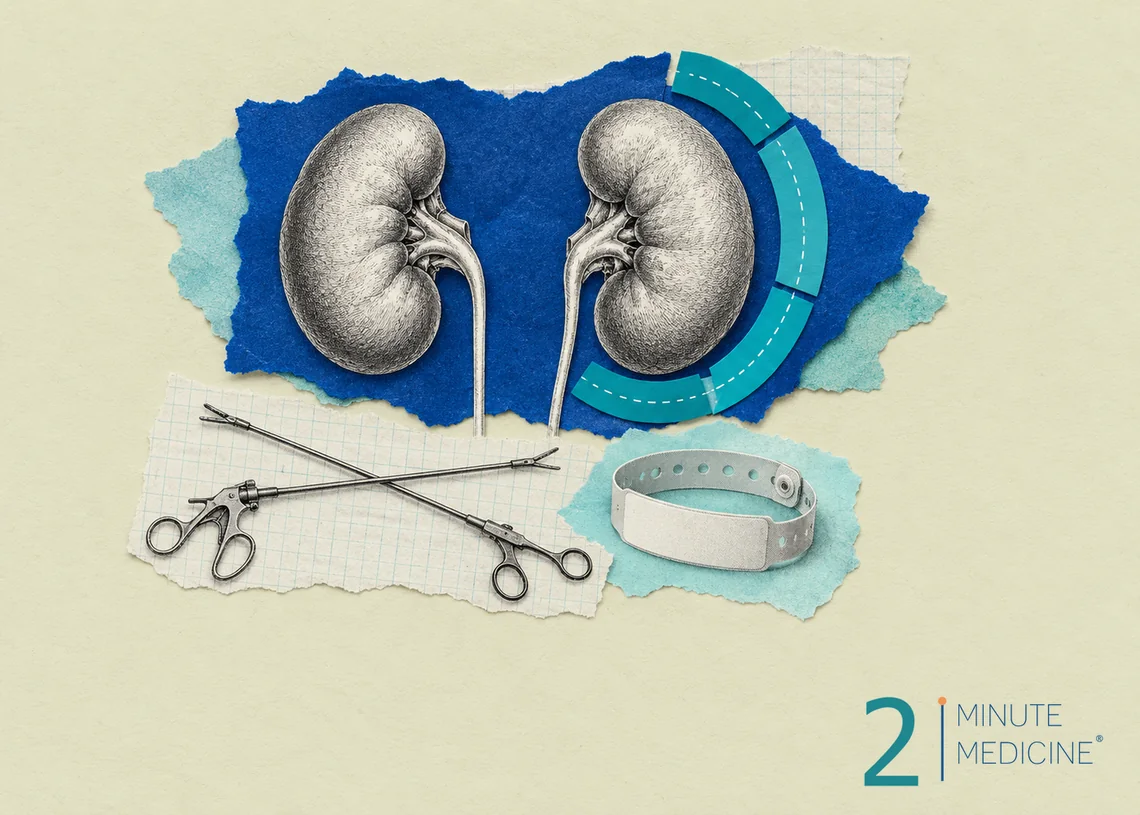
Collage of two kidneys, one outlined in teal for a nephrectomy, with slim surgical tools and a blank wristband
Share on FacebookShare on TwitterShare on LinkedIn

A nephrectomy (kidney removal surgery) is an operation to remove a kidney, or part of one. The most common reason is kidney cancer. Other reasons include a kidney damaged beyond repair and giving a kidney to someone who needs a transplant. Most people live a full, normal life with one healthy kidney.

Key points

  • A partial nephrectomy removes only the diseased part of the kidney. A radical nephrectomy removes the whole kidney and the tissue around it.
  • Most nephrectomies are now done through a few small cuts using a camera, often with a robotic system.
  • Expect to stay in the hospital 1 to 3 days after keyhole surgery, and longer after open surgery.
  • Avoid heavy lifting for several weeks while you heal.
  • Afterward, regular checks of your blood pressure and kidney function help protect the kidney you have left.

Why a nephrectomy is done

  • Kidney cancer. Small tumors are often treated with a partial nephrectomy to save as much healthy kidney as possible. Larger tumors may need the whole kidney removed.
  • A kidney that no longer works and causes problems, such as pain, repeated infections or high blood pressure. This can follow a long-term blockage, large kidney stones or an injury.
  • Living kidney donation. A healthy person gives one kidney to someone with kidney failure.
  • Polycystic kidney disease, in some cases, when very large kidneys cause pain or leave no room for a transplant.
  • Wilms tumor, a kidney cancer that affects young children.

Types of nephrectomy

  • Partial nephrectomy. Only the tumor or damaged area is cut out, with a rim of normal tissue, and the kidney is stitched closed.
  • Simple nephrectomy. The whole kidney is removed, often because it has stopped working.
  • Radical nephrectomy. The whole kidney comes out along with its layer of fat. Sometimes the adrenal gland, a small hormone gland perched above the kidney, and nearby lymph nodes come out too. This is done for cancer.

Most operations are laparoscopic or robot-assisted. The surgeon makes 3 to 5 small cuts and works with a camera and long, thin tools. Recovery is usually faster and less painful than with open surgery, which uses one longer cut on the side or belly. Open surgery may be needed for very large tumors or cancer that has grown into nearby veins. Now and then, a keyhole operation has to switch to an open one partway through.

Before surgery

  • You’ll have blood and urine tests and a CT or MRI scan. Some people also have a nuclear scan that measures how much work each kidney does.
  • Tell your surgeon about every medicine and supplement you take. Blood thinners, aspirin, some diabetes medicines and some herbal products may need to be stopped or changed.
  • If you smoke, stop, ideally several weeks ahead. This lowers the risk of wound and lung problems.
  • Follow the instructions about when to stop eating and drinking.
  • Arrange for help at home for the first week or two.

During surgery

You’ll be fully asleep under general anesthesia, usually lying on your side with the kidney side up and the table bent slightly to open the space between your ribs and hip. A thin tube (catheter) drains urine from your bladder during and after the operation. Surgery often takes 2 to 4 hours, and a partial nephrectomy can take longer.

Recovery after a nephrectomy

In the hospital, you’ll get pain medicine and be asked to walk the same day or the next. Walking and deep-breathing exercises lower the risk of blood clots and pneumonia. The bladder catheter usually comes out within a day or two. After keyhole surgery, most people go home in 1 to 3 days. After open surgery, the stay may be closer to a week.

At home:

  • Walk a little more each day.
  • Don’t lift anything heavier than about 10 pounds for 4 to 6 weeks, or for as long as your surgeon advises.
  • Don’t drive while you’re taking opioid pain medicine.
  • Expect some shoulder pain for a day or two after keyhole surgery. It comes from the gas used to inflate the belly during the operation.
  • Many people return to desk work in 2 to 4 weeks. Heavy physical work takes longer. Most people are back to their usual activities in about 6 weeks after keyhole surgery, and later after open surgery.

Possible risks

  • Bleeding, sometimes needing a blood transfusion
  • Infection of the wound or urinary tract
  • Blood clots in the legs or lungs
  • Injury to nearby organs, such as the bowel, spleen, liver or pancreas
  • Urine leaking from the kidney after a partial nephrectomy
  • A hernia at the cut, more likely after open surgery
  • Lower kidney function, especially if the other kidney isn’t healthy

Living with one kidney

The kidney that’s left grows a little and takes on more of the work. Overall kidney function usually settles somewhat lower than before, but for most people it stays in a healthy range.

RELATED REPORTS

Nivolumab plus ipilimumab does not improve survival in post-nephrectomy patients with renal cell carcinoma

#VisualAbstract: Pembrolizumab after nephrectomy improves survival in renal-cell carcinoma patients

  • Have your blood pressure, kidney blood tests and urine checked as often as your doctor advises, often once a year.
  • Keep blood pressure and diabetes under control, and stay at a healthy weight.
  • Ask your doctor before taking ibuprofen, naproxen or other NSAIDs often, since they can harm the kidneys.
  • Tell any doctor that you have one kidney before you start a new medicine or have a scan with contrast dye.
  • Ask whether contact sports are safe for you.

If your surgery was for cancer, you’ll also have follow-up scans for several years.

When to call your doctor

  • Fever of 100.4°F (38°C) or higher, or chills
  • Redness, swelling, pus or growing pain at a cut
  • Nausea or vomiting that won’t stop, or you can’t eat or drink
  • Very little urine, or blood in your urine that doesn’t clear
  • Swelling or pain in one leg

Call 911 for chest pain or sudden shortness of breath.

Common questions about nephrectomy

What does nephrectomy mean?

Nephrectomy means surgery to take out a kidney. The word joins nephr-, from the Greek word for kidney, with -ectomy, which means cutting out. A partial nephrectomy removes part of the kidney, a simple one removes the whole kidney, and a radical one also takes the fat around it.

Is a kidney removed from the front or the back?

Usually through the side or the front of the belly. Keyhole and robotic surgery use a few small cuts on the belly and side, and open surgery uses one longer cut on the side or front. Some surgeons reach the kidney through small cuts in the back instead.

What is the process for donating a kidney?

Living donors first go through weeks to months of testing, including blood and urine tests, scans, heart checks and talks with a mental health professional and a donor advocate. The surgery is usually a keyhole nephrectomy. Most donors go home in 1 to 3 days and return to normal activities within about 6 weeks.

Questions to ask your doctor

  • Can I have a partial nephrectomy instead of losing the whole kidney?
  • Will you operate through small cuts or one larger cut?
  • How well is my other kidney working?
  • How long will I need off work?
  • What follow-up visits and tests will I need?

Learn more

  • Kidney removal (MedlinePlus Medical Encyclopedia)

This guide is general information and doesn’t replace advice from your own doctor. Last updated October 2026.

Tags: Nephrectomy
Previous Post

Patient Basics: Ovarian Cancer

Next Post

Patient Basics: Neuroblastoma

RelatedReports

Tenofovir disoprovil fumarate HIV prophylaxis linked with minimal kidney impact
Chronic Disease

Nivolumab plus ipilimumab does not improve survival in post-nephrectomy patients with renal cell carcinoma

March 21, 2023
#VisualAbstract: Pembrolizumab after nephrectomy improves survival in renal-cell carcinoma patients
StudyGraphics

#VisualAbstract: Pembrolizumab after nephrectomy improves survival in renal-cell carcinoma patients

October 13, 2021
Radiographic surrogates may predict tumor-specific survival in renal carcinoma
Nephrology

Pembrolizumab after nephrectomy improves survival in renal-cell carcinoma patients

October 4, 2021
Chronic Disease

Regional variation in CT imaging is associated with nephrectomy risk

January 3, 2018
Next Post
Collage on myositis: a middle-aged woman, a bundle of muscle fibers, a light hand weight, a short stair and a blood tube

Patient Basics: Myositis

Collage for nabothian cysts: small pearls on a pale paper disc, a magnifying glass, a clinic gown on a hook and a swab

Patient Basics: Nabothian Cysts

Narcolepsy collage: a young man dozing against a pillow, a blank-faced alarm clock and a paper crescent moon

Patient Basics: Narcolepsy

✦ EvidencePulse™ by 2 Minute Medicine 3 reports You asked top stroke trials 2026 Synthesizing medical evidence... Top 2026 stroke trial results: OCEANIC — ischemic stroke: 6.2% vs 8.4% OPTION* — mRS 0–1: 43.6% vs 34.2% ORIENTAL* — mRS 0–2: 58.6% vs 46.6% *Higher sICH in intervention arms Participants randomizedN OCEANIC 12,327 OPTION 570 ORIENTAL 564 Ask about guidelines or landmark trials... Try EvidencePulse™ Get the signal. Try it now → Physician-trained medical AI by 2 Minute Medicine

2MM+ All Access

Full details →
$4.99 /month

3-day free trial · cancel anytime

  • ✓100+ physician-written reports
  • ✓EvidencePulse™ + HypeCheck™
  • ✓Ad-free reading + newsletters
Start 3-day free trial

Then $4.99/month. Manage renewal in your account.

2 Minute Medicine® is an award winning, physician-run, expert medical media company. Our content is curated, written and edited by practicing health professionals who have clinical and scientific expertise in their field of reporting. Our editorial management team is comprised of highly-trained MD physicians. Join numerous brands, companies, and hospitals who trust our licensed content.

Recent Reports

  • Percutaneous nephrolithotomy and flexible ureteroscopy may have similar outcomes in pediatric nephrolithiasis
  • Cannabis use, including smoked or edible, linked to higher stroke risk
  • Ivonescimab plus chemotherapy produced major and complete pathological responses in resectable NSCLC in a phase II study
License Content
Terms of Use | Disclaimer
Cookie Policy

Get the app

Read 2 Minute Medicine on iPhone, iPad and Android.

Download on the App StoreGet it on Google Play
QR code for www.2minutemedicine.com/app
On a computer? Scan this with your phone’s camera.
2MM+ All Access Full details →

The medical literature, distilled daily.

Monthly plan selected: $4.99 /month.

$4.99/month

3-day free trial · cancel anytime

Start 3-day free trial

Then $4.99/month. Manage renewal in your account.

Yearly plan selected: $49.90 /year.

$49.90/year

2 months free

Start 3-day free trial

Then $49.90/year.

Membership benefits

  • ✓100+ physician-written reports
  • ✓AI EvidencePulse™ + HypeCheck™
  • ✓Ad-free reading + newsletters
  • ✓FDA drug approvals + clinical calculators

Already a member? Sign in

  • Get the app
  • About
  • Specialties
    • All Specialties, All Recent Reports
    • Cardiology
    • Chronic Disease
    • Dermatology
    • Emergency
    • Endocrinology
    • Gastroenterology
    • Imaging and Intervention
    • Infectious Disease
    • Nephrology
    • Neurology
    • Obstetrics
    • Oncology
    • Ophthalmology
    • Pediatrics
    • Pharma
    • Preclinical
    • Psychiatry
    • Public Health
    • Pulmonology
    • Rheumatology
    • Surgery
    • Rewinds
    • The Scan
  • EvidencePulse™
  • HypeCheck™
  • AI News
  • Classics™
    • 2MM+ Online Access
    • Paperback and Ebook
  • Tools
    • NPI Registry Lookup
    • RVU Search
    • Physician Pay by Specialty
    • ICD-10 Code Lookup
    • FDA Drug Approvals
    • Drug Safety for Breastfeeding/Pregnancy
    • Clinical Guidelines
    • Medical Calculators
    • ECG Reference
      • QTc Calculator
      • Sgarbossa Criteria
      • ECG Axis Calculator
      • AV Block Helper
  • Rankings
    • Medical School Rankings
    • Residency Rankings
  • Partners
    • License Content
    • Advertise with Us
No Result
View All Result

© 2026 2 Minute Medicine, Inc. - Physician-written medical news.