

The 2 Minute Medicine Podcast Episode 29
November 30th 2023
Welcome to the 2 Minute Medicine Podcast, summarizing the latest medical studies, curated and written by practicing physicians. On this podcast, twice a month, we cover the latest in healthcare news and research evidence.
Our episode is live!
Episode Description
We begin this episode by discussing our article of the week from the New England Journal of Medicine, entitled “Sarilumab for Relapse of Polymyalgia Rheumatica during Glucocorticoid Taper”. Next, in the second half, we begin by discussing the UK’s approval of the first licensed medication using CRISPR technology. Next, we will dive into the American Heart Association’s decision to remove race as one of the biological risk factors for cardiovascular disease in their cardiac risk algorithm. Then we will discuss the news of NBA player CJ McCollum’s pneumothorax, and finally we will end with a conversation about a recent finding that the life expectancy gap between men and women has widened.
Click here to listen to this episode on Apple podcast
Click here to listen to this episode on Spotify
 Transcript
[Deepti] Welcome to the 2 Minute Medicine Podcast, summarizing the latest medical studies, curated and written by practicing physicians.
For our full suite of daily medical study summaries and updates written by practicing doctors, please visit our website at 2minutemedicine.com to start reading new daily content right now, for free. On this podcast, twice a month, we cover the latest in health care news and research evidence. We are your hosts Deepti and Andrew. On today’s episode, we’ll start off by discussing our two articles of the week. In the second half of the episode, we will look at health issues that have arisen in popular media.
[Andrew] Our article of the week comes from the New England Journal of Medicine and is entitled “Sarilumab for Relapse of Polymyalgia Rheumatica during Glucocorticoid Taper”.
Polymyalgia rheumatica (PMR) is an autoimmune condition that causes significant joint pain and discomfort. Glucocorticoid therapy is often used in this population. Yet, some patients have persistent active disease. This has led to studies investigating the efficacy of interleukin-6 (IL-6) antagonists in reducing disease activity. This phase III study explored the role of another IL-6 antagonist, sarilumab, in the treatment of PMR.
The Sarilumab in Patients with Polymyalgia Rheumatica (SAPHYR) trial is a phase III randomized controlled trial comparing the efficacy of sarilumab in inducing PMR remission as compared to a placebo. Patients who had at least one episode of disease flare during their glucocorticoid taper (daily dose 7.5 mg or greater) without any other inflammatory arthropathies were included. These patients were randomly assigned in a 1:1 ratio to either receive biweekly subcutaneous injections of sarilumab (200 mg) plus a 14-week prednisone taper (60 total patients) versus placebo plus a 52-week prednisone taper (58 total patients), with an initial daily prednisone dose of 15 mg.
The primary outcome was sustained remission at 52 weeks, defined by the resolution of signs and symptoms of PMR and normalization of C-reactive protein levels by week 12, as well as adherence to the prednisone taper from weeks 12-52. At week 52, 28% of the patients in the sarilumab group were found to be in sustained remission versus 10% of those in the placebo group, suggesting an 18% increase in remission rates (95% Confidence Interval, 4 to 32%; p=0.02). The median cumulative glucocorticoid dose was also found to be lower in the sarilumab group versus the placebo group (777 mg vs. 2044 mg; p<0.001). Moreover, despite utilizing a faster prednisone taper than that recommended by guidelines, the patients in the sarilumab group exhibited a decreased incidence of disease flare following remission and a decreased need for rescue glucocorticoid therapy.
Sarilumab was associated with increased rates of adverse events including neutropenia and diarrhea compared to placebo. This trial was terminated prematurely due to the coronavirus-19 pandemic leading to decreased sample size, limiting the statistical significance of the study and safety database of sarilumab.
[Andrew] Now for The Scan.
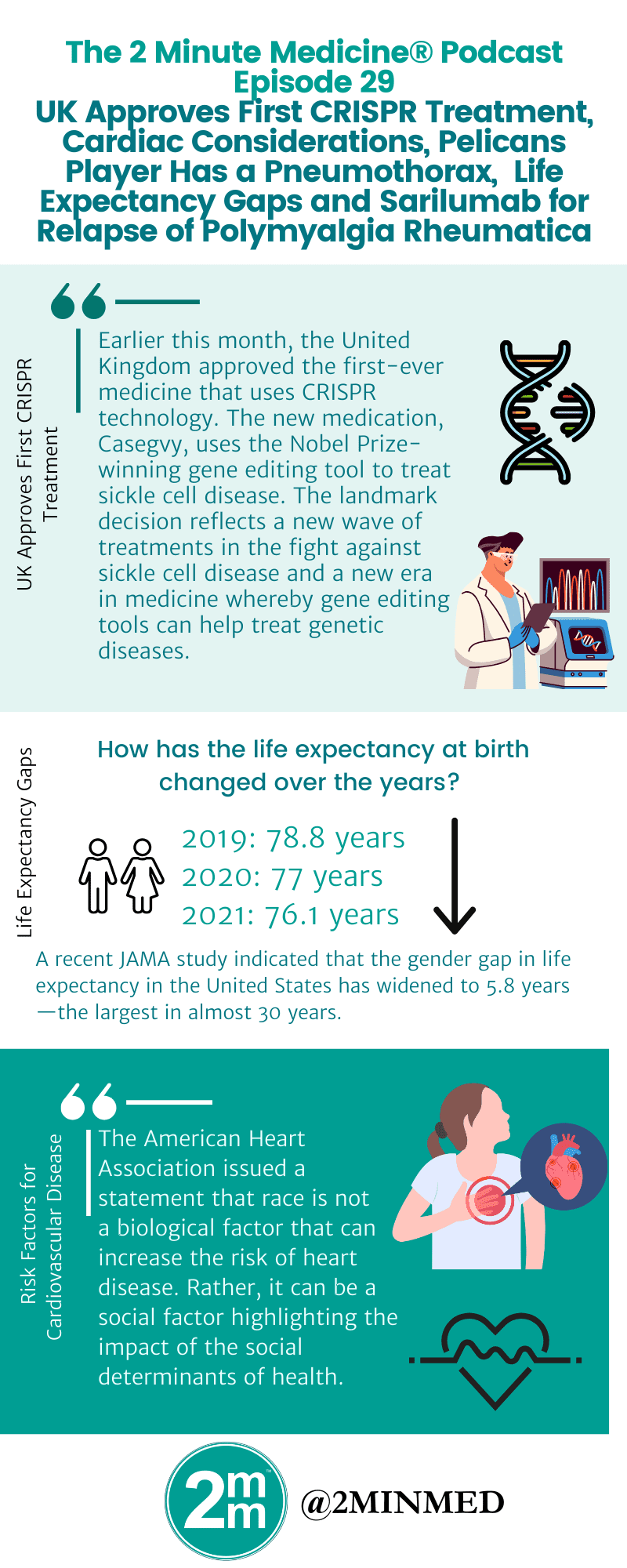
The Story: Earlier this month, the United Kingdom approved the first-ever medicine that uses CRISPR technology. The new medication, Casegvy, uses the Nobel Prize-winning gene editing tool to treat sickle cell disease. The landmark decision reflects a new wave of treatments in the fight against sickle cell disease and a new era in medicine whereby gene editing tools can help treat genetic diseases. Before we discuss genetic editing, let’s talk about sicke cell disease and what it is.
[Deepti]: Absolutely. In a nutshell, sickle cell disease is a genetic disorder that occurs when someone inherits two copies of the gene encoding for an abnormal hemoglobin protein. Hemoglobin is the main component of red blood cells that helps carry oxygen throughout the body. In sickle cell disease, red blood cells become C-shaped, or “sickled,” and breakdown much quicker than normal red blood cells, leading to anemia, and can block the flow of blood in small vessels, leading to symptoms such as pain, and vision problems, or serious complications such as stroke and organ damage. Complications of sickle cell disease can be life-threatening, and the life expectancy for those affected is significantly reduced compared to the rest of the population. However, the burden of disease is not distributed equally: it is the most common genetic disorder affecting African Americans, with 1 in 500 having the disease and 1 in 12 being a carrier of the mutation.
[Andrew] That’s right. The only known cure for sickle cell disease is a bone marrow transplant, which replaces the stem cells carrying the genes for the abnormal hemoglobin protein with healthy ones. However, finding a match for a bone marrow transplant can prove difficult, and complications such as graft versus host disease, where the transplanted cells attack the recipient’s cells, make the cure less feasible. This leaves most sickle cell patients with no cure, and their only option is symptom relief. However, the new CRISPR technology may circumvent these issues. The treatment involves removing a patient’s own stem cells and modifying the DNA using CRISPR technology to correct the mutation before reimplanting them. The treatment was shown to completely relieve painful episodes in 28 patients for at least one year following treatment. The new medication represents a huge step forward in improving the quality of life for sickle cell patients and gives hope to others with genetic diseases about the use of CRISPR technologies in future therapies. Next, let’s talk about how recent changes to a cardiac-risk algorithm have removed race as one of the biological risk factors for cardiovascular disease.
[Deepti] The use of race in clinical algorithms has long been debated, and the decision to remove it from consideration in measurements of cardiac-risk points to advances in addressing racial bias within the healthcare system. The American Heart Association issued a statement that race is not a biological factor that can increase the risk of heart disease. Rather, it can be a social factor highlighting the impact of the social determinants of health. However, they concluded that using race as a proxy for social factors could be harmful and lead to inequitable treatment decisions. The National Kidney Foundation previously removed race from estimates of kidney function. However, the changes to the clinical algorithms should not detract from the disproportionate effects of cardiovascular disease: Black Americans are not only at higher risk of cardiovascular disease, but they are also more likely to die than White Americans. Addressing issues such as structural racism and other social determinants of health is necessary to shrink the gap in cardiovascular disease burden and outcomes. Now, a conversation about a Pelicans player who was diagnosed with a pneumothorax.
[Andrew] NBA player for the New Orleans Pelicans, CJ McCollum, had an unexpected start to the season when he was diagnosed with a pneumothorax for the second time in his career. A pneumothorax, or “collapsed lung,” occurs when enters the space between the lung and chest wall. The air exerts pressure on the lung, causing it to collapse. Injury to the chest, lung disease, or ruptured air blisters are just some of the things that can precipitate a pneumothorax. McCollum suffered his first pneumothorax back in 2021 following a game-related injury to the chest. Other athletes who have experienced a collapsed lung include Drew Brees and Rob Gronkowski.
Treatment for a pneumothorax depends on the size and severity of the collapse. A small pneumothorax can heal on its own with time, while larger or more severe cases may require evacuation of the air around the lung using a needle or even surgery. Although there are no clear guidelines on when an athlete can return to play following a pneumothorax, radiographic resolution of the condition is necessary. While there’s no timeline for McCollum’s return yet, he was able to hit the court again six weeks after his first injury back in 2021. Last but not least, let’s take a closer look at life expectancy gaps.
[Deepti] A recent JAMA study indicated that the gender gap in life expectancy in the United States has widened to 5.8 years—the largest in almost 30 years. While American women have boasted a higher life expectancy than men for quite some time, the difference between men and women is at a startling high. A huge contributor to this difference is COVID-19 and the gender differences associated with the virus. Men are more likely to be exposed to the virus and to die upon infection. However, this isn’t the only group experiencing drops in life expectancy. Experts show the mortality gap between college graduates and those without a college degree is widening. Those without college degrees likewise experienced a reduction in life expectancy during the pandemic.
[Andrew] We’d like to acknowledge the following members of our team for their contributions to this week’s episode
- Ashley Jackson
- Junghoon Ko
- Kiera Liblik
Thank you for joining us today for this episode of the 2 Minute Medicine Podcast. New episodes come out every other week and all of our content has been curated and written by practicing physicians.
Please head to our website at 2minutemedicine.com to learn more and to access all of our content including medical study summaries, visual abstracts, excerpts from our Classics book series which is available on Amazon, and The Scan, which is our medical newsletter.
Thank you so much once again. To make sure that you don’t miss any of our content please subscribe and follow us on Twitter or Instagram @2MinMed
©2023 2 Minute Medicine, Inc. All rights reserved. No works may be reproduced without expressed written consent from 2 Minute Medicine, Inc. Inquire about licensing here. No article should be construed as medical advice and is not intended as such by the authors or by 2 Minute Medicine, Inc.
RelatedReports









 Get the app