• About
  • Masthead
  • License Content
  • Advertise
  • Press Releases
  • Newsroom
  • RSS/Email List
  • 2MM Podcast
  • Write for us
  • Contact Us
2 Minute Medicine
No Result
View All Result

No products in the cart.

Sign in
SUBSCRIBE
  • About
  • Specialties
    • All Specialties, All Recent Reports
    • Cardiology
    • Chronic Disease
    • Dermatology
    • Emergency
    • Endocrinology
    • Gastroenterology
    • Imaging and Intervention
    • Infectious Disease
    • Nephrology
    • Neurology
    • Obstetrics
    • Oncology
    • Ophthalmology
    • Pediatrics
    • Pharma
    • Preclinical
    • Psychiatry
    • Public Health
    • Pulmonology
    • Rheumatology
    • Surgery
    • Rewinds
    • The Scan
  • EvidencePulse™
  • HypeCheck™
  • AI News
  • Classics™
    • 2MM+ Online Access
    • Paperback and Ebook
  • Tools
    • NPI Registry Lookup
    • RVU Search
    • Physician Pay by Specialty
    • ICD-10 Code Lookup
    • FDA Drug Approvals
    • Drug Safety for Breastfeeding/Pregnancy
    • Clinical Guidelines
    • Medical Calculators
    • ECG Reference
      • QTc Calculator
      • Sgarbossa Criteria
      • ECG Axis Calculator
      • AV Block Helper
  • Rankings
    • Medical School Rankings
    • Residency Rankings
  • Partners
    • License Content
    • Advertise with Us
2 Minute Medicine
  • About
  • Specialties
    • All Specialties, All Recent Reports
    • Cardiology
    • Chronic Disease
    • Dermatology
    • Emergency
    • Endocrinology
    • Gastroenterology
    • Imaging and Intervention
    • Infectious Disease
    • Nephrology
    • Neurology
    • Obstetrics
    • Oncology
    • Ophthalmology
    • Pediatrics
    • Pharma
    • Preclinical
    • Psychiatry
    • Public Health
    • Pulmonology
    • Rheumatology
    • Surgery
    • Rewinds
    • The Scan
  • EvidencePulse™
  • HypeCheck™
  • AI News
  • Classics™
    • 2MM+ Online Access
    • Paperback and Ebook
  • Tools
    • NPI Registry Lookup
    • RVU Search
    • Physician Pay by Specialty
    • ICD-10 Code Lookup
    • FDA Drug Approvals
    • Drug Safety for Breastfeeding/Pregnancy
    • Clinical Guidelines
    • Medical Calculators
    • ECG Reference
      • QTc Calculator
      • Sgarbossa Criteria
      • ECG Axis Calculator
      • AV Block Helper
  • Rankings
    • Medical School Rankings
    • Residency Rankings
  • Partners
    • License Content
    • Advertise with Us
Sign in
SUBSCRIBE
2 Minute Medicine
Sign in
Subscribe
2 Minute MedicineFree on Google PlayGet
✦EvidencePulse™by 2 Minute Medicine3 reportsYou askedtop stroke trials 2026Synthesizing medical evidence...Top 2026 stroke trial results:OCEANIC — ischemic stroke: 6.2% vs 8.4%OPTION* — mRS 0–1: 43.6% vs 34.2%ORIENTAL* — mRS 0–2: 58.6% vs 46.6%*Higher sICH in intervention armsParticipants randomizedNOCEANIC12,327OPTION570ORIENTAL564Ask about guidelines or landmark trials...↑Try EvidencePulse™Ask the evidence. Get the signal.Try it now →
Home AI Roundup

2MM: AI Roundup- PTSD Prediction, Gait as a Biomarker, Faster Cardiac MRI, and Perinatal Mental Health Chatbots [November 12th, 2026]

byDeepti Shroff, DMD, MS
November 16, 2026
in AI Roundup
Reading Time: 5 mins read
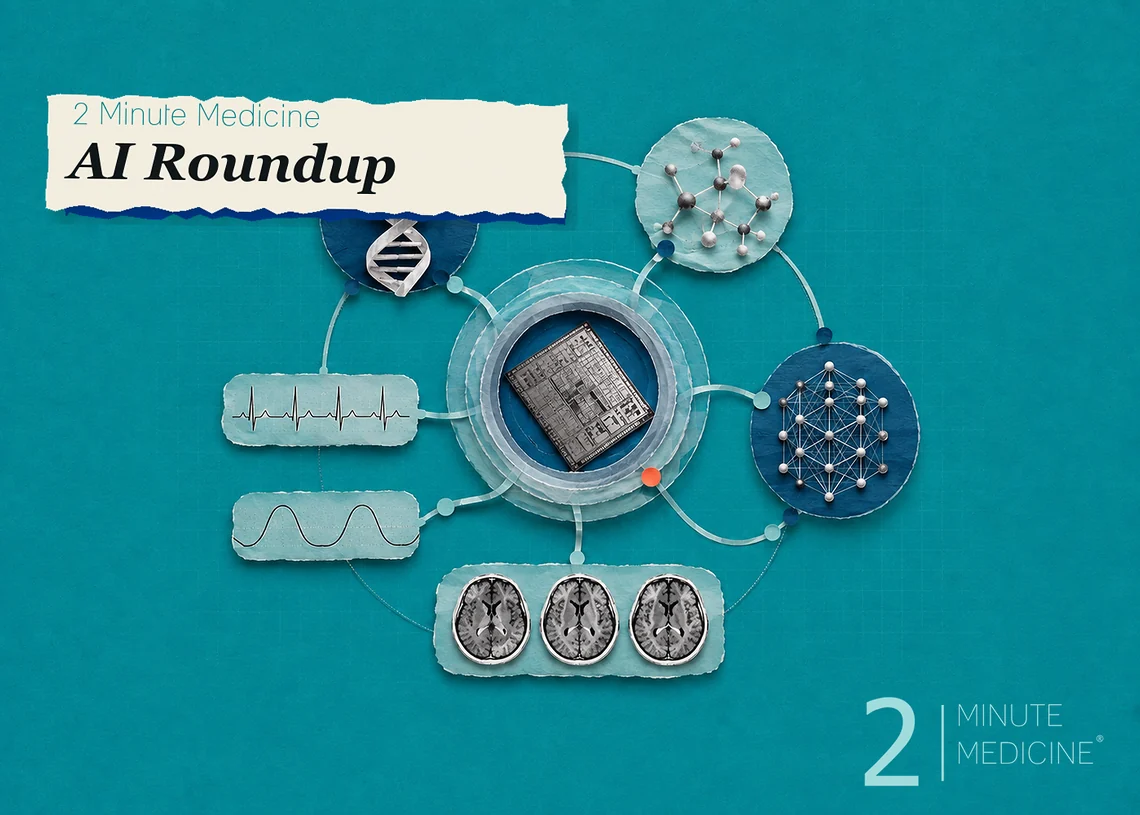
Collage of medical tech icons circling a central chip with 'AI Roundup' title and 2 Minute Medicine logo in teal background.
Share on FacebookShare on TwitterShare on LinkedIn

AI Model Shows Promise in Predicting PTSD Risk Following Trauma

1. PREVIA, a clinically informed large language model ensemble, accurately predicted PTSD risk using patient narratives collected during emergency room visits.
2. The tool could serve as a helpful and scalable screener to provide patients with targeted and timely interventions, although further studies are needed to validate its findings in larger, independent cohorts.

According to the VA, approximately six in 100 people will develop post-traumatic stress disorder (PTSD) at some point in their lives, and women are about twice as likely, compared to men, (eight in 100 women versus four in 100 men) to develop it. A diagnosis of PTSD requires a patient to have symptoms that last at least one month. In a study published in early November in Nature Communications, PREVIA, a clinically informed large language model ensemble, was used in the setting of the emergency room to predict who would then later go on to develop PTSD, given the patient’s narratives during the visit.

On one hand, approximately 43 million patients each year are admitted to an emergency department after sustaining trauma, and 27% of them go on to develop PTSD, according to past studies. However, oftentimes, emergency room physicians have severe time constraints and are unable to take full advantage of currently available screening tools. By taking responses to routine questions and analyzing unstructured patient trauma narratives, this tool, PREVIA, accurately forecasted PTSD, as well as a physician specifically trained in PTSD, on a subset of 30 patients, and was able to generate interpretable explanations. The data included in the study consisted of 145 patients across two New York City Level 1 Trauma Centers. The patients were seen within 24 hours of having trauma and were assessed for PTSD one month following this trauma. Clinically, this could be a helpful and scalable screener that can help provide patients with targeted and timely interventions, although further studies are required to validate these findings, especially in larger, independent cohorts.

Citation

Gait analysis predicts health, sleep, and medication use across 18 body systems

RELATED REPORTS

Large genetic association study identifies additional Alzheimer disease risk loci and candidate pathways

Spousal traumatic brain injury is associated with increased mortality in the uninjured partner

1. The findings of the study highlight that human movement, analyzing gait, can play a much broader role in understanding health and disease progression than what was previously appreciated and that gait itself is a multisystem biomarker.
2. In a nutshell, this study highlights the importance of gait as a multisystem biosignal that can independently be assessed in clinical assessment of patients to determine more about their health and medication use.

Gait has traditionally been looked at in order to treat a specific pathology, not as a systemic biomarker. In a study published in Nature Medicine recently, researchers analyzed the full pattern of a person’s movement and then used that information to predict health phenotypes and sleep quality across 18 body systems. The findings of the study highlight that human movement, analyzing gait, can play a much broader role in understanding health and disease progression than what was previously appreciated and that gait itself is a multisystem biomarker, clinical gait that is.

Researchers were able to pinpoint which areas of the body contain what type of health information. For example, leg movements contained most of the signal for metabolic health and frailty and torso movements for sleep and lifestyle traits.Further, the models were also able to predict other factors, such as what medications those participants were taking, such as antihistamines, antidepressants, etc. In a nutshell, this study highlights the importance of gait as a multisystem biosignal that can independently be assessed in clinical assessment of patients to determine more about their health and medication use.

Citation

AI cardiac MRI analysis marginally outperforms clinicians in predicting all-cause mortality

1. Interestingly, the study findings highlight that the AI-derived left ventricular ejection fraction marginally outperformed the clinically derived ejection fraction for the purposes of predicting all-cause mortality.
2. The AI analysis in this study was done at the rate of 3–4 seconds per patient, while previous studies have shown it took a median of 13 minutes for the same to be done by a clinician.

Left ventricular ejection fraction is an important measure of cardiac function, and it is primarily assessed via cardiac MRI (CMR). However, manual clinical segmentation in the process of assessing the left ventricular ejection fraction introduces variability, thereby reducing its precision. In a recent study, AI was used to compare AI-derived and clinician-derived left ventricular segmentation for the prediction of patient mortality.

27,382 patients were included in this study from two international centers. Interestingly, the study findings highlight that the AI-derived left ventricular ejection fraction marginally outperformed the clinically derived ejection fraction for the purposes of predicting all-cause mortality. However, by using the AI tools, a higher throughput can be achieved, and clinical workload is reduced. The AI analysis in this study was done at the rate of 3–4 seconds per patient, while previous studies have shown it took a median of 13 minutes for the same to be done by a clinician.

Overall, the study underlines the benefits of incorporating AI tools as a first-line approach given that the AI errors were uncommon (~1%) for left ventricular segmentation while employing clinicians to detect AI errors.

Citation

AI health chatbot shows no benefit for perinatal anxiety or depression

1. Approximately 1 in 8 women experience depressive symptoms during the perinatal period.
2. Overall, the study found that AI chatbot use did not demonstrate differences compared with the control group in anxiety scores, depression scores, emergency visits, postpartum care, or sleep duration.

The time period between pregnancy and the postpartum period is especially vulnerable for women and represents an opportunity to improve maternal health outcomes. While women have frequent contact with the healthcare system during pregnancy, following delivery, they have medical and physiological needs but also increased responsibilities while they manage their recovery and provide care for their children, and often experience changes to their mental health.

Approximately 1 in 8 women experience depressive symptoms during the perinatal period. These risks can be amplified in racial or ethnic minorities in the United States. A study published recently in JAMA Network Open analyzed whether generative artificial intelligence, in the form of a health chatbot, can be used to improve maternal health outcomes in racial and ethnic minorities, specifically anxiety and depression, in pregnant or postpartum individuals. Overall, the study found that after analyzing 400 randomized participants with a mean age of 32 years, AI chatbot use was not shown to demonstrate any differences when compared to the control group in anxiety scores, depression scores, emergency visits, postpartum care, or sleep duration. Still, they may be able to provide value when used as adjunctive tools to help in the improvement of maternal health outcomes.

Citation

© 2026 2 Minute Medicine, Inc. All rights reserved. No part of this article may be reproduced, distributed or transmitted in any form or by any means without the prior written permission of 2 Minute Medicine, Inc. To license this content, contact 2 Minute Medicine, Inc. This article is for informational and educational purposes only; it is not medical advice and does not replace the judgment of a qualified healthcare professional.
Image: © 2 Minute Medicine


Tags: biomarkergaithealthmaternal healthmental healthptsdsleepstudy
Previous Post

Large genetic association study identifies additional Alzheimer disease risk loci and candidate pathways

RelatedReports

A senior woman looks thoughtfully, accompanied by a DNA helix, a brain illustration, and cellular motifs, representing Alzheimer's genetic research.
Chronic Disease

Large genetic association study identifies additional Alzheimer disease risk loci and candidate pathways

November 15, 2026
Collage on head injury in adults: a calm man beside an engraved brain drawing, a bicycle helmet and a small penlight
Chronic Disease

Spousal traumatic brain injury is associated with increased mortality in the uninjured partner

November 13, 2026
Collage on urinary incontinence: an older woman smiling calmly beside an engraved bladder, a stopwatch and a teal ribbon
Chronic Disease

Use of β3 adrenergic agonists and anticholinergics for overactive bladder are associated with similar dementia risk

November 13, 2026
VATS collage: a pair of engraved lungs with a slim thoracoscope beside them, an incentive spirometer and a teal ribbon
Chronic Disease

Thoracic epidural and paravertebral blockade have similar efficacy for reduction of chronic post-thoracotomy pain

November 12, 2026
✦ EvidencePulse™ by 2 Minute Medicine 3 reports You asked top stroke trials 2026 Synthesizing medical evidence... Top 2026 stroke trial results: OCEANIC — ischemic stroke: 6.2% vs 8.4% OPTION* — mRS 0–1: 43.6% vs 34.2% ORIENTAL* — mRS 0–2: 58.6% vs 46.6% *Higher sICH in intervention arms Participants randomizedN OCEANIC 12,327 OPTION 570 ORIENTAL 564 Ask about guidelines or landmark trials... Try EvidencePulse™ Get the signal. Try it now → Physician-trained medical AI by 2 Minute Medicine

2MM+ All Access

Full details →
$4.99 /month

3-day free trial · cancel anytime

  • ✓100+ physician-written reports
  • ✓EvidencePulse™ + HypeCheck™
  • ✓Ad-free reading + newsletters
Start 3-day free trial

Then $4.99/month. Manage renewal in your account.

2 Minute Medicine® is an award winning, physician-run, expert medical media company. Our content is curated, written and edited by practicing health professionals who have clinical and scientific expertise in their field of reporting. Our editorial management team is comprised of highly-trained MD physicians. Join numerous brands, companies, and hospitals who trust our licensed content.

Recent Reports

  • 2MM: AI Roundup- PTSD Prediction, Gait as a Biomarker, Faster Cardiac MRI, and Perinatal Mental Health Chatbots [November 12th, 2026]
  • Large genetic association study identifies additional Alzheimer disease risk loci and candidate pathways
  • Pelacarsen lowers lipoprotein(a) but does not reduce major cardiovascular events in patients with established cardiovascular disease
License Content
Terms of Use | Disclaimer
Cookie Policy

Get the app

Read 2 Minute Medicine on iPhone, iPad and Android.

Download on the App StoreGet it on Google Play
QR code for www.2minutemedicine.com/app
On a computer? Scan this with your phone’s camera.
2MM+ All Access Full details →

The medical literature, distilled daily.

Monthly plan selected: $4.99 /month.

$4.99/month

3-day free trial · cancel anytime

Start 3-day free trial

Then $4.99/month. Manage renewal in your account.

Yearly plan selected: $49.90 /year.

$49.90/year

2 months free

Start 3-day free trial

Then $49.90/year.

Membership benefits

  • ✓100+ new physician-written study summaries monthly, 12,000+ searchable
  • ✓AI EvidencePulse™ + HypeCheck™
  • ✓Ad-free reading + newsletters
  • ✓FDA drug approvals + clinical calculators

Already a member? Sign in

  • Get the app
  • About
  • Specialties
    • All Specialties, All Recent Reports
    • Cardiology
    • Chronic Disease
    • Dermatology
    • Emergency
    • Endocrinology
    • Gastroenterology
    • Imaging and Intervention
    • Infectious Disease
    • Nephrology
    • Neurology
    • Obstetrics
    • Oncology
    • Ophthalmology
    • Pediatrics
    • Pharma
    • Preclinical
    • Psychiatry
    • Public Health
    • Pulmonology
    • Rheumatology
    • Surgery
    • Rewinds
    • The Scan
  • EvidencePulse™
  • HypeCheck™
  • AI News
  • Classics™
    • 2MM+ Online Access
    • Paperback and Ebook
  • Tools
    • NPI Registry Lookup
    • RVU Search
    • Physician Pay by Specialty
    • ICD-10 Code Lookup
    • FDA Drug Approvals
    • Drug Safety for Breastfeeding/Pregnancy
    • Clinical Guidelines
    • Medical Calculators
    • ECG Reference
      • QTc Calculator
      • Sgarbossa Criteria
      • ECG Axis Calculator
      • AV Block Helper
  • Rankings
    • Medical School Rankings
    • Residency Rankings
  • Partners
    • License Content
    • Advertise with Us
No Result
View All Result

© 2026 2 Minute Medicine, Inc. - Physician-written medical news.