• About
  • Masthead
  • License Content
  • Advertise
  • Submit Press Release
  • RSS/Email List
  • 2MM Podcast
  • Write for us
  • Contact Us
2 Minute Medicine
No Result
View All Result

No products in the cart.

SUBSCRIBE
  • Specialties
    • All Specialties, All Recent Reports
    • Cardiology
    • Chronic Disease
    • Dermatology
    • Emergency
    • Endocrinology
    • Gastroenterology
    • Imaging and Intervention
    • Infectious Disease
    • Nephrology
    • Neurology
    • Obstetrics
    • Oncology
    • Ophthalmology
    • Pediatrics
    • Pharma
    • Preclinical
    • Psychiatry
    • Public Health
    • Pulmonology
    • Rheumatology
    • Surgery
  • Tools
    • EvidencePulse™
    • RVU Search
    • NPI Registry Lookup
  • Pharma
  • AI News
  • The Scan+
  • Classics™+
    • 2MM+ Online Access
    • Paperback and Ebook
  • Rewinds
  • Partners
    • License Content
    • Submit Press Release
    • Advertise with Us
  • Account
    • Subscribe
    • Sign-in
    • My account
2 Minute Medicine
  • Specialties
    • All Specialties, All Recent Reports
    • Cardiology
    • Chronic Disease
    • Dermatology
    • Emergency
    • Endocrinology
    • Gastroenterology
    • Imaging and Intervention
    • Infectious Disease
    • Nephrology
    • Neurology
    • Obstetrics
    • Oncology
    • Ophthalmology
    • Pediatrics
    • Pharma
    • Preclinical
    • Psychiatry
    • Public Health
    • Pulmonology
    • Rheumatology
    • Surgery
  • Tools
    • EvidencePulse™
    • RVU Search
    • NPI Registry Lookup
  • Pharma
  • AI News
  • The Scan+
  • Classics™+
    • 2MM+ Online Access
    • Paperback and Ebook
  • Rewinds
  • Partners
    • License Content
    • Submit Press Release
    • Advertise with Us
  • Account
    • Subscribe
    • Sign-in
    • My account
SUBSCRIBE
2 Minute Medicine
Subscribe
Home All Specialties Cardiology

Image-guided assessment of coronary inflammation improves cardiac risk prediction for patients without obstructive coronary artery disease
byNeel MistryandTeddy Guo
July 16, 2024
in Cardiology, Chronic Disease, Imaging and Intervention
Reading Time: 2 mins read
0
Share on FacebookShare on Twitter

1. Individuals with elevated fat attenuation index scores without obstructive coronary artery disease had significantly increased rates of major adverse cardiac events.

2. Fat attenuation index score and AI-Risk classification showed an additive risk for cardiac mortality based on the number of involved coronary vessels.

Evidence Rating Level: 2 (Good)

Study Rundown: Coronary computed tomography angiography (CCTA) is commonly used to assess chest pain, resulting in many patients without obstructive coronary artery disease (CAD) whose prognosis remains unclear. Measuring coronary inflammation with the fat attenuation index (FAI) score from CCTA could help predict cardiovascular risk for patients without obstructive CAD. This randomized controlled trial assessed risk profiles and event rates in UK CCTA patients, testing if coronary inflammation drives major adverse cardiac events (MACE) and validating an artificial intelligence (AI)-Risk algorithm. The primary outcome of this study was rate of MACEs while a key secondary outcome was the accuracy of the AI-Risk prediction algorithm. According to study results, patients without obstructive CAD still had a significant risk for cardiac events. Although this study was well done, it was limited by data from only eight hospitals, which may affect the generalizability of findings.

Click to read the study in The Lancet

Relevant Reading: Inflammatory Markers and the Risk of Coronary Heart Disease in Men and Women

RELATED REPORTS

Three vs 12-month DAPT after implantation of biodegradable-polymer sirolimus-eluting coronary stent: a randomised clinical trial

Incidence of atrial fibrillation after coronary artery bypass graft surgery and percutaneous coronary intervention: a prospective 2-year follow-up observational study

Identification of NSTE-ACS patients with totally occluded infarct-related artery: the role of the SAVE risk score in improved risk stratification

In-depth [prospective cohort]: 48 466 patients were assessed for eligibility across 8 UK hospitals. Included were patients undergoing CCTA with or without CAD. Altogether, 43 484 patients (40 091 in cohort A – understanding the risk profile of people undergoing CCTA – and 3 393 in cohort B – validating FAI score, AI-Risk, and the AI-Risk classification) were included in the final analysis. In cohort A, patients without obstructive CAD (32 533 of 40 091, 81.1%) accounted for most of the total MACE (2857 of 4307, 66.3%) and cardiac deaths (1118 of 1754, 63.7%). Increased FAI score was associated with increased cardiac mortality (hazard ratio [HR] 29.8, p<0.001) or MACE (HR 12.6, p<0.001), as was AI-Risk classification score (HR 6.75, p<0.001 for cardiac mortality and HR 4.68, p<0.001 for MACE). Findings from this study suggest that the FAI Score and AI-Risk algorithm provide valuable prognostic information beyond traditional risk factors and CCTA interpretation, particularly for patients without obstructive CAD.

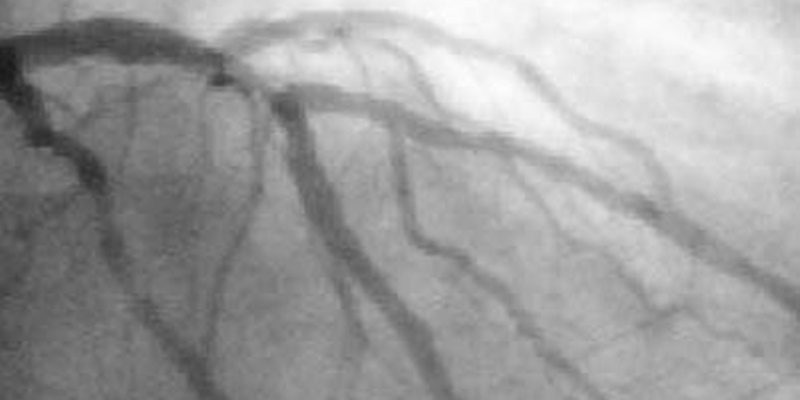
Image: PD

©2024 2 Minute Medicine, Inc. All rights reserved. No works may be reproduced without expressed written consent from 2 Minute Medicine, Inc. Inquire about licensing here. No article should be construed as medical advice and is not intended as such by the authors or by 2 Minute Medicine, Inc.


Tags: acute myocardial infarctioncardiologycoronary angiographycoronary artery disease (CAD)Coronary computed tomography angiographyheart diseasemyocardial infarction
Previous Post

Pantoprazole prophylaxis for individuals on mechanical ventilation with stress ulcers

Next Post

#VisualAbstract: Tisotumab Vedotin is Effective as Second- or Third-Line Therapy for Recurrent Cervical Cancer

RelatedReports

Using HEART score to risk stratify patients with chest pain is safe but underutilized in the ED
Cardiology

Three vs 12-month DAPT after implantation of biodegradable-polymer sirolimus-eluting coronary stent: a randomised clinical trial

December 31, 2025
Lariat device for left atrial appendage exclusion associated with adverse events
Cardiology

Incidence of atrial fibrillation after coronary artery bypass graft surgery and percutaneous coronary intervention: a prospective 2-year follow-up observational study

December 2, 2025
PCI not superior to medical therapy alone in stable coronary disease: The COURAGE study
Cardiology

Identification of NSTE-ACS patients with totally occluded infarct-related artery: the role of the SAVE risk score in improved risk stratification

November 24, 2025
Using HEART score to risk stratify patients with chest pain is safe but underutilized in the ED
Cardiology

Smaller infarct size with ticagrelor vs. clopidogrel in STEMI patients: Insights from cardiac magnetic resonance

November 6, 2025
Next Post
#VisualAbstract: Tisotumab Vedotin is Effective as Second- or Third-Line Therapy for Recurrent Cervical Cancer

#VisualAbstract: Tisotumab Vedotin is Effective as Second- or Third-Line Therapy for Recurrent Cervical Cancer

Stroke expansion following intra-arterial therapy may explain worse outcomes

Reteplase associated with improved functional outcomes in ischemic stroke patients

#VisualAbstract: Temsirolimus Combined with VAC/VI Chemotherapy Did Not Improve Clinical Outcomes of Intermediate-Risk Rhabdomyosarcoma

#VisualAbstract: Temsirolimus Combined with VAC/VI Chemotherapy Did Not Improve Clinical Outcomes of Intermediate-Risk Rhabdomyosarcoma

2 Minute Medicine® is an award winning, physician-run, expert medical media company. Our content is curated, written and edited by practicing health professionals who have clinical and scientific expertise in their field of reporting. Our editorial management team is comprised of highly-trained MD physicians. Join numerous brands, companies, and hospitals who trust our licensed content.

Recent Reports

  • Obstructive Sleep Apnea Risk and Mental Health Conditions Among Older Canadian Adults in the Canadian Longitudinal Study on Aging
  • Neighborhood Deprivation and Days Spent at Home After Fall-Related Hip Fracture
  • Three vs 12-month DAPT after implantation of biodegradable-polymer sirolimus-eluting coronary stent: a randomised clinical trial
License Content
Terms of Use | Disclaimer
Cookie Policy
Privacy Statement (EU)
Disclaimer

© 2025 2 Minute Medicine, Inc. - Physician-written medical news.

  • Specialties
    • All Specialties, All Recent Reports
    • Cardiology
    • Chronic Disease
    • Dermatology
    • Emergency
    • Endocrinology
    • Gastroenterology
    • Imaging and Intervention
    • Infectious Disease
    • Nephrology
    • Neurology
    • Obstetrics
    • Oncology
    • Ophthalmology
    • Pediatrics
    • Pharma
    • Preclinical
    • Psychiatry
    • Public Health
    • Pulmonology
    • Rheumatology
    • Surgery
  • Tools
    • EvidencePulse™
    • RVU Search
    • NPI Registry Lookup
  • Pharma
  • AI News
  • The Scan
  • Classics™
    • 2MM+ Online Access
    • Paperback and Ebook
  • Rewinds
  • Partners
    • License Content
    • Submit Press Release
    • Advertise with Us
  • Account
    • Subscribe
    • Sign-in
    • My account
No Result
View All Result

© 2025 2 Minute Medicine, Inc. - Physician-written medical news.