• About
  • Masthead
  • License Content
  • Advertise
  • Submit Press Release
  • RSS/Email List
  • 2MM Podcast
  • Write for us
  • Contact Us
2 Minute Medicine
No Result
View All Result

No products in the cart.

SUBSCRIBE
  • Specialties
    • All Specialties, All Recent Reports
    • Cardiology
    • Chronic Disease
    • Dermatology
    • Emergency
    • Endocrinology
    • Gastroenterology
    • Imaging and Intervention
    • Infectious Disease
    • Nephrology
    • Neurology
    • Obstetrics
    • Oncology
    • Ophthalmology
    • Pediatrics
    • Pharma
    • Preclinical
    • Psychiatry
    • Public Health
    • Pulmonology
    • Rheumatology
    • Surgery
  • Tools
    • EvidencePulse™
    • RVU Search
    • NPI Registry Lookup
  • Pharma
  • AI News
  • The Scan+
  • Classics™+
    • 2MM+ Online Access
    • Paperback and Ebook
  • Rewinds
  • Partners
    • License Content
    • Submit Press Release
    • Advertise with Us
  • Account
    • Subscribe
    • Sign-in
    • My account
2 Minute Medicine
  • Specialties
    • All Specialties, All Recent Reports
    • Cardiology
    • Chronic Disease
    • Dermatology
    • Emergency
    • Endocrinology
    • Gastroenterology
    • Imaging and Intervention
    • Infectious Disease
    • Nephrology
    • Neurology
    • Obstetrics
    • Oncology
    • Ophthalmology
    • Pediatrics
    • Pharma
    • Preclinical
    • Psychiatry
    • Public Health
    • Pulmonology
    • Rheumatology
    • Surgery
  • Tools
    • EvidencePulse™
    • RVU Search
    • NPI Registry Lookup
  • Pharma
  • AI News
  • The Scan+
  • Classics™+
    • 2MM+ Online Access
    • Paperback and Ebook
  • Rewinds
  • Partners
    • License Content
    • Submit Press Release
    • Advertise with Us
  • Account
    • Subscribe
    • Sign-in
    • My account
SUBSCRIBE
2 Minute Medicine
Subscribe
Home StudyGraphics

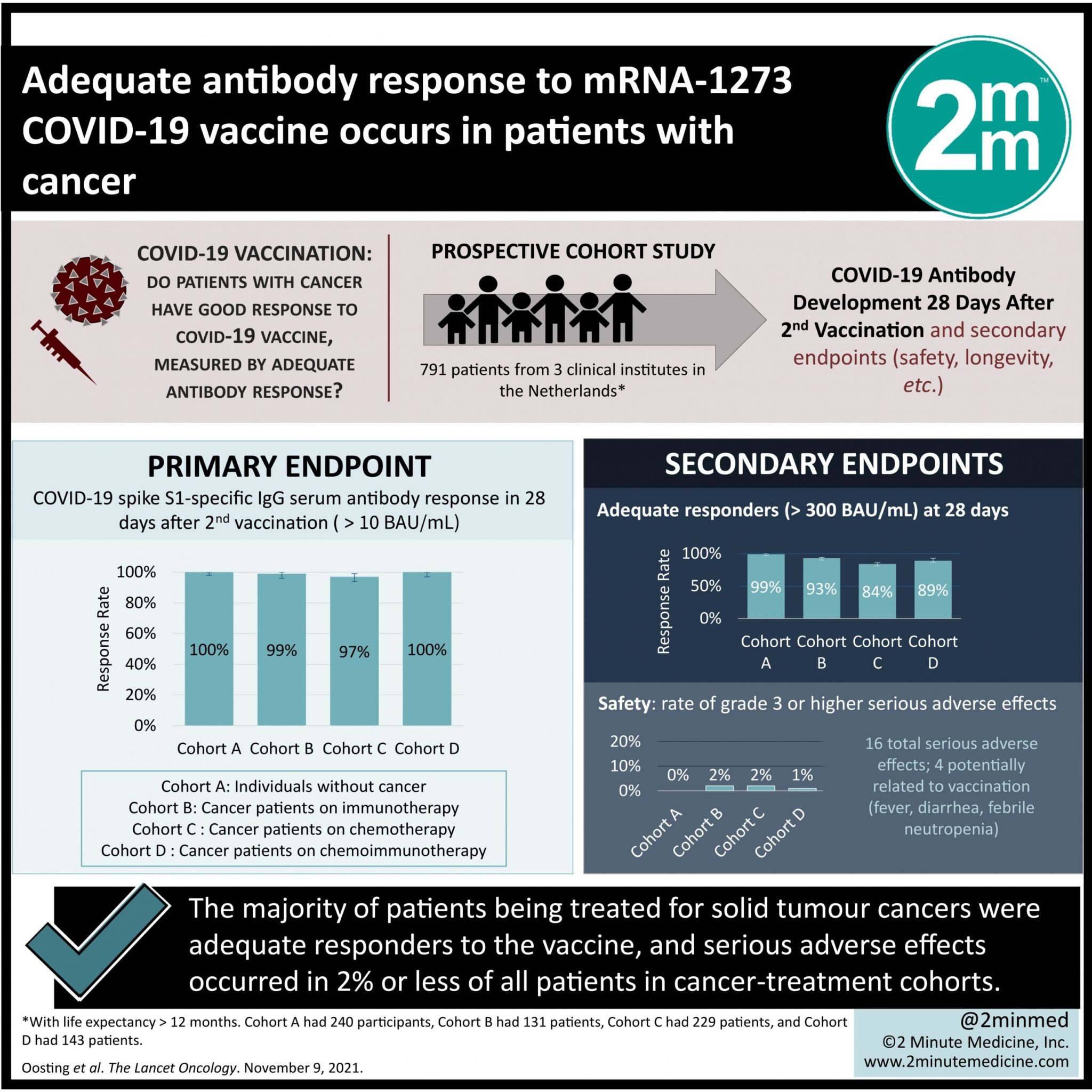
#VisualAbstract: Adequate antibody response to mRNA-1273 COVID-19 vaccine occurs in patients with cancer
byMinjee Kim
November 26, 2021
in StudyGraphics
Reading Time: 3 mins read
0
Share on FacebookShare on Twitter

1. The majority of patients being treated for solid tumour cancers were adequate responders to the vaccine.

2. Serious adverse events occurred in 2% or less of all patients in the cancer-treatment cohorts.

Evidence Rating Level: 1 (Excellent)

Study Rundown: Patients with cancer have an increased likelihood of developing severe COVID-19 infections. This study discusses the outcome of the mRNA-1273 COVID-19 vaccine on immunogenicity and safety in patients with cancer (solid tumour) receiving treatment as compared to those without cancer. Treatment modalities included either or both chemo- or immuno-therapy and study cohorts were classified as follows: individuals without cancer (A), cancer patients on immunotherapy (B), chemotherapy (C), or chemoimmunotherapy (D). A 100% response rate to the vaccine was observed on day 28 after the second dose in cohort A, a 99% response rate in cohort B, 97% in cohort C, and 100% in cohort D, supporting a conclusion of non-inferiority in each of the patient cohorts as compared to the control (A) based on statistical calculations. Using post-hoc analysis to categorize participants in each group into adequate, suboptimal, or non-responders found that 99% of cohort A, 93% of cohort B, 84% of cohort C, and 89% of cohort D were adequate responders at 28 days after the second dose. Patients receiving chemotherapy had the highest level of suboptimal or non-responders at 16%. The most prevalent local adverse event was pain where the vaccine was injected. The most prevalent systemic adverse effect noted was fatigue. Serious adverse events were uncommon and occurred in less than 2% of all cancer patient cohorts, and not at all in the control cohort (A). No vaccine-related deaths were reported. One particular limitation to this study is that its low-powered design prevents it from being able to inform on the impact of specific cancer treatments and their timing. Overall, patients with cancer who are receiving either immunotherapy, chemotherapy, or both, are mostly protected with two doses of the mRNA-1273 COVID-19 vaccination without great risk for severe adverse events.

Click to read the study in The Lancet Oncology

RELATED REPORTS

Guideline-based lymph node sampling is not associated with increased postoperative complications in lung cancer

Why Pfizer Is Looking East for Its Next Generation of Cancer Drugs

2MM: Pharma Roundup – Pfizer’s $10.5B Innovent oncology partnership, Guselkumab (Tremfya) gains a broader psoriatic arthritis label, Venetoclax (Venclyxto) expands first-line CLL options, and Seladelpar (Livdelzi) advances in primary biliary cholangitis

Relevant Reading: The ESMO Call to Action on COVID-19 vaccinations and patients with cancer: Vaccinate. Monitor. Educate.

In-Depth [prospective cohort]: This prospective, non-inferiority trial was based out of 3 clinical institutes in the Netherlands. 791 patients were included and divided into study cohorts A through D. Cohort A had 240 participants without cancer, cohort B had 131 cancer patients on immunotherapy, cohort C had 229 cancer patients on chemotherapy, and cohort D had 143 cancer patients on chemoimmunotherapy. Eligibility criteria for this study were adults with a life expectancy greater than 12 months. The primary endpoint of antibodies to SARS-CoV-2 at 28 days post-second vaccine was determined in 743 participants (per-protocol analysis; 240 from cohort A, 131 from cohort B, 229 from cohort C, and 143 from cohort D). Antibody concentration 28 days post-second dose of greater than 10 BAU/mL was measured in 100% of cohort A (95% confidence interval (CI), 98 to 100%), 99% of cohort B (95% CI, 96 to >99%), 97% of cohort C (95%, 94 to 99%), and 100% of cohort D (95% CI, 97 to 100%). Non-inferiority for all patient cohorts was reached based on a non-inferiority margin of 10% and an alpha value of 0.05. A post-hoc analysis differentiated cohort participants into adequate responders (>300 BAU/mL) and suboptimal responders (>10 BAU/mL to ≤300 BAU/mL). Adequate responders were found in greater than 99% of cohort A (95% CI, 98 to >99%), 93% of cohort B (95% CI, 87 to 97%), 84% of cohort C (95% CI, 78 to 88%), and 89% of cohort D (95% CI, 82 to 93%). Those who did not meet adequate response cutoff were categorized as suboptimal or non-responders. One of the secondary endpoints was safety, as indicated by adverse events. Adverse events were more frequent and of greater severity after the second vaccination as compared to the first. The most common systemic adverse event after the second dose was fatigue, reported in 54% of cohort A, 59% of cohort B, 49% of cohort C, and 48% of cohort D. Injection site pain was the most common local adverse event and was more frequent after the first than second vaccination in all cohorts. Post-second dose pain occurred in less than 10% of participants in all cohorts. Severe adverse events were reported in 0% of cohort A, 2% of cohort B, 2% of cohort C, and 1% of cohort D. The least common adverse events were injection site erythema and induration, occurring in less than 5% of participants in all cohorts. No new safety signals were reported compared to prior studies and no vaccine-related deaths occurred in any cohort.

Image: PD

©2021 2 Minute Medicine, Inc. All rights reserved. No works may be reproduced without expressed written consent from 2 Minute Medicine, Inc. Inquire about licensing here. No article should be construed as medical advice and is not intended as such by the authors or by 2 Minute Medicine, Inc.
Tags: cancerCoronaviruscovidcovid vaccinecovid vaccine cancerCOVID-19oncologySARS-CoV-2vaccinationvaccine
Previous Post

Oral P2Y12 inhibitor pretreatment offers no benefit in non-ST elevation acute coronary syndromes

Next Post

Wellness Check: Addictions

RelatedReports

Lessons from real-world implementation of lung cancer screening
Chronic Disease

Guideline-based lymph node sampling is not associated with increased postoperative complications in lung cancer

June 9, 2026
Quick Take: Effect of Pregabalin on Radiotherapy-Related Neuropathic Pain in Patients With Head and Neck Cancer: A Randomized Controlled Trial
Oncology

Why Pfizer Is Looking East for Its Next Generation of Cancer Drugs

June 4, 2026
2 Minute Medicine: Pharma Roundup: Price Hikes, Breakthrough Approvals, Legal Showdowns, Biotech Expansion, and Europe’s Pricing Debate [May 12nd, 2025]
Pharma

2MM: Pharma Roundup – Pfizer’s $10.5B Innovent oncology partnership, Guselkumab (Tremfya) gains a broader psoriatic arthritis label, Venetoclax (Venclyxto) expands first-line CLL options, and Seladelpar (Livdelzi) advances in primary biliary cholangitis

June 3, 2026
Novel coronavirus identified from patients with pneumonia in Wuhan, China
Infectious Disease

Ensitrelvir associated with reduced risk of Covid-19 among household contacts

May 26, 2026
Next Post
Quick Take: The clinical effectiveness of sertraline in primary care and the role of depression severity and duration (PANDA): a pragmatic, double-blind, placebo-controlled randomized trial

Wellness Check: Addictions

Novel coronavirus identified from patients with pneumonia in Wuhan, China

Dual therapy with infliximab and IVIG in children with multi-system inflammatory syndrome

#VisualAbstract Intensive chemotherapy is associated with better long-term survival in older patients with acute myeloid leukemia

#VisualAbstract Intensive chemotherapy is associated with better long-term survival in older patients with acute myeloid leukemia

2 Minute Medicine® is an award winning, physician-run, expert medical media company. Our content is curated, written and edited by practicing health professionals who have clinical and scientific expertise in their field of reporting. Our editorial management team is comprised of highly-trained MD physicians. Join numerous brands, companies, and hospitals who trust our licensed content.

Recent Reports

  • 2MM: AI Roundup: Food and Drug Administration reviews liver injury prediction tool, Joint Commission launches healthcare artificial intelligence certification, governance playbooks aim to standardize adoption, and pediatric hospitals bring generative tools to the frontline
  • Food coloring additives are associated with higher incidence of type 2 diabetes
  • Children conceived through infertility treatments may have similar growth compared to naturally conceived children
License Content
Terms of Use | Disclaimer
Cookie Policy
Privacy Statement (EU)
Disclaimer
  • Specialties
    • All Specialties, All Recent Reports
    • Cardiology
    • Chronic Disease
    • Dermatology
    • Emergency
    • Endocrinology
    • Gastroenterology
    • Imaging and Intervention
    • Infectious Disease
    • Nephrology
    • Neurology
    • Obstetrics
    • Oncology
    • Ophthalmology
    • Pediatrics
    • Pharma
    • Preclinical
    • Psychiatry
    • Public Health
    • Pulmonology
    • Rheumatology
    • Surgery
  • Tools
    • EvidencePulse™
    • RVU Search
    • NPI Registry Lookup
  • Pharma
  • AI News
  • The Scan
  • Classics™
    • 2MM+ Online Access
    • Paperback and Ebook
  • Rewinds
  • Partners
    • License Content
    • Submit Press Release
    • Advertise with Us
  • Account
    • Subscribe
    • Sign-in
    • My account
No Result
View All Result

© 2026 2 Minute Medicine, Inc. - Physician-written medical news.